Band 4.5 IELTS Writing Task 1 Model Answer
Overall Band Score: 4.5 · Cambridge IELTS 15 · 2026-11-26
IELTS Writing Task 1 question
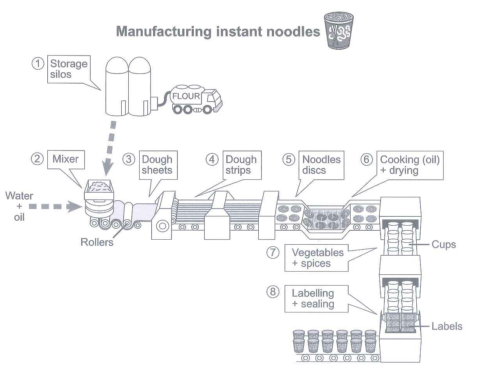
The diagram below shows how instant noodles are manufactured.
Summarize the information by selecting and reporting the main features and make comparisons where relevant.
Student answer (Band 4.5)
this diagram illustrates the manufacturation of the instant noodles
overall the process consists of 6 major stages , the production begins with the floor in the storage silos , diving into a mixer , putting the mixture in dough sheets
in the forth stage it,s noticiable that the mixture is putten in dough strips turnin into noodls discs and finishing with cooking the mixture with oil and dying it
AI examiner evaluation
| Criterion | Band |
|---|---|
| Task Achievement / Task Response | 4.0 |
| Coherence and Cohesion | 5.0 |
| Lexical Resource | 5.0 |
| Grammatical Range and Accuracy | 4.5 |
| Overall | 4.5 |
Task Achievement / Task Response: Band 4.0
You identify the topic and mention several early and middle stages, including flour in silos, mixing, dough sheets and strips, noodle discs, and cooking with oil. However, the response reports only a small part of the process and gives an inaccurate overview: it says there are “6 major stages,” while the diagram shows a sequence continuing through adding vegetables and spices, placing the noodles in cups, and labelling and sealing them. The final stages and the finished product are omitted, and some details are unclear. The response is also 81 words below the required minimum, leaving too little space to summarise the main features. To improve, describe the full sequence and give a concise overview of how the raw flour becomes packaged instant noodles.
Coherence and Cohesion: Band 5.0
There is a basic sense of sequence: the response moves from storage silos to a mixer, then to dough sheets, strips, discs, and cooking. This shows an attempt to organise the process in order. However, the information is compressed into two lines, with no clear paragraphing or distinct overview and process description. The long second sentence joins several stages together, making the progression difficult to follow, and the linking phrase “in the forth stage” does not clearly connect to the stated six-stage overview. Use separate sentences for groups of stages and clear sequence markers such as “Next,” “After this,” and “Finally.” A short overview followed by a logically ordered description would make the organisation clearer.
Lexical Resource: Band 5.0
The response uses some relevant process vocabulary, including “storage silos,” “mixer,” “dough sheets,” “dough strips,” and “noodles discs,” so the reader can recognise the general subject. However, the range is limited and several spelling or word-form errors make the description less clear, including “manufacturation,” “floor,” “noticiable,” “putten,” “noodls,” and “dying.” Some wording is also imprecise: “putting the mixture in dough sheets” does not clearly describe the dough being rolled into sheets. Use accurate process verbs and check spelling; for example, “manufacture,” “flour,” “noticeable,” “turned into,” and “drying.” More precise terms such as “are shaped,” “are cooked,” and “are packaged” would help describe the stages.
Grammatical Range and Accuracy: Band 4.5
You attempt to describe a sequence and use a present-tense process style, but grammatical control is weak and the response relies on a very limited range of structures. The opening, “this diagram illustrates the manufacturation of the instant noodles,” lacks capitalisation and has an awkward article pattern. The overview sentence is a fragment-like series of phrases—“the production begins with the floor in the storage silos, diving into a mixer”—rather than a clearly controlled sentence. In “in the forth stage it,s noticiable,” punctuation and sentence boundaries are also faulty. Practise writing complete sentences with a clear subject and verb, and use passive forms suited to process descriptions, such as “The flour is transferred to a mixer” and “The noodles are then cooked and dried.”
See this exact question answered at other band scores. The same prompt compared across bands.
Browse more IELTS Writing model answers or get your own writing scored by the same AI examiner.