Band 5.5 IELTS Writing Task 1 Model Answer
Overall Band Score: 5.5 · Cambridge IELTS 15 · 2026-11-27
IELTS Writing Task 1 question
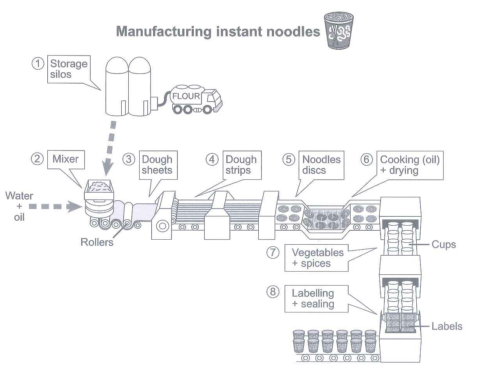
The diagram below shows how instant noodles are manufactured.
Summarize the information by selecting and reporting the main features and make comparisons where relevant.
Student answer (Band 5.5)
The given diagram illustrates how the instant noodles are produced.
Overall, there are eight steps that involve manufacturing noodles such as, storing, processing, grinding, rolling and packaging. It starts with storing the flour in stored silos and ends with labelling and sealing the cups.
Initially, the lorry that carried the flour is stored in the large storage soil container and then the flour is transfered to the mixer adding water and oil which the forms into a fine soft dough. After that the dough pass through the grinding into a dough sheets and strips and into noodles discs.
In 5 steps, the noodles disces is cooked with oil and then they are dried. Once the noodles are completely dried then they are placed into the indiviual cups with the added vegetables and spices into each cups which added flavour to the products. In the final steps the cups are sent for the sealed and labelling the each one. Once the process is complete the cups are ready to distribute and sell in the market.
AI examiner evaluation
| Criterion | Band |
|---|---|
| Task Achievement / Task Response | 6.0 |
| Coherence and Cohesion | 6.0 |
| Lexical Resource | 5.5 |
| Grammatical Range and Accuracy | 5.0 |
| Overall | 5.5 |
Task Achievement / Task Response: Band 6.0
You give a relevant account of the process, with a clear start and finish: flour enters storage silos, and the cups are labelled and sealed at the end. You also identify the main stages of mixing, shaping, cooking, drying and adding flavourings. However, some details are unclear or inaccurate. The lorry does not store the flour; it delivers it to the silos, and the diagram shows rollers shaping the dough rather than a grinding stage. The overview says there are eight steps but then lists broad activities rather than summarising the process’s main phases. The final claim that the cups are ready to be sold is plausible but not shown. More precise reporting of the diagram’s sequence and equipment would make the coverage more complete.
Coherence and Cohesion: Band 6.0
The response follows the manufacturing sequence and uses paragraphs to separate the overview from the stages, so the reader can generally follow the process. Sequencing expressions such as “Initially,” “After that,” and “In the final steps” help connect events. However, some links are mechanical or confusing: “In 5 steps” does not clearly explain where this stage falls, and “Once the noodles are completely dried then” repeats the time relationship. The second paragraph also compresses several distinct stages—rollers, sheets, strips and discs—into one sentence, making the progression harder to track. Use one clear stage per sentence and refer consistently to the noodles, dough and cups to improve cohesion.
Lexical Resource: Band 5.5
You use a reasonable range of process vocabulary, including “mixer,” “dough,” “noodles discs,” “vegetables and spices,” and “labelling and sealing.” These terms make the topic clear, but several word choices and collocations are inaccurate or awkward, sometimes obscuring the intended meaning. For example, “stored silos” should be “storage silos,” “storage soil container” is not an appropriate description, and “the cups are sent for the sealed” is unnatural. There are also spelling errors such as “transfered,” “disces,” and “indiviual.” Aim for precise process verbs and standard technical labels from the diagram, and check spelling and word forms carefully.
Grammatical Range and Accuracy: Band 5.0
You attempt both simple and more complex sentences, including time clauses such as “Once the noodles are completely dried” and a sequence of actions linked with “and.” However, control is uneven, and errors in verb forms, agreement, articles and sentence construction sometimes make the process difficult to understand. Examples include “the dough pass,” “which the forms,” “each cups,” and “the cups are sent for the sealed.” The opening description of the lorry and flour also has an unclear passive construction. Practise forming accurate passive sentences for process descriptions—for example, “The flour is transferred to the mixer”—and check subject–verb agreement and singular/plural forms before submitting.
See this exact question answered at other band scores. The same prompt compared across bands.
Browse more IELTS Writing model answers or get your own writing scored by the same AI examiner.