Band 6.0 IELTS Writing Task 1 Model Answer
Overall Band Score: 6.0 · Cambridge IELTS 15 · 2026-11-27
IELTS Writing Task 1 question
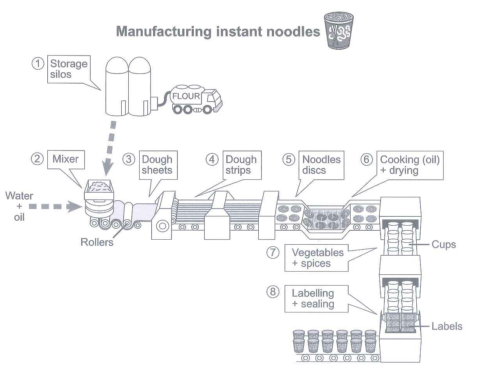
The diagram below shows how instant noodles are manufactured.
Summarize the information by selecting and reporting the main features and make comparisons where relevant.
Student answer (Band 6.0)
The given flow diagram explains the formation of instant noodles in eight different steps.
Overall, the formation of noodles is consist of eight steps, starts from flour at storage silos shifted to mixers machine and after several other manufacturing process it ends labelling and sealing.
first of all, the flour is stored at silos which transfered to a mixer machine where water and oil get mixed. After this process dough sheets are formed with the help of rollers and in the next step the dough sheets are converted to strips and then strips into discs.
furthermore, noodles discs are mixed with cooking oil and goes under process of drying. It is then kept in cups where extra vegetables and spices are added for flavor. Now noodles are ready for final step.
At the final step, the cups full of noodles are moved for labelling and sealing and that's how noodles are made from a flour.
AI examiner evaluation
| Criterion | Band |
|---|---|
| Task Achievement / Task Response | 6.0 |
| Coherence and Cohesion | 6.0 |
| Lexical Resource | 6.0 |
| Grammatical Range and Accuracy | 5.5 |
| Overall | 6.0 |
Task Achievement / Task Response: Band 6.0
You cover the main stages in the correct general order, from flour storage and mixing through shaping, cooking, adding flavourings, and final packaging. The overview also identifies the process as a sequence ending in labelling and sealing. However, some details are less fully or precisely reported: the diagram shows the noodles being cooked in oil and dried, rather than being “mixed with cooking oil,” and the cups are filled with noodles as vegetables and spices are added. The opening claim of “eight different steps” is not clearly supported by the way the stages are described, since several transformations are grouped together. A more precise overview and clearer reporting of the cup-filling and cooking stages would make the account more complete.
Coherence and Cohesion: Band 6.0
The response has a coherent overall arrangement: an introduction and overview are followed by the early production stages, later processing, and packaging. Sequencing expressions such as “first of all,” “after this process,” “furthermore,” and “at the final step” help the reader follow the process. However, the linking is somewhat mechanical, and the paragraphing and sentence boundaries are not consistently controlled: “first of all” and “furthermore” begin sentences without capital letters, while “Now noodles are ready for final step” is a rather abrupt transition. Some references, such as “It is then kept in cups,” could be clearer about what “it” refers to. More varied transitions and clearer links between stages would improve progression.
Lexical Resource: Band 6.0
You use an adequate range of process vocabulary, including “storage silos,” “dough sheets,” “strips,” “discs,” “drying,” and “labelling and sealing.” These terms make the manufacturing sequence understandable, and “formed” and “converted” show some effort to avoid repetition. Some word choices and collocations are imprecise, however: “formation” is repeated where “production” or “manufacture” would sound more natural, and “mixed with cooking oil” does not accurately express the cooking stage. “Extra vegetables” is less suitable than simply “vegetables,” while “full of noodles” is informal for a process description. Aim for precise verbs such as “pass through,” “are cooked,” and “are packaged,” and check spelling and word forms such as “transferred.”
Grammatical Range and Accuracy: Band 5.5
You use a mixture of simple sentences and some longer structures, including the sequence “where water and oil get mixed” and the sentence describing dough sheets becoming strips and discs. The main meaning is generally clear, but some grammatical errors remain. For example, “the formation of noodles is consist of eight steps” has an incorrect verb construction; use “consists of.” In “the flour … which transfered,” the verb form and agreement are incorrect, and “noodles discs … goes” has a subject–verb agreement error. Articles are also missing in “for final step,” and the overview sentence has an unclear tense and structure. Review subject–verb agreement, passive forms, articles, and sentence punctuation to make your varied structures more accurate.
See this exact question answered at other band scores. The same prompt compared across bands.
Browse more IELTS Writing model answers or get your own writing scored by the same AI examiner.