Band 6.0 IELTS Writing Task 1 Model Answer
Overall Band Score: 6.0 · Cambridge IELTS 15 · 2026-11-27
IELTS Writing Task 1 question
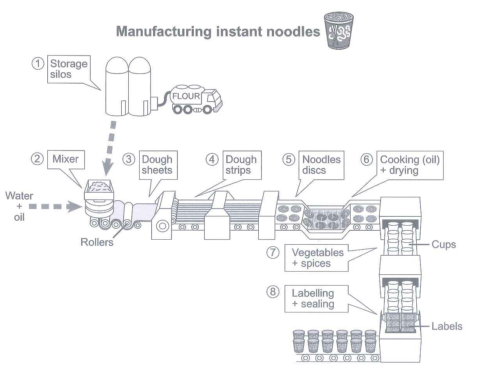
The diagram below shows how instant noodles are manufactured.
Summarize the information by selecting and reporting the main features and make comparisons where relevant.
Student answer (Band 6.0)
The diagram shows how instant noodles are manufactured going through different stages including, storage silos, mixer, dough sheets, dough strips, making noodles discs, cooking and drying, adding vegetables and spices and labelling and sealing.
Starting from stage 1 where storage silos are located for flour. The flour is then passed on to the rollers section before that water and oil are mixed into the flour then smooth dough sheets are made.
Moving on, the dough is then cut into thin strips at level 4 where as, at the stage 5 noodles discs are made and then after the cooking oil is added they are dried out at stage 6 of the maufacturing process.
Coming to the last 2 stages of the manufacturing process of noodles, they are packaged into cups with vegetables and spice added to them. At the final stage labelling and sealing is done to the noodles cups. After this the noodles are ready to be taken into multiple stores and are sold.
AI examiner evaluation
| Criterion | Band |
|---|---|
| Task Achievement / Task Response | 5.5 |
| Coherence and Cohesion | 6.5 |
| Lexical Resource | 6.0 |
| Grammatical Range and Accuracy | 5.5 |
| Overall | 6.0 |
Task Achievement / Task Response: Band 5.5
You identify the process as a sequence and include several key stages, from flour storage through mixing, shaping, cooking and drying, to adding vegetables and spices and sealing the cups. However, some details are inaccurate or unclear: the diagram shows water and oil entering the mixer, before the dough passes through rollers, rather than being added after it reaches the rollers. It also shows the noodles entering cups as vegetables and spices are added, followed by labelling and sealing; the claim that the finished product is then sent to stores is not shown. A clearer overview of the process’s start and finish, together with a more precise account of the stages, would make the report more complete and better supported by the visual.
Coherence and Cohesion: Band 6.5
The response has a coherent overall arrangement: it moves from the initial stages to the middle of production and then to packaging, with paragraph breaks helping to separate these sections. Sequencing phrases such as “Starting from stage 1,” “Moving on,” and “Coming to the last 2 stages” make the progression easy to follow. This meets the lower-band expectation for clear overall organisation and shows some flexibility in linking ideas. However, the transitions are somewhat formulaic, and the first paragraph lists stages without giving a distinct overview of the process. Some references, such as “they” in the final paragraph, could be clearer. Use more varied links and ensure each sentence connects explicitly to the preceding stage.
Lexical Resource: Band 6.0
You use an adequate range of process vocabulary, including “storage silos,” “dough sheets,” “thin strips,” “noodles discs,” and “labelling and sealing.” These terms help communicate the main stages, and the reader can generally understand the account. There are also some imprecise or awkward choices: “the cooking oil is added” suggests oil is added at that point, whereas the diagram labels the stage as cooking in oil; “packaged into cups” is less precise than describing the noodles and ingredients being placed in cups. “Maufacturing” is misspelled, and “multiple stores” adds an unsupported detail. Aim for more accurate process collocations and check spelling so that the vocabulary is consistently precise.
Grammatical Range and Accuracy: Band 5.5
You attempt a mixture of sentence forms, including the longer sequence beginning “At the final stage,” and most of the process remains understandable. However, some sentence structures are incomplete or awkward. “Starting from stage 1 where storage silos are located for flour” is a fragment rather than a complete sentence, while “before that water and oil are mixed into the flour then smooth dough sheets are made” joins several steps without clear grammatical links. The phrase “at the stage 5 noodles discs are made” also needs clearer sentence structure and punctuation. Passive forms are appropriate for describing a process, but they are not controlled consistently. Practise writing complete sentences with clear subjects and use linking clauses to show the order of actions.
See this exact question answered at other band scores. The same prompt compared across bands.
Browse more IELTS Writing model answers or get your own writing scored by the same AI examiner.