Band 5.0 IELTS Writing Task 1 Model Answer
Overall Band Score: 5.0 · Cambridge IELTS 15 · 2026-11-27
IELTS Writing Task 1 question
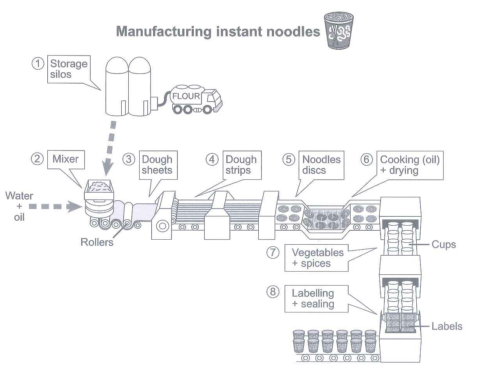
The diagram below shows how instant noodles are manufactured.
Summarize the information by selecting and reporting the main features and make comparisons where relevant.
Student answer (Band 5.0)
This picrure illustrate that how to manufactures instant noodles.
First of all I can notice a flour truck that unloading flour into srorage silos. After that those flours goes into mixer, after that water and oil are being mix together.
After mixing those thing toghether those ingridient come into dough sheets and then it goes into convier belt. After that those are convert into strips, after that those are go to noodles discs. Finally they spray some cooking oil as well as it leave there for drying.
After all of those process the noodles making process are end. Now those are finally going for packaging. I can see there are some cups and those noodles are putting into cup and then adding some vegetables and spices.
After all of those process those cup of noodles are finally go for lebelling and sealing. And after that those noodles are ready for sell.
AI examiner evaluation
| Criterion | Band |
|---|---|
| Task Achievement / Task Response | 5.0 |
| Coherence and Cohesion | 5.5 |
| Lexical Resource | 5.0 |
| Grammatical Range and Accuracy | 5.0 |
| Overall | 5.0 |
Task Achievement / Task Response: Band 5.0
You identify the main stages, from flour storage and mixing through shaping, cooking, and packaging, so the response is relevant to the process. However, the account is only partly complete: it does not clearly describe the rollers forming dough sheets, the strips being shaped into noodle discs, or the finished cups emerging on a conveyor. The overview is also unclear; “the noodles making process are end” suggests production ends before you describe packaging. Some details are imprecise, such as saying oil is sprayed on the noodles rather than explaining that they are cooked in oil and dried. To strengthen the report, give a concise overview of the full sequence and describe each key transformation accurately.
Coherence and Cohesion: Band 5.5
The response follows the general order of production and separates the early manufacturing stages from packaging, which gives it some organisation. However, progression is weakened by repeated linking phrases such as “After that” and “After all of those process,” and the sequence becomes confusing when you say the noodle-making process has ended before introducing packaging. References such as “those,” “it,” and “those ingredient” are not always clear, making it harder to track which material or product is being described. Use clearer stage-based paragraphs and vary the links—for example, “Once the dough is mixed” and “The cooked discs are then placed in cups”—while ensuring each reference has an obvious noun.
Lexical Resource: Band 5.0
You use some relevant process vocabulary, including “mixer,” “dough sheets,” “strips,” “noodles discs,” “vegetables and spices,” and “labelling and sealing.” This gives the reader a basic understanding of the diagram. However, the range is limited and several spelling or word-choice errors reduce precision, including “srorage,” “ingridient,” “convier belt,” and “lebelling.” Some phrases are also unnatural, such as “those flours” and “ready for sell.” Aim for accurate process terms and natural collocations, and avoid repeating general words such as “those” and “process.”
Grammatical Range and Accuracy: Band 5.0
You attempt to connect stages in longer sentences, but the range of sentence structures is limited and errors occur frequently. For example, “This picture illustrate that how to manufactures” has problems with subject–verb agreement and the verb pattern after “how”; “those flours goes” also has agreement and number errors. Passive forms are often inaccurate, as in “are being mix together” and “those noodles are putting into cup.” Articles and plurals are also inconsistent in “adding some vegetables” and “those cup of noodles.” These errors sometimes make the process difficult to follow. Practise accurate present-simple and passive constructions, such as “The flour is mixed with water and oil,” before combining stages into longer sentences.
See this exact question answered at other band scores. The same prompt compared across bands.
Browse more IELTS Writing model answers or get your own writing scored by the same AI examiner.