Band 6.5 IELTS Writing Task 1 Model Answer
Overall Band Score: 6.5 · Cambridge IELTS 15 · 2026-11-27
IELTS Writing Task 1 question
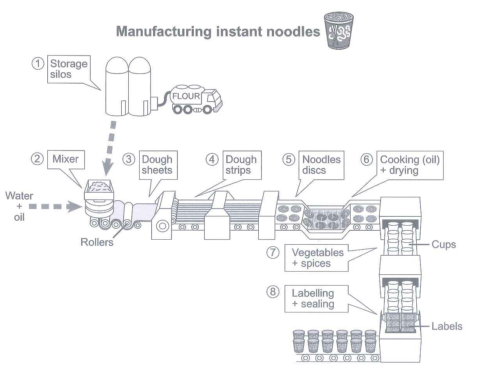
The diagram below shows how instant noodles are manufactured.
Summarize the information by selecting and reporting the main features and make comparisons where relevant.
Student answer (Band 6.5)
The process diagram illustrates how instant noodles are produced.
Overall, the process consists of 8 main stages, beginning with flour storage silos and ended with labelling and sealing the instant noodle cups.
Initially, Flour is delivered by a large truck to the storage silos. Following this, mixer take place where flour mixed with water and oil for a fixed period of time. The material is then comes out in form rollers, which is also called dough sheets. Dough sheets are cut into strips using special cutting machine before being transferred to another machine that forms noodles discs, which is round in shape.
In the subsequent stages, noodles discs are cooked with oil and goes through a drying process. After that, noodles are put into cups where certain amount of vegetables and spices are also mixed to improve taste. Finally, labelling of product information put on the cups and seal them carefully and this is how a instant noodles is produced for consumption.
AI examiner evaluation
| Criterion | Band |
|---|---|
| Task Achievement / Task Response | 6.5 |
| Coherence and Cohesion | 7.0 |
| Lexical Resource | 6.5 |
| Grammatical Range and Accuracy | 5.5 |
| Overall | 6.5 |
Task Achievement / Task Response: Band 6.5
You cover the main sequence from flour delivery through mixing, shaping, cooking and packaging, and the opening overview identifies the process as a series of stages. Most details match the diagram, including the addition of water and oil and the final labelling and sealing. However, the overview says there are eight stages without clearly summarising the two broad phases, and the account omits the rollers that form the dough sheets and the finished cups emerging on a conveyor. Some details are also imprecise: the diagram shows vegetables and spices being added to cups, rather than mixed into the noodles, and it does not specify a fixed mixing period or that the discs are round. More precise coverage and a clearer overview would strengthen the response.
Coherence and Cohesion: Band 7.0
The response is organised in a clear sequence, with an introduction, an overview and two paragraphs that move from preparation to packaging. Linking expressions such as “Initially,” “Following this,” “In the subsequent stages” and “Finally” help the reader follow the process, and the stages are generally presented in the correct order. To make the progression more polished, connect each transformation more explicitly—for example, explain that the dough passes through rollers to form sheets before it is cut into strips. Some transitions are slightly mechanical, and the final sentence combines labelling, sealing and the conclusion in a way that makes the endpoint less clear. More precise referencing and a separate, concise closing description would improve cohesion.
Lexical Resource: Band 6.5
You use a suitable range of process vocabulary, including “storage silos,” “transferred,” “drying process” and “labelling and sealing,” which makes the manufacturing stages understandable. There is also some useful variation in how you describe movement and transformation. However, several choices are imprecise or awkward for this diagram: “mixer take place” does not clearly name the action, “comes out in form rollers” confuses the product with the equipment, and “certain amount” is vague. “Improve taste” and “produced for consumption” add interpretation rather than describing visible stages. Aim for accurate process collocations such as “the flour is mixed,” “the dough passes through rollers,” and “the cups are sealed.”
Grammatical Range and Accuracy: Band 5.5
You attempt both simple and more developed sentences, including a relative clause in “another machine that forms noodles discs” and a sequence of linked process clauses. The overall meaning remains understandable, but errors in verb forms, agreement and sentence construction occur across the response. Examples include “the process … beginning … and ended,” “mixer take place,” “flour mixed,” and “the material is then comes out.” Later, “noodles discs … goes” and “labelling … put” also lack correct agreement or passive forms. Articles and singular/plural forms need attention in “a instant noodles.” Practise consistent present-simple passive constructions for processes, such as “the flour is mixed” and “the cups are labelled and sealed,” while checking subject–verb agreement.
See this exact question answered at other band scores. The same prompt compared across bands.
Browse more IELTS Writing model answers or get your own writing scored by the same AI examiner.