Band 5.5 IELTS Writing Task 1 Model Answer
Overall Band Score: 5.5 · Cambridge IELTS 15 · 2026-11-27
IELTS Writing Task 1 question
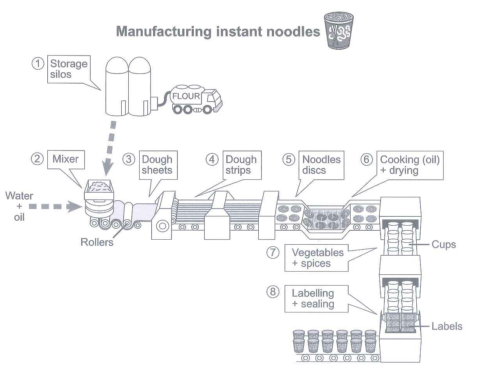
The diagram below shows how instant noodles are manufactured.
Summarize the information by selecting and reporting the main features and make comparisons where relevant.
Student answer (Band 5.5)
The diagram illustrates that how instant noodles are manufactured.
Overall, It has been clear that there are total eight steps in all process. The process is in step by step. It is starting from stroage silos and then further process and it is completing on labelling and sealing means it is ready to sale.
Firstly, the flour is taken from storage silos because noodles are made of flour. Then we have to mix it with water and oil. After mixing, the process is completed in machine in factory. Then this mixture is pass from dough sheets and dough strips. When it is passed from stips then it is pass from noodles discs.
Furthermore, the cooking oil is added then we dry it. After drying, we add some spices and materials like vagetable and spices.
Now, there is almost all process have been done. There are now final steps like labelling, packing, and sealing.
AI examiner evaluation
| Criterion | Band |
|---|---|
| Task Achievement / Task Response | 5.5 |
| Coherence and Cohesion | 6.0 |
| Lexical Resource | 5.0 |
| Grammatical Range and Accuracy | 5.0 |
| Overall | 5.5 |
Task Achievement / Task Response: Band 5.5
You identify the process as having eight stages and give a basic start-to-finish overview, from the storage silos to labelling and sealing. Several key stages are also mentioned, including mixing flour with water and oil, shaping the dough, cooking and drying, and adding vegetables and spices. However, some details are unclear or inaccurate: the noodles are formed into discs before cooking, and the cups are filled with noodles and ingredients before labelling and sealing. The response also says “packing,” which is not shown as a separate stage, and does not clearly explain the rollers or the final cups emerging on a conveyor. A more precise overview and fuller reporting of the sequence would make the account more complete.
Coherence and Cohesion: Band 6.0
The response has a recognisable overall structure: an introduction, an overview, and paragraphs describing the earlier and later stages. Sequencing expressions such as “Firstly,” “After mixing,” and “Furthermore” help the reader follow the process. However, progression is sometimes mechanical, and links between stages are not always clear. For example, “Then this mixture is pass from dough sheets and dough strips” does not explain how the mixture becomes sheets and then strips. The final paragraph repeats that the process is nearly complete before listing the last steps. Use clearer stage-to-stage links and group related actions more logically—for instance, describe shaping and forming the noodle discs together, then explain cooking, filling, and sealing.
Lexical Resource: Band 5.0
You use relevant process vocabulary, including “storage silos,” “dough sheets,” “dough strips,” “noodles discs,” and “labelling and sealing,” so the reader can identify many stages. However, the range is limited and several word choices or spellings reduce precision, such as “stroage,” “stips,” and “vagetable.” Phrases including “the process is completed in machine in factory” and “some spices and materials like vagetable and spices” are vague or repetitive. Aim for accurate process verbs and collocations, such as “the dough is rolled into sheets,” “cut into strips,” and “the cups are filled with vegetables and spices.” This would make the description more concise and precise.
Grammatical Range and Accuracy: Band 5.0
You communicate the general sequence using simple sentences and some attempts at longer structures, such as “After drying, we add some spices and materials…” However, errors occur frequently in verb forms, sentence construction, and articles, and some make the process difficult to follow. Examples include “illustrates that how,” “there are total eight steps,” “this mixture is pass,” and “it is pass from noodles discs.” The overview also shifts awkwardly between “It has been clear” and “it is starting.” Practise passive forms, which are useful for describing processes: for example, “The flour is mixed with water and oil,” followed by “The dough is rolled into sheets.” More accurate sentence patterns would improve clarity while allowing you to vary your structures.
See this exact question answered at other band scores. The same prompt compared across bands.
Browse more IELTS Writing model answers or get your own writing scored by the same AI examiner.