Band 6.0 IELTS Writing Task 1 Model Answer
Overall Band Score: 6.0 · Cambridge IELTS 15 · 2026-11-27
IELTS Writing Task 1 question
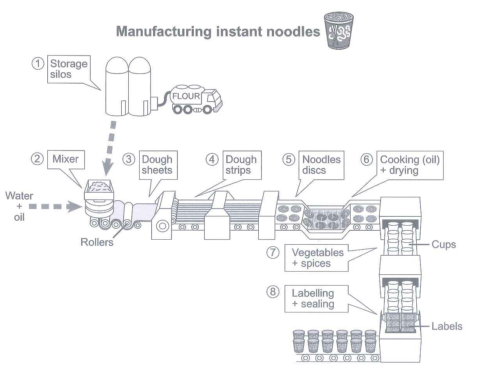
The diagram below shows how instant noodles are manufactured.
Summarize the information by selecting and reporting the main features and make comparisons where relevant.
Student answer (Band 6.0)
The diagram below illustrates how instant noodles are created although this is a linear process.
In the overview,it is simply a step by step process of manufacturing of instant noodles.
At first,a truck delivered a flour to the storage silos then the flour is added into the mixer machine where two ingredients are added for instance water and oil to make a dough for the noodles after that the dough passed through the rollers and dough sheet is ready.
Furthermore,dough sheets are converted into the strips and then these strips gave the shape of the disc called noodles discs additionally;after the cooking process of noodles in oil they all are dried and then the cups should be placed inside the machine.
More importantly, vegetables and spices are added inside the cups and these cups gave labelling of instant noodles after that these cups are sealed by the help of the machine which is air tight and then these instant noodles cups are ready to deliver in the markets.
AI examiner evaluation
| Criterion | Band |
|---|---|
| Task Achievement / Task Response | 6.0 |
| Coherence and Cohesion | 6.0 |
| Lexical Resource | 6.0 |
| Grammatical Range and Accuracy | 5.0 |
| Overall | 6.0 |
Task Achievement / Task Response: Band 6.0
The response covers the main stages from flour delivery through mixing, shaping, cooking and drying, to adding vegetables and spices and sealing the cups. This gives the reader a generally accurate account of the process. However, some details are unclear or not fully grounded in the diagram: the cups are introduced at the filling stage, but the description that they “should be placed inside the machine” does not explain that the cooked noodle discs enter the cups as well. The overview also repeats that the process is step by step without highlighting its main phases. To strengthen the report, give a concise overview of the sequence and describe more precisely how the noodles and seasonings are combined with the cups before labelling and sealing.
Coherence and Cohesion: Band 6.0
The stages are presented in a broadly logical order, and sequencing expressions such as “At first,” “after that,” and “Furthermore” help the reader follow the process. The response also has an opening and an overview before moving into the details. However, the information is arranged in very long sentences, with several stages joined together, so the progression can feel mechanical and some relationships are difficult to follow. For example, the sentence beginning “Furthermore” combines shaping, cooking, drying and cup placement. Use clearer paragraphing and divide the process into manageable stages, with linking phrases that show sequence without repeatedly relying on “after that.”
Lexical Resource: Band 6.0
There is an adequate range of process vocabulary, including “storage silos,” “mixer,” “rollers,” “dough sheets,” “strips,” and “labelling.” These terms make the general manufacturing sequence understandable. Some word choices and collocations are less precise, however: “created” is less suitable than “manufactured” for this formal process description, “gave the shape of the disc” is awkward, and “gave labelling” does not clearly describe the final stage. The phrase “ready to deliver in the markets” is also unnatural. Aim for accurate process verbs and natural collocations, such as “are shaped into discs,” “are labelled and sealed,” and “are ready for distribution.”
Grammatical Range and Accuracy: Band 5.0
The response attempts both simple and complex sentence forms, including clauses linked with “where,” “after,” and “although.” The overall meaning is usually recoverable, but errors in sentence construction, tense, articles and punctuation are frequent enough to make some sentences difficult to process. For example, “a truck delivered a flour” has an unnecessary article and an awkward tense choice, while “the dough passed through the rollers and dough sheet is ready” shifts tense and omits an article. Several sentences also run together without appropriate punctuation. Practise consistent present simple passive forms for process descriptions, and check articles, plural forms and sentence boundaries when editing.
See this exact question answered at other band scores. The same prompt compared across bands.
Browse more IELTS Writing model answers or get your own writing scored by the same AI examiner.