Band 6.5 IELTS Writing Task 1 Model Answer
Overall Band Score: 6.5 · Cambridge IELTS 15 · 2026-11-28
IELTS Writing Task 1 question
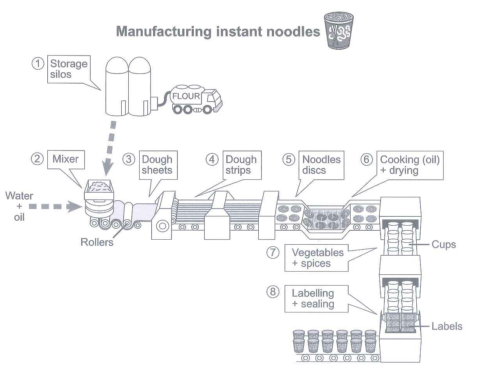
The diagram below shows how instant noodles are manufactured.
Summarize the information by selecting and reporting the main features and make comparisons where relevant.
Student answer (Band 6.5)
The given diagram illustrates the whole process of manufacturing instant noodles.
Overall, there are eight steps in the manufacturing of noodles. Flour moves from storage to a mixture, then through rollers to form noodle shapes for the process of cooking and drying. At the end, the noodles are packed.
First, I will look at the first process of it, in which flour is stored in storage silos from trucks. Afterwards, flour is sent to the mixer, where water and oil are added and mixed well to make dough; then rollers make the dough sheets. The machine converts it into dough strips, then into noodle discs, which then move to the process of cooking in oil and then drying to put it into cups. Subsequently, the various vegetables and spices are added into noodles cups. At the end, the cups are labelled and sealed by machine and then arranged in order.
AI examiner evaluation
| Criterion | Band |
|---|---|
| Task Achievement / Task Response | 6.5 |
| Coherence and Cohesion | 7.0 |
| Lexical Resource | 6.0 |
| Grammatical Range and Accuracy | 6.5 |
| Overall | 6.5 |
Task Achievement / Task Response: Band 6.5
You cover the main stages and provide an overview that identifies the movement from flour storage through processing to packaging. The sequence from mixing and rolling to dough sheets, strips and noodle discs is generally accurate, as are cooking, drying, adding vegetables and spices, and sealing. This gives the response a clear account of the process. However, some details are imprecise or omitted: the flour is delivered from a truck into the silos, rather than being stored there “from trucks,” and the final cups emerge on a conveyor rather than simply being “arranged in order.” The overview could also distinguish the key transformation stages more clearly. The task is addressed, but some features are less fully and precisely reported than others.
Coherence and Cohesion: Band 7.0
The response is organised into an introduction, an overview and a chronological description, so the reader can follow the manufacturing process from beginning to end. Sequencing expressions such as “First,” “Afterwards,” “then,” “Subsequently” and “At the end” help signal progression, and the stages are presented in a sensible order. Some linking is a little mechanical, however, particularly the repeated use of “then,” and “First, I will look at the first process of it” is an awkward transition that draws attention to the writing rather than the diagram. The overview and detail paragraph also repeat some information. More varied, precise links between stages and clearer references to the machines or products would make the progression smoother.
Lexical Resource: Band 6.0
You use a relevant range of process vocabulary, including “storage silos,” “mixer,” “rollers,” “dough sheets,” “dough strips,” “noodle discs,” and “labelled and sealed.” These terms make the stages recognisable, and the meaning remains clear. However, some word choices and combinations are imprecise or unnatural: “a mixture” is less suitable than “a mixer,” “make noodle shapes” is vague, and “added into noodles cups” is not a natural description. “Arranged in order” also does not clearly convey the final conveyor stage. The vocabulary is adequate for describing the process, but greater precision and more natural collocations would improve the account. Aim to use the diagram’s specific terms consistently rather than relying on general phrases such as “the process.”
Grammatical Range and Accuracy: Band 6.5
You use a mixture of simple and complex sentences, including a relative clause in “the mixer, where water and oil are added” and a sequence of clauses describing how the dough is transformed. Most of the process remains understandable, and passive forms such as “are added” and “are labelled and sealed” suit a manufacturing description. Some grammatical inaccuracies remain. In “flour is stored in storage silos from trucks,” the relationship between the truck and silos is expressed unclearly; “flour is delivered by truck to the silos” would be more controlled. The phrase “which then move to the process of cooking … to put it into cups” also has an unclear reference and awkward clause structure. More consistently controlled sentence construction and clearer pronoun references would strengthen accuracy.
See this exact question answered at other band scores. The same prompt compared across bands.
Browse more IELTS Writing model answers or get your own writing scored by the same AI examiner.