Band 6.0 IELTS Writing Task 1 Model Answer
Overall Band Score: 6.0 · Cambridge IELTS 15 · 2026-11-28
IELTS Writing Task 1 question
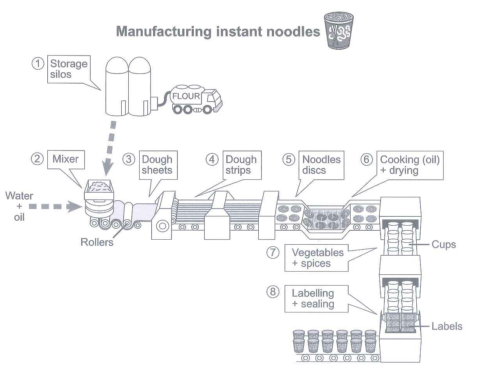
The diagram below shows how instant noodles are manufactured.
Summarize the information by selecting and reporting the main features and make comparisons where relevant.
Student answer (Band 6.0)
The diagram illustrates the manufacturing process of noodles. Instant noodles we preapre nowadays has huge manufacturing story behind them.
Noodles are basically made from flour.The flour is tranferred into storage silos by means of a truck. From storage, flour is mixed inside a mixer with other useful ingredients like water and oil. The mixture formed is then passed thorugh rollers to make dough sheets. To make them separable, sheets are passed through a mechanism which put stripes on the dough. After that they are pressed under high pressure into specific shaped to form noodle discs.
Now, the noodle discs are cooked under little heat to dry up oil from them because if the oil is there, they are hard to carry and transport. Moreover, it is essential for next step too which is packing in the cups. Noodles are packed in specific cups and different kind of spices and vegetables are also added in this particular step. At the last step, specific lables are attached against the specific flavours and a proper air tight seal is also applied.
In the end, the seal packed cups are transported to different marts and shops from where the people can easily buy and enjoy them.
AI examiner evaluation
| Criterion | Band |
|---|---|
| Task Achievement / Task Response | 5.5 |
| Coherence and Cohesion | 6.5 |
| Lexical Resource | 5.5 |
| Grammatical Range and Accuracy | 5.5 |
| Overall | 6.0 |
Task Achievement / Task Response: Band 5.5
You cover the main stages from flour storage through mixing, shaping, cooking, adding ingredients and sealing, so the reader can follow the general process. However, the account is only partly accurate and omits some important details: the diagram shows dough strips being formed before they become noodle discs, and the finished cups emerge on a conveyor; it does not show transport to shops. The explanation that cooking removes oil because it makes the noodles hard to carry is also invented, as is the claim that pressure shapes the discs. A clear overview identifying the process as a sequence from flour to sealed cups would strengthen the response, while sticking closely to the diagram would make the selected features more reliable.
Coherence and Cohesion: Band 6.5
The response has a generally coherent sequence, moving from flour storage to the final packaging stages, and the paragraph break helps separate the earlier and later steps. Connectors such as “From storage,” “After that,” “Moreover,” and “At the last step” make the order clear. This meets the lower-band expectation of an overall coherent arrangement and shows some stronger progression. However, the linking can feel mechanical, and “Moreover” introduces an explanation rather than a new process stage. The final sentence about shops also shifts away from the diagram. Grouping stages into clearer sections and using concise transitions tied to the process would make cohesion more flexible and precise.
Lexical Resource: Band 5.5
You use some relevant process vocabulary, including “storage silos,” “mixer,” “rollers,” “dough sheets,” “noodle discs,” and “seal,” which helps communicate the general sequence. However, the range is limited and several noticeable spelling and word-choice errors reduce precision: “preapre,” “tranferred,” “thorugh,” and “lables” are misspelled, while “put stripes on the dough” is an imprecise description of forming strips. Phrases such as “useful ingredients,” “specific shaped,” and “proper air tight seal” are also awkward or unclear. Aim for accurate process terms and natural collocations, such as “the dough is cut into strips” and “the cups are sealed.”
Grammatical Range and Accuracy: Band 5.5
You attempt both simple and more extended sentence forms, including the conditional clause “because if the oil is there…” and the relative clause “from where the people can easily buy…”. The sequence is usually understandable, but errors recur in agreement, articles, verb forms and sentence construction. For example, “Instant noodles … has” has a subject–verb agreement problem, while “sheets are passed through a mechanism which put stripes” shifts awkwardly between plural and singular forms. “To make them separable” also has an unclear reference, and “into specific shaped” is grammatically incomplete. Use consistent passive forms to describe the stages, check singular/plural agreement, and keep explanations concise so that sentence accuracy improves.
See this exact question answered at other band scores. The same prompt compared across bands.
Browse more IELTS Writing model answers or get your own writing scored by the same AI examiner.