Band 6.0 IELTS Writing Task 1 Model Answer
Overall Band Score: 6.0 · Cambridge IELTS 15 · 2026-11-08
IELTS Writing Task 1 question
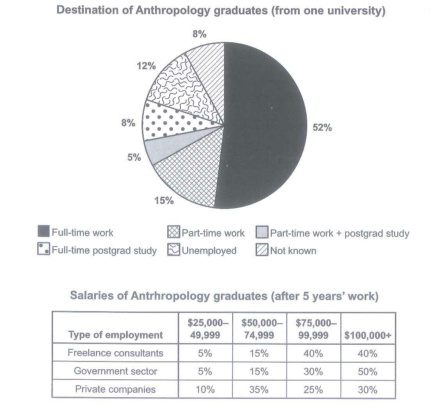
The chart below shows what Anthropology graduates from one university did after finishing their undergraduate degree course. The table shows the salaries of the anthropologists in work after five years.
Summarize the information by selecting and reporting the main features and make comparison where relevant.
Student answer (Band 6.0)
The pie chart illustrates the proportion of the status of the graduates after completing the undergraduate degree on Anthropology from a university. And the table represents their salaries after five years of working for different kinds of jobs.
Overall, more than half of the graduates started full-time job after completing their graduation whereas the smallest portion chose both part-time job and postgrad study. Additionally, half of the graduates got highest salary after working for five years in government sector.
After finishing the undergraduate degree full-time work was chosen by just over the half of students. The second choice was joining in a part-time job which was 15% of the total. However, a insignificant minority chosed to do part-time job and postgrad study together which was 5 % of the total.
After completing five years of work, half of the graduates got the salary of more than $100,000 for government sector which was given to 40% of the freelance consultants and 50% of the private companies. A tiny protion (5%) of graduates received salary between $25,000 and $49,999 for freelance consultants
AI examiner evaluation
| Criterion | Band |
|---|---|
| Task Achievement / Task Response | 5.0 |
| Coherence and Cohesion | 6.0 |
| Lexical Resource | 6.0 |
| Grammatical Range and Accuracy | 6.0 |
| Overall | 6.0 |
Task Achievement / Task Response: Band 5.0
You identify the main destination, noting that full-time work accounted for just over half, and correctly highlight the 5% who combined part-time work with postgraduate study. You also include relevant salary comparisons. However, the response covers the chart only partially: it omits several destinations, including unemployment, full-time postgraduate study and the unknown category, and gives little account of the salary bands overall. There is also a factual reversal: the text says 50% in government and 40% in private companies earned over $100,000, whereas the figures are 50% for government and 30% for private companies; freelance consultants are at 40%. The overview is useful but incomplete, and the salary discussion needs accurate, broader coverage of the table.
Coherence and Cohesion: Band 6.0
The response has a recognisable structure: an introduction, an overview, and separate paragraphs for graduate destinations and salaries. This makes the main topics easy to locate, and transitions such as “Overall,” “After finishing,” and “Additionally” help signal the stages of the report. However, the final paragraph is brief and ends after one salary-band detail, so the comparison of the table does not develop fully. Some linking is also mechanical, and the opening “And the table…” is not an effective way to connect the two introductory statements. Improve progression by grouping related figures and using comparisons to connect them, for example contrasting the highest salary shares across all three employment types.
Lexical Resource: Band 6.0
You use an adequate range of task-related vocabulary, including “proportion,” “graduates,” “postgrad study,” “salary,” and “freelance consultants.” These terms make the subject clear, and phrases such as “the second choice” help describe ranking. There are, however, several inaccurate or awkward choices: “status of the graduates” is imprecise for their destinations, “joining in a part-time job” is unnatural, and “a insignificant minority” contains an article error as well as an unsuitable phrase. Spelling errors such as “chosed” and “protion” also reduce accuracy. Aim for precise chart language and check word forms and spelling; for example, use “destination,” “worked part-time,” and “a small proportion.”
Grammatical Range and Accuracy: Band 6.0
You use a mix of simple statements and more developed structures, including the contrast introduced by “whereas” and the clause beginning “which was 5% of the total.” Most sentences remain understandable, so grammatical errors rarely obstruct the message. Some sentence construction and punctuation need attention: “The pie chart illustrates… And the table represents…” is an awkward sentence break, while “After finishing the undergraduate degree full-time work was chosen…” has an unclear opening phrase and would benefit from clearer subject placement. There are also errors in articles and agreement, such as “a insignificant minority,” and inconsistent spacing around percentages. Practise combining the introduction into one well-formed sentence and use clear subjects and accurate articles in each comparison.
See this exact question answered at other band scores. The same prompt compared across bands.
Browse more IELTS Writing model answers or get your own writing scored by the same AI examiner.