Band 4.5 IELTS Writing Task 1 Model Answer
Overall Band Score: 4.5 · Cambridge IELTS 15 · 2026-11-10
IELTS Writing Task 1 question
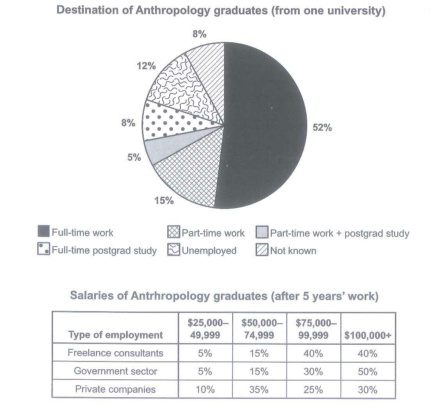
The chart below shows what Anthropology graduates from one university did after finishing their undergraduate degree course. The table shows the salaries of the anthropologists in work after five years.
Summarize the information by selecting and reporting the main features and make comparison where relevant.
Student answer (Band 4.5)
The pie shows us how anthropology graduates has performed in there lifes after finishing there undergraduate degree course.The chart shows the life of people after five years in anthropologists work and there salaries.52% of people are fulltime workers and full-time postgrad study.15% are part-time work and 5% are part-time work + postgrad study. 12% of people are unemployed and 8% are unknown.The antrhpropology graduates have different types of employment and there salaries after five years are:
Freelance consultants who make $25,000-49,999 are 5 , $50,000-74-999 are 15% , $75,000-99,999 are 40% and $100,000+ are 40%.
Government sector who make $25,000-49,999 are 5% , $50,000-74-999 are 15% , $75,000-
AI examiner evaluation
| Criterion | Band |
|---|---|
| Task Achievement / Task Response | 3.5 |
| Coherence and Cohesion | 4.5 |
| Lexical Resource | 5.0 |
| Grammatical Range and Accuracy | 4.5 |
| Overall | 4.5 |
Task Achievement / Task Response: Band 3.5
The response identifies several relevant figures, including 52% in full-time work, 15% in part-time work, and the salary distributions for freelance consultants. However, it misreports the first figure by saying that 52% are full-time workers “and full-time postgrad study”; these are separate destinations, at 52% and 8%. The salary account is also incomplete: it stops partway through the government-sector figures and omits private companies, while there is no clear overview of the main patterns. The task requires at least 150 words, and this response is substantially short, leaving important information unreported. To improve, give an accurate overview first, compare the main destinations and salary patterns, and cover all three employment types concisely.
Coherence and Cohesion: Band 4.5
The response has a basic sequence: it introduces the charts, reports graduate destinations, and then begins describing salaries. This gives the reader some sense of the task’s two parts. However, the ideas are not developed into clear paragraphs, and the salary section ends abruptly during the government-sector data. The opening sentence also combines the charts’ subjects unclearly, and the repeated “who make” construction makes the table details feel like a list rather than a comparison. Use a short introduction, a distinct overview, and organised body paragraphs. Group salary bands to highlight similarities and differences, and use linking phrases such as “by contrast” or “the highest proportion” to make progression clearer.
Lexical Resource: Band 5.0
The response uses some relevant task vocabulary, including “full-time work,” “unemployed,” “freelance consultants,” and “government sector,” so the reader can recognise the subject. However, the range is limited and several expressions are inaccurate or informal for an academic summary. “The pie shows us” and “the life of people” do not describe the data precisely, while “unknown” is less suitable than the chart label “not known.” There are also spelling and form errors, such as “antrhpropology” and “fulltime,” which reduce clarity. Aim for precise reporting language and accurate chart terminology; for example, describe what graduates “did” or their “destinations,” rather than their “life.”
Grammatical Range and Accuracy: Band 4.5
Most of the response uses short, simple statements, and some figures are presented in understandable sentence patterns. However, grammatical control is inconsistent. The opening has agreement and possessive problems in “graduates has performed” and “there lifes,” and the phrase “52% of people are fulltime workers and full-time postgrad study” does not form a parallel or accurate sentence. The repeated “who make … are” pattern is also awkward, and punctuation is missing after the first sentence. Use complete, carefully punctuated sentences, check subject–verb agreement and plurals, and make list items grammatically parallel. A wider mix of accurate sentence structures would help present comparisons more clearly.
See this exact question answered at other band scores. The same prompt compared across bands.
Browse more IELTS Writing model answers or get your own writing scored by the same AI examiner.