Band 6.0 IELTS Writing Task 1 Model Answer
Overall Band Score: 6.0 · Cambridge IELTS 15 · 2026-11-11
IELTS Writing Task 1 question
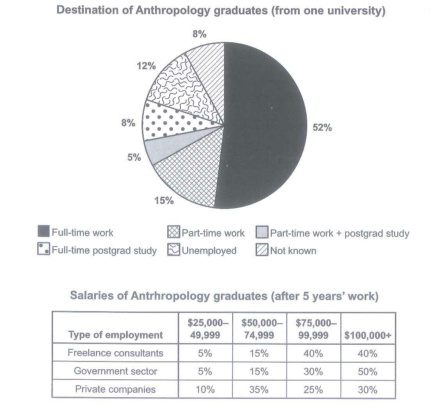
The chart below shows what Anthropology graduates from one university did after finishing their undergraduate degree course. The table shows the salaries of the anthropologists in work after five years.
Summarize the information by selecting and reporting the main features and make comparison where relevant.
Student answer (Band 6.0)
The pie char below illustrates the professional activities of Anthropology graduates after completing their undergraduate degree course from one university.
The table shows the earning estimates of Anthropology graduates after 5 years of work in different areas of profession.
Overall, more than half of the students started full time work after finishing thier undergraduate degree, 15% of the students chose to work part time only and 5% students started working part time along with their postgrad study. Around 8% of students enrolled in full-time postgrad degree course. We also don't have any information 8% of the total student's professional destination. It also shows that 12% of the total students stated unemployed.
In terms of their salaries, 40% of the freelance consultants made over $[redacted phone] while the same number of students earned between $75000 and $99,999. We also see 15% making between $50,000 and $74,999 but a small portion made betweem $25000 to $49,999.
Government sector has bigger numbers in the $75000 to $99,999 thousand range and $100,000 range. Specifally 10% less in the first range and 10$% more in the highest pay range in comparison with Freelance consultant.
Private sector had less progress after 5 years of work as only 30% of the students reached $100,000 pay while most acheived $50000 to $74,999 salary.
AI examiner evaluation
| Criterion | Band |
|---|---|
| Task Achievement / Task Response | 6.0 |
| Coherence and Cohesion | 6.5 |
| Lexical Resource | 6.0 |
| Grammatical Range and Accuracy | 5.5 |
| Overall | 6.0 |
Task Achievement / Task Response: Band 6.0
You cover both the graduate destinations and the salary table, and your overview correctly identifies full-time work as the largest destination, alongside the 15% working part-time and 5% combining work with postgraduate study. Several salary details are also accurate: freelance consultants are reported correctly, and you note that private-sector employees most commonly earned $50,000–$74,999. However, some comparisons are unclear or incomplete. For example, “Government sector has bigger numbers” does not specify that 50% earned $100,000 or more, the highest share in that sector; the comparison with freelance consultants also needs the actual figures (30% versus 40% in the $75,000–$99,999 band). “Less progress” is an unsupported interpretation of salary distribution. Select and compare the key figures more precisely.
Coherence and Cohesion: Band 6.5
The response has a clear overall arrangement: an introduction, an overview of destinations, and separate discussion of salary patterns. This makes the two visual elements easy to follow, and phrases such as “In terms of their salaries” signal the shift effectively. The sequence within the destination overview is also generally logical. To make the progression more controlled, group related salary comparisons and state the comparison directly rather than relying on vague links such as “bigger numbers” and “the same number.” The final paragraph would be clearer if it contrasted the private-company distribution with the other sectors, rather than ending on a broad claim about “progress.” Some references, including “the first range” and “the highest pay range,” require readers to look back to identify the exact bands.
Lexical Resource: Band 6.0
You use a suitable range of task-related vocabulary, including “professional activities,” “freelance consultants,” “Government sector,” and “postgrad study,” so the main information is generally understandable. There are also attempts to describe proportions and compare categories. However, some choices are imprecise or unnatural for reporting data: “earning estimates” is less suitable than “salary bands,” and “less progress” suggests change over time, which the table does not show. Spelling slips such as “thier,” “betweem,” “Specifally,” and “acheived” reduce accuracy. Use consistent, precise terms for the salary brackets and avoid wording that implies a trend when the table presents a distribution. These improvements would make the vocabulary more controlled and appropriate to an academic report.
Grammatical Range and Accuracy: Band 5.5
You use both simple statements and longer sentences, including a sentence with “while” to compare salary figures, and most meanings remain clear. Some grammatical errors nevertheless affect accuracy. In “We also don't have any information 8%,” the relationship between the information and the percentage is not expressed correctly; write, for example, “The destination of 8% of graduates is unknown.” The phrase “10% less in the first range and 10$% more” is also incomplete and lacks a clear grammatical structure. There are inconsistent forms in “students stated unemployed” and “students earned,” where a more accurate construction would be “were unemployed” and “earned.” Check sentence completeness, verb patterns, and punctuation, especially when presenting comparisons.
See this exact question answered at other band scores. The same prompt compared across bands.
Browse more IELTS Writing model answers or get your own writing scored by the same AI examiner.