Band 6.5 IELTS Writing Task 1 Model Answer
Overall Band Score: 6.5 · Cambridge IELTS 15 · 2026-11-12
IELTS Writing Task 1 question
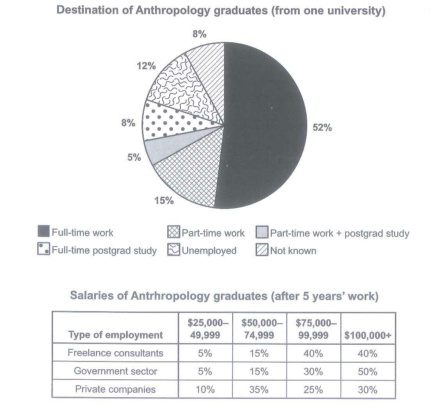
The chart below shows what Anthropology graduates from one university did after finishing their undergraduate degree course. The table shows the salaries of the anthropologists in work after five years.
Summarize the information by selecting and reporting the main features and make comparison where relevant.
Student answer (Band 6.5)
The pie chart illustrates the percentage of anthropology graduates who finished their undergraduate degree course from one university, while the table presents the salaries of those graduates after five years work experienced in three major jobs such as freelance consultants, government sector and private companies.
Overall, it is clear that those who did full-time work accounted for the largest proportion, whereas who did part time work and postgrad study those were represented the smallest percentage. Furthermore, the government sector employees earned the highest salary, than the freelance consultants and the private companies employees.
Looking at the pie chart, the graduates who did full-time work constituted the largest proportion, at 52%, while those who did only part-time work accounted for the 15%. Similarly, unemployed represented approximately 12% of the total, making it another significant group. In addition, both the full-time postgrad study students and not known accounted for the 8%. In comparison, the proportion of part-time work and postgrad study students was relatively insignificant, standing at just 5%, which was the smallest figure among all categories.
Regarding the table, 50% students earned more than one lakh who worked in the government sector and remaining 50% earned between $25,000 and $99,999. Similarly, 60% graduates earned between $25,000 and $99,999, and only 40% earned above $100,000 who worked as a freelance consultant. By contrast, 10% students earned between $25,000 and 49,999, 35% earned between $50,000-$74,999 and remaining 30% earned more than one lakh who worked in private companies.
AI examiner evaluation
| Criterion | Band |
|---|---|
| Task Achievement / Task Response | 6.5 |
| Coherence and Cohesion | 6.5 |
| Lexical Resource | 6.5 |
| Grammatical Range and Accuracy | 6.0 |
| Overall | 6.5 |
Task Achievement / Task Response: Band 6.5
You cover both visuals and provide a clear overview: full-time work is correctly identified as the largest destination, and part-time work combined with postgraduate study as the smallest. Most figures are reported accurately, including the 52%, 15%, 12%, 8% and 5% shares. The salary section also includes useful comparisons, such as 50% of government employees earning $100,000 or more and 40% of freelance consultants doing so. However, the overview’s claim that government employees earned the highest salary is too broad: the government group has the largest share in the top band, but freelance consultants also have 40% in that band. The private-company account omits the 25% earning $75,000–99,999. More precise coverage of the salary distribution would strengthen the response.
Coherence and Cohesion: Band 6.5
The response is arranged in a clear sequence, with an introduction, an overview, and separate paragraphs for the pie chart and table. This makes the two sources easy to follow, and linking expressions such as “Overall,” “Looking at the pie chart,” and “By contrast” help signal the direction of the discussion. Some connections are less effective or repetitive, however. “Similarly” introduces figures that are not especially similar, and the repeated “who worked…” clauses at the ends of salary statements make the paragraph cumbersome. The overview also moves from the destination chart to salary comparisons without clearly distinguishing the top salary band from overall earnings. Use more precise links and organise the table paragraph by comparing salary bands across sectors or by describing each sector consistently.
Lexical Resource: Band 6.5
You use a suitable range of task-related vocabulary, including “constituted,” “accounted for,” “proportion,” “represented,” and “standing at,” which helps describe percentages without relying on one verb throughout. Some less natural choices reduce precision: “five years work experienced” is not an appropriate phrase, “major jobs” is vague, and “earned more than one lakh” is less suitable than the dollar-based wording used in the table. “Relatively insignificant” also overstates the meaning of a small share; a neutral description is preferable. There is some repetition of “graduates,” “students,” and “earned.” Aim for accurate collocations and consistent terminology, and use the exact salary bands rather than converting them into informal expressions.
Grammatical Range and Accuracy: Band 6.0
You attempt a mix of simple and complex structures, including contrast clauses with “while” and “whereas,” and most of the information remains understandable. Some grammatical errors persist, particularly in the overview and salary paragraph. For example, “whereas who did part time work and postgrad study those were represented” has an incorrect clause structure, while “the government sector employees earned the highest salary, than…” uses an unnecessary comparative marker. There are also article and number issues in “accounted for the 15%” and “50% students,” and the phrase “50% earned between $25,000 and $99,999” needs clearer grammatical framing. Check clause construction, articles, and plural forms, and proofread punctuation and spacing to make the complex sentences more controlled.
See this exact question answered at other band scores. The same prompt compared across bands.
Browse more IELTS Writing model answers or get your own writing scored by the same AI examiner.