Band 5.5 IELTS Writing Task 1 Model Answer
Overall Band Score: 5.5 · Cambridge IELTS 15 · 2026-11-12
IELTS Writing Task 1 question
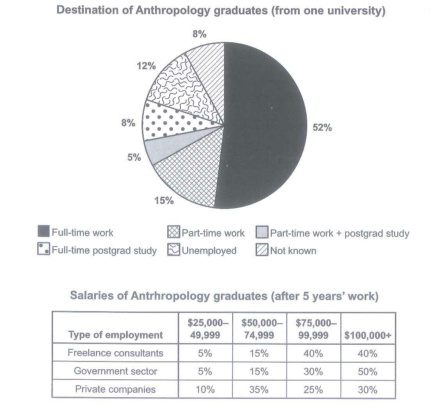
The chart below shows what Anthropology graduates from one university did after finishing their undergraduate degree course. The table shows the salaries of the anthropologists in work after five years.
Summarize the information by selecting and reporting the main features and make comparison where relevant.
Student answer (Band 5.5)
The chart below represents that what Anthropology graduates from one institution have done when they pursued their bachelor. The table picturing the pay of the anthropologists after five years of experience.
It clearly shows that most of the graduates from that particular university are able to manage a full time job meanwhile the rest of them are doing part time jobs or study further. But some of them are doing both. The graph also shows that almost every one out of ten students are unempoloyed and there is no data for eight parcentage of them.
When it comes to their payscale after five years of experience, the table displalys that whoever got the chance to work for the government got the highest amount of salary than others, right after them, we can see that freelance consultants are earning more than private corporate job holders. But we can also find that there are a fraction of people who are earning very less than the majority of people, they are earnig less than fifty grand while majority of them earnig more than seventy five thousands or even more than hundred thousands.
Lastly, we can say that, there are a lot of difference among them about study and work place.
AI examiner evaluation
| Criterion | Band |
|---|---|
| Task Achievement / Task Response | 5.0 |
| Coherence and Cohesion | 6.0 |
| Lexical Resource | 5.0 |
| Grammatical Range and Accuracy | 5.0 |
| Overall | 5.5 |
Task Achievement / Task Response: Band 5.0
You identify the main destination, noting that full-time work is the largest group, and you include the unemployed and unknown categories. You also attempt to compare the salary sectors. However, the response only partially reports the visual information: it omits several destination figures, including the 15% in part-time work and the two postgraduate-study groups, and the overview that graduates differ in “study and work place” is vague. Some salary claims are too broad or inaccurate: government employees have the largest share in the top salary band, but the table does not show that they earn the highest salary overall; private-company employees are not simply below freelancers across all bands. Select key figures and make precise comparisons between salary bands and employment types.
Coherence and Cohesion: Band 6.0
The response has a generally understandable order: it introduces the chart and table, discusses graduate destinations, then turns to salaries. Paragraphing helps distinguish these topics, and phrases such as “When it comes to” signal the shift. However, progression within the paragraphs is sometimes unclear. The first paragraph moves from full-time work to other destinations without reporting their proportions, while the salary paragraph combines several comparisons and a broad claim about earnings in one long sentence. “Lastly” introduces a conclusion, but it repeats a general point rather than synthesising the main findings. Use clearer topic sentences and organise each section around a small number of specific comparisons, with references that make clear which group each claim concerns.
Lexical Resource: Band 5.0
You use some relevant vocabulary, including “graduates,” “unemployed,” “freelance consultants,” and “government,” so the topic is generally clear. However, the range is limited and several word choices or collocations are inaccurate or informal for an academic report. “Picturing the pay” and “got the chance to work” are not natural descriptions of what the table presents, while “grand” is too informal for salary reporting. Spelling errors such as “unempoloyed,” “parcentage,” “displalys,” and “earnig” are noticeable and can distract the reader. Aim for precise reporting language such as “shows,” “salary distribution,” and “the proportion earning,” and check spelling carefully.
Grammatical Range and Accuracy: Band 5.0
You attempt both simple and more extended sentences, but control is uneven, and errors sometimes make relationships between ideas difficult to follow. The opening contains an incomplete construction: “The table picturing the pay…” needs a main verb, such as “The table shows…”. In “most of the graduates … are able to manage a full time job,” the present-tense phrasing does not fit the past destination data, and “there are a fraction of people” has an agreement error. The sentence beginning “But we can also find…” becomes difficult to track because its clauses are joined without clear grammatical structure. Practise complete sentences, consistent tense, subject–verb agreement, and punctuation when combining comparisons.
See this exact question answered at other band scores. The same prompt compared across bands.
Browse more IELTS Writing model answers or get your own writing scored by the same AI examiner.