Band 4.5 IELTS Writing Task 1 Model Answer
Overall Band Score: 4.5 · Cambridge IELTS 15 · 2026-11-12
IELTS Writing Task 1 question
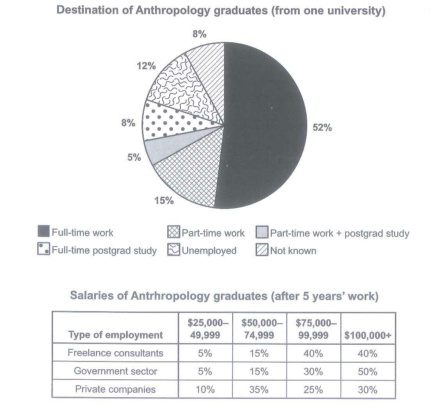
The chart below shows what Anthropology graduates from one university did after finishing their undergraduate degree course. The table shows the salaries of the anthropologists in work after five years.
Summarize the information by selecting and reporting the main features and make comparison where relevant.
Student answer (Band 4.5)
The chart below Gives information about what the graduates of Anthropology from university did after finishing their studies . The table provides the income of the anthropologists in a job after five years.
Overall, The destination of Anthropology who graduates showed that the lagrest percentage was seen in people who had worked the whole time . while the smallest proportion was belonged to thoes who postgrad study in part time work. in contract , The highest income of Anthropology after graduation was in the goverment sector . however the lowest expenditure was in the private companies .
the majority of students who had full time word accounted for 52% ,compared with who had part time that made up about only 15% . postgrad student thoes who word full time was 8% while the part time workers compromised nearly 5% , the remaing were students that did had a job
AI examiner evaluation
| Criterion | Band |
|---|---|
| Task Achievement / Task Response | 4.0 |
| Coherence and Cohesion | 4.5 |
| Lexical Resource | 5.0 |
| Grammatical Range and Accuracy | 5.0 |
| Overall | 4.5 |
Task Achievement / Task Response: Band 4.0
The response identifies the main destination category, reporting that full-time work accounts for 52%, and gives several other figures, including 15% for part-time work and 8% for full-time postgraduate study. However, it addresses the task only partially: the salary table is barely described, and the claim that the highest income was in government and the lowest in private companies is unclear and does not accurately summarise the salary distributions. The overview also misidentifies the smallest destination category: part-time work combined with postgraduate study is 5%, but the response’s comparison is difficult to follow. The response is one word below the required minimum. To improve, include a clear overview and compare the salary bands across employment types using accurate figures.
Coherence and Cohesion: Band 4.5
There is a basic attempt to organise the response, beginning with an introduction, followed by an overview and then details about graduate destinations. This gives the reader some sense of the intended structure. However, progression is weak because the salary information introduced in the overview is not developed, and the final sentence ends without a clear conclusion or complete account of the remaining categories. Linking expressions such as “while,” “compared with,” and “however” are used, but some connections are inaccurate or confusing; for example, “in contract” does not clearly signal the intended contrast. Improve coherence by using separate, focused paragraphs for the overview and key details, and ensure each comparison directly connects the figures being discussed.
Lexical Resource: Band 5.0
The response uses some task-related vocabulary, including “graduates,” “destination,” “full time,” “part time,” and “postgrad study,” so the topic is generally recognisable. However, the range is limited and several word-choice, spelling, and collocation errors make parts difficult to interpret. Examples include “lagrest,” “thoes,” “word” for “work,” “compromised” for “comprised,” and “lowest expenditure” when discussing salaries. “The whole time” is also an imprecise way to describe full-time employment. These errors sometimes obscure the intended meaning, particularly in the overview. Build a more accurate set of terms for employment and salary comparisons, and check spelling and word forms carefully before submitting.
Grammatical Range and Accuracy: Band 5.0
The response attempts both simple and longer sentence forms, including comparisons with “compared with” and “while.” However, control is inconsistent, and frequent errors affect clarity. For example, “The destination of Anthropology who graduates showed” has faulty clause structure, while “the smallest proportion was belonged” uses an incorrect verb construction. The sentence beginning “the majority of students who had full time…” also lacks a clear grammatical link between the groups being compared. Capitalisation and spacing around punctuation are inconsistent, and the final sentence is not fully controlled. Practise forming accurate subject–verb patterns and complete comparison sentences, such as stating one category’s percentage and then clearly contrasting it with another. Use a final proofread to check sentence boundaries and punctuation.
See this exact question answered at other band scores. The same prompt compared across bands.
Browse more IELTS Writing model answers or get your own writing scored by the same AI examiner.