Band 5.5 IELTS Writing Task 1 Model Answer
Overall Band Score: 5.5 · Cambridge IELTS 15 · 2026-11-17
IELTS Writing Task 1 question
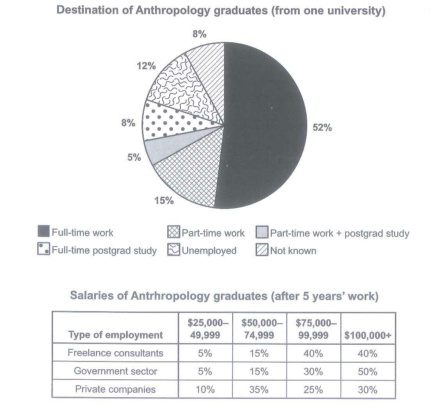
The chart below shows what Anthropology graduates from one university did after finishing their undergraduate degree course. The table shows the salaries of the anthropologists in work after five years.
Summarize the information by selecting and reporting the main features and make comparison where relevant.
Student answer (Band 5.5)
The pie chart illustrate the the work done by Anthropology graduates after completion of the dgree course from one university. The tabular data brings out the income generate by this anthropologists in five years.
First of all, half of the anthropologists done full-time work the number is 52% which holds highest share in the chart. The number of part-time work is 15% and it followed by unemploued once with 12%. Anthropologists who works are not known and full- time postgrad study stand same at 8%. Only 5% graduates are do part-time work with postgrad study.
The tabular dats shows the salaries who graduate with Anthropology dgree. The freelance consultants earn large income then other in $75,000-99,999 and $100,000+ with 40% share of each and the number are low in $25000-74,999 with 5% and 15%. In government sectore the half of the employe earn upto $100,000 and 30% who earn $75,000-99,999, other two are same as previous one. The maximun slaries of private company employees who salaries are $50,000-74,999 with 35% and $100,000+ with 30% and and other are uner 25%.
Overall, the most of the students do full time work as anthropologists after finishing their graduation, and higer salaries earn by government sectors employees.
AI examiner evaluation
| Criterion | Band |
|---|---|
| Task Achievement / Task Response | 5.5 |
| Coherence and Cohesion | 6.0 |
| Lexical Resource | 5.5 |
| Grammatical Range and Accuracy | 5.0 |
| Overall | 5.5 |
Task Achievement / Task Response: Band 5.5
You cover both visuals and identify the main destination, full-time work, correctly at 52%. You also report several other destination figures and make relevant salary comparisons, including the high proportions in the top two bands for freelance consultants. However, some details are inaccurate or unclear: the overview says government employees earn the highest salaries, but the table shows 50% in the top band for government workers versus 40% for freelance consultants, while freelancers have the largest combined share in the top two bands (80%). The statement that private-company salaries are “other are under 25%” does not accurately summarise the 10% and 25% figures. The overview is also limited and does not clearly capture the contrast between destinations and salary distributions. Select the key comparisons more precisely and explain them clearly.
Coherence and Cohesion: Band 6.0
The response has a generally coherent arrangement: it introduces the two visuals, discusses graduate destinations, then turns to salaries, and ends with an overview. This makes the information easy to locate. Basic linking phrases such as “First of all,” “The tabular data shows,” and “Overall” help signal these stages. However, progression within the salary paragraph is less clear, particularly in “other two are same as previous one,” where the reader must infer which figures are being compared. Some links are mechanical, and the final overview repeats the full-time-work point without bringing the salary comparison into sharper focus. Use clearer references to the relevant employment groups and salary bands, and organise the table details in a consistent order.
Lexical Resource: Band 5.5
You use relevant task vocabulary, including “full-time work,” “part-time work,” “freelance consultants,” “government sector,” and salary-band labels. This gives you enough language to communicate the main subject. However, the range is limited and several word-choice, collocation, and spelling problems make parts difficult to interpret. For example, “the income generate by this anthropologists” and “the number of part-time work” are not natural expressions, while “the maximun slaries” contains spelling errors. Repetition of “number,” “earn,” and “work” also reduces precision. Aim to use accurate reporting language such as “accounted for,” “proportion,” and “salary band,” and check spelling carefully. More precise vocabulary would help distinguish the highest individual band from the combined share across bands.
Grammatical Range and Accuracy: Band 5.0
You attempt both simple statements and longer sentences, and the response is divided into paragraphs that broadly match the task’s stages. However, grammatical control is inconsistent, and errors occur often enough to make several sentences awkward or unclear. Examples include “The pie chart illustrate,” “half of the anthropologists done full-time work,” and “Only 5% graduates are do,” which show problems with agreement, verb forms, and sentence construction. The sentence beginning “The maximun slaries of private company employees…” is also difficult to follow because its clauses are not connected grammatically. Build accuracy first with clear subject–verb patterns, then add complex clauses using reliable structures such as “while” or “whereas.” Check articles, plurals, and verb forms during revision.
See this exact question answered at other band scores. The same prompt compared across bands.
Browse more IELTS Writing model answers or get your own writing scored by the same AI examiner.