Band 6.0 IELTS Writing Task 1 Model Answer
Overall Band Score: 6.0 · Cambridge IELTS 15 · 2026-11-17
IELTS Writing Task 1 question
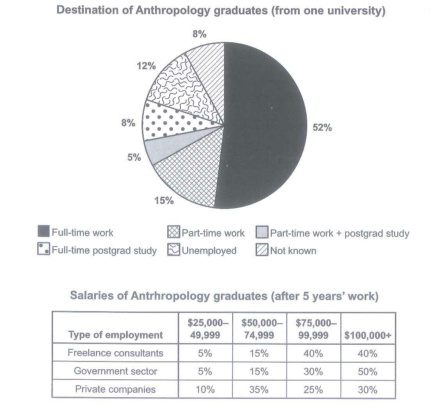
The chart below shows what Anthropology graduates from one university did after finishing their undergraduate degree course. The table shows the salaries of the anthropologists in work after five years.
Summarize the information by selecting and reporting the main features and make comparison where relevant.
Student answer (Band 6.0)
The pie chart illustrates the proportion of Anthropology graduates destination after completing their undergraduate degree.there are five destinations ,fulltime work ,part-time work ,part-time with a postgrad study ,full-time postgrad study and unemployed.whereas the table compares the salaries of the anthropologists in work after five years based on the type of employment.
Overall, we can notice that full-time work accounts for the largest share among the different destinations with 52% .In addition ,the majority of anthropology graduates earn more than 75 thousand after 5 years of work despite the type of employment.
After graduation, more than a half landed a full-time work , while 15% of them started a part-time job and unemployed made up 12% of the total propotion.
Salaries distribution varies based on the type of employment ,for example, 40% of freelance consultants gain more than 100k ,whereas for the goverment sector 50% made that kind of salary . and coming last the private companies type where only 30% gain more than 100k
AI examiner evaluation
| Criterion | Band |
|---|---|
| Task Achievement / Task Response | 5.5 |
| Coherence and Cohesion | 6.0 |
| Lexical Resource | 6.0 |
| Grammatical Range and Accuracy | 5.5 |
| Overall | 6.0 |
Task Achievement / Task Response: Band 5.5
You identify the main destination, full-time work at 52%, and include relevant salary comparisons, such as the 40% of freelance consultants and 50% of government employees earning over $100,000. The overview also recognises that full-time work is the largest destination. However, the coverage is uneven: the chart’s 8% whose destination was not known is omitted, as are the 5% combining part-time work with postgraduate study and the 8% in full-time postgraduate study. The statement that most graduates earned over $75,000 is not supported across every employment type: in private companies, only 55% earned at least $75,000. Develop the overview with accurate comparisons across both visuals and report the salary bands more fully.
Coherence and Cohesion: Band 6.0
The response has a recognisable structure: an introduction, an overview, and separate paragraphs for destinations and salaries. This makes the two visuals easy to distinguish, and linking phrases such as “Overall” and “In addition” help signal the main points. However, progression within the paragraphs is sometimes abrupt. The destination paragraph lists only three categories, while the salary paragraph moves from freelance consultants to government and then private companies without comparing the salary bands systematically. The final phrase, “and coming last,” is also an awkward transition. Grouping related figures and using clearer comparisons—for example, contrasting the highest-income shares across all three employment types—would make the organisation more coherent and cohesion less mechanical.
Lexical Resource: Band 6.0
You use an adequate range of task-related vocabulary, including “proportion,” “accounts for the largest share,” “salary distribution,” and “freelance consultants.” These choices help communicate the chart’s subject and some comparisons. There are, however, several inaccurate or informal expressions: “landed a full-time work” is an unsuitable collocation, “gain” is less appropriate than a reporting verb such as “earned,” and “that kind of salary” is vague. Spelling errors such as “propotion” and “goverment,” along with inconsistent forms such as “fulltime,” reduce accuracy. Aim for precise, consistent terms such as “graduates entered full-time employment” and “earned more than $100,000,” and proofread spelling.
Grammatical Range and Accuracy: Band 5.5
You attempt both simple and more complex sentence forms, including a contrast with “whereas” and a sentence beginning “despite the type of employment.” The main information is generally understandable, but some grammatical errors and punctuation problems remain. For example, “Anthropology graduates destination” needs a possessive or a different construction, and “more than a half landed a full-time work” has problems with the article and noun phrase. The sentence beginning “and coming last” is not a complete, well-formed continuation, while several sentences run together after full stops without capital letters. Use complete sentences, check articles and possessives, and punctuate each comparison clearly to improve control.
See this exact question answered at other band scores. The same prompt compared across bands.
Browse more IELTS Writing model answers or get your own writing scored by the same AI examiner.