Band 5.0 IELTS Writing Task 1 Model Answer
Overall Band Score: 5.0 · Cambridge IELTS 15 · 2026-11-21
IELTS Writing Task 1 question
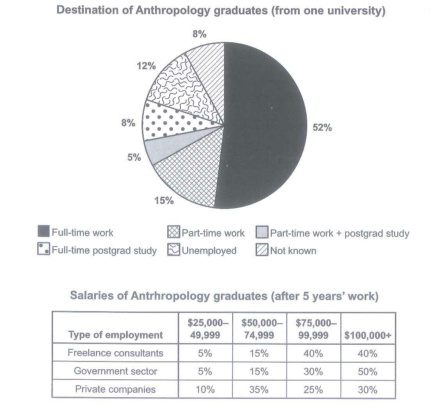
The chart below shows what Anthropology graduates from one university did after finishing their undergraduate degree course. The table shows the salaries of the anthropologists in work after five years.
Summarize the information by selecting and reporting the main features and make comparison where relevant.
Student answer (Band 5.0)
The pie chart indicates what Anthropology graduates from one popular university did after graduating from their degree course. The table below illustrates the amount of salaries they have in their jobs after five years of being anthropologists.
Overall, the chart shows that most of the anthropologists are having a full-time job whereas a very small number of them are working part-time while studing postgard. As it can be seen from the chat that 8% do not work at all, they are just full-time students in postgrad degree at the same time, the other 8% are not well recognized.
In general, 12% are completely unemployed and 15% are part-time workes. It is evident from the table that 40% are working in freelance consultants and according to their knowlage they have a salary of 75,000 up to 99,999 while the other same percentage or given 100,000 and more.
It is showen in the chart that, the 5% who are working in diffrent government sectors are payed 25,000 up to almost 60,000. the 35% of anthropologists who are working in private companies have a great salary of 50,000 and high to 74,999 each time.
AI examiner evaluation
| Criterion | Band |
|---|---|
| Task Achievement / Task Response | 5.0 |
| Coherence and Cohesion | 5.5 |
| Lexical Resource | 5.0 |
| Grammatical Range and Accuracy | 5.0 |
| Overall | 5.0 |
Task Achievement / Task Response: Band 5.0
You identify the main destination, full-time work, and include several relevant figures, such as 52% in full-time work and 12% unemployed. However, coverage of the chart and salary table is partial, and some details are inaccurate or unclear. The 8% who are “not well recognized” are actually in the “not known” category; this does not mean they are unrecognized. The salary discussion also misreports government-sector earnings: 5% are in the lowest band, while the remaining percentages are 15%, 30%, and 50% across higher bands—not a range up to “almost 60,000.” The overview should compare the main salary patterns across all three employment types, rather than focus on isolated figures.
Coherence and Cohesion: Band 5.5
The response has a basic paragraph structure, moving from an introduction and overview to details about graduate destinations and salaries. Some linking phrases, including “Overall,” “In general,” and “It is evident from the table,” help signal the topic. However, progression is not consistently clear: the second paragraph mixes destination categories with an unclear interpretation of the 8% figures, and the final paragraphs move between salary groups without a systematic comparison. References such as “the other 8%” and “the same percentage” make it difficult to identify which category or figure is meant. Organise the response into a clear overview followed by separate, logically ordered comparisons of destinations and salary bands.
Lexical Resource: Band 5.0
You use some task-relevant vocabulary, including “full-time,” “unemployed,” “freelance consultants,” and “government sectors,” so the reader can generally identify the topics being discussed. However, the range and control are limited, with repeated or imprecise expressions such as “great salary” and “not well recognized.” Several spelling errors—“studing,” “postgard,” “knowlage,” “showen,” and “diffrent”—are noticeable and reduce clarity. Some collocations are also unnatural, for example, “the amount of salaries they have” and “are given 100,000 and more.” Use precise terms for proportions and income bands, and check spelling carefully to make the information easier to interpret.
Grammatical Range and Accuracy: Band 5.0
You attempt both simple and longer sentences, including clauses introduced by “whereas” and “while,” but control is inconsistent. Errors occur in verb forms and agreement: “most of the anthropologists are having a full-time job” is better expressed as “most had full-time jobs,” and “It is showen” should use a correct past or present form. Sentence boundaries and punctuation also need attention; for example, “the 5% who are working in diffrent government sectors are payed…” begins after a full stop with a lowercase letter, and the comma after “chart” is unnecessary. These recurring problems sometimes make relationships between figures unclear. Practise accurate past-tense reporting and build complex sentences with clear subjects and punctuation.
See this exact question answered at other band scores. The same prompt compared across bands.
Browse more IELTS Writing model answers or get your own writing scored by the same AI examiner.