Band 6.5 IELTS Writing Task 1 Model Answer
Overall Band Score: 6.5 · Cambridge IELTS 15 · 2026-11-24
IELTS Writing Task 1 question
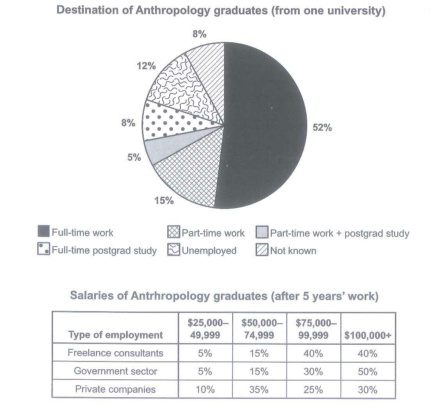
The chart below shows what Anthropology graduates from one university did after finishing their undergraduate degree course. The table shows the salaries of the anthropologists in work after five years.
Summarize the information by selecting and reporting the main features and make comparison where relevant.
Student answer (Band 6.5)
The pie chart presents data on the kind of work Anthropology graduates did after finishing their bachelors course from one university. The data presented on the table shows the employed anthropologists' earnings after five years.
Overall, most anthropologists did full-time work after completing school, while less of them did part-time work + postgrad study. Additionally, those who worked in government sector after five years earned a good salary.
In terms of destination of anthropology graduates, most of them enrolled for full-time work as their proportion was slightly above average, that is at 52%. While 15% of the graduates took part-time jobs, 12% of them remained unemployed. Those that their whereabouts were not known and those who enrolled for full-time postgard study had the same parcentage of 8% each. Part-time work + postgrad study was the least common destination of all the 6 destination with a parcentage of 5%.
On the other hand, graduate salaries varied alot with 50% of those in government sectors earning a considerable amount of money that is $100,000+, and only 5% in this sector earning less than $50,000. Moreover, 80 % of those in freelance consultants earned $75,000+. In contrast, those in private sectors had more graduates of around 35% of them earning a salary of $50,000-$74,999, and 10% of them earning less than $50,000.
AI examiner evaluation
| Criterion | Band |
|---|---|
| Task Achievement / Task Response | 6.5 |
| Coherence and Cohesion | 7.0 |
| Lexical Resource | 6.0 |
| Grammatical Range and Accuracy | 6.0 |
| Overall | 6.5 |
Task Achievement / Task Response: Band 6.5
You cover both visuals and give a relevant overview: full-time work is the largest destination, while part-time work combined with postgraduate study is the smallest, and you identify high earnings in government employment. Most figures are reported accurately, including the 52%, 15%, 12%, and 5% destination shares, as well as the government and freelance salary patterns. This already shows clear selection of key information. However, the overview is somewhat general: “earned a good salary” does not specify the main salary contrast, and the table discussion omits that private-company employees were most concentrated in the $50,000–$74,999 band. Also, “slightly above average” is not a useful comparison here. A more precise overview and fuller comparison across all three employment types would strengthen the response.
Coherence and Cohesion: Band 7.0
The response is organised in a clear sequence: an introduction, an overview, a paragraph on graduate destinations, and a final paragraph on salaries. This gives the reader a logical progression through both visuals. Linking phrases such as “Overall,” “On the other hand,” and “Moreover” help signal the relationships between points, and the destination figures are grouped effectively. Some connections are less precise, however. “On the other hand” suggests a contrast between the two visuals, when the salary table is better introduced as a second set of information. The final paragraph also moves quickly from government to freelance to private-sector figures without a clear comparative framework. Use transitions that express addition or comparison accurately, and group salary bands or employment types more systematically.
Lexical Resource: Band 6.0
You use an adequate range of task-related vocabulary, including “destination,” “proportion,” “unemployed,” “earnings,” and “varied,” and the meaning is generally clear. There are also attempts at more formal phrasing, such as “a considerable amount of money.” However, several choices are imprecise or unnatural for describing statistical data: “enrolled for full-time work” and “remained unemployed” do not fit the chart as naturally as “entered full-time employment” and “were unemployed.” “Good salary” is vague, while “parcentage,” “postgard,” and “alot” show spelling errors. Aim for precise reporting verbs and standard collocations, and proofread spelling. This would make the vocabulary more accurate and flexible without changing the clear overall message.
Grammatical Range and Accuracy: Band 6.0
You use a mix of simple and more complex sentence forms, including a subordinate clause in “while less of them did…” and a contrast structure beginning “While 15%…”. Most sentences communicate the intended comparisons, and errors do not generally prevent understanding. Some grammatical control is inconsistent, though. “While 15% of the graduates took part-time jobs, 12% of them remained unemployed” is a dependent-clause construction used as a sentence, and “those that their whereabouts were not known” has an unclear, faulty relative structure. There are also article and number issues in “in government sector” and “all of the 6 destination.” Work on complete clause structure, relative clauses, and articles/plurals, while retaining the complex sentence patterns you already attempt.
See this exact question answered at other band scores. The same prompt compared across bands.
Browse more IELTS Writing model answers or get your own writing scored by the same AI examiner.