Band 5.0 IELTS Writing Task 1 Model Answer
Overall Band Score: 5.0 · Cambridge IELTS 15 · 2026-11-25
IELTS Writing Task 1 question
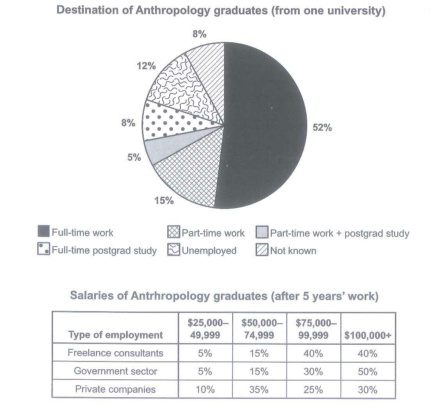
The chart below shows what Anthropology graduates from one university did after finishing their undergraduate degree course. The table shows the salaries of the anthropologists in work after five years.
Summarize the information by selecting and reporting the main features and make comparison where relevant.
Student answer (Band 5.0)
The pie chart illustrates the percentage distribution of what Anthropology gradutes from one univeristy did after finishing their undergraduate degree course.
Overall, most of the graduated students from one university land thier full-time roles as a full -time worker for a company.And very least amount of students go for the part-time work + postgrad study.
Furthermore, the estimated percentage of students who get full-time role after studying anthropology is about 52%,On the other hand, 15% of students go for the part-time work, in contrast, 12 percent of students are still unemployed.Additionaly, 8% of graduates are gone for full-time postgrad study and also 8% are not known.
At the end, Only 5% graduates of one university choose to go for part-time work+ postgrad study which is considered as a lowest distribution.
Finally, 52 percent of pie chart is covered by full-time graduates and reminaing 48 percent are distributed amoung different roles.
AI examiner evaluation
| Criterion | Band |
|---|---|
| Task Achievement / Task Response | 3.5 |
| Coherence and Cohesion | 4.5 |
| Lexical Resource | 5.5 |
| Grammatical Range and Accuracy | 5.5 |
| Overall | 5.0 |
Task Achievement / Task Response: Band 3.5
The response identifies the main destination, full-time work at 52%, and reports several other figures accurately, including part-time work at 15%, unemployment at 12%, and the two 8% categories. It also notes that part-time work combined with postgraduate study is the smallest group. However, the overview is partly inaccurate: the chart does not say graduates took full-time roles “for a company,” and the response does not cover the salary table at all, despite this being a major part of the task. The final comparison of 52% and the remaining 48% adds little analysis. To address the task more fully, summarise the salary patterns and compare the employment sectors as well as the destinations.
Coherence and Cohesion: Band 4.5
The response has a recognisable sequence: an introduction, an overview, details about several destinations, and a closing statement. This gives the reader some structure, and linking expressions such as “Overall” and “On the other hand” signal relationships between points. However, progression is weakened by repeated information: full-time work at 52% is mentioned in the overview, again in the details, and once more at the end. “Furthermore,” “Additionaly,” “At the end,” and “Finally” are used mechanically, and the final sentence does not develop a new comparison. Organise the response into a concise overview and a details paragraph, grouping related figures and using links only where they clarify the comparison.
Lexical Resource: Band 5.5
The response uses some relevant task vocabulary, including “percentage distribution,” “unemployed,” “graduates,” and “postgrad study,” so the topic is generally understandable. There is also an attempt to vary expressions, for example “distribution” and “roles.” However, several word choices and collocations are inaccurate or awkward: “land their full-time roles,” “the graduated students,” and “full-time graduates” do not clearly describe the chart categories. Spelling errors such as “gradutes,” “univeristy,” “thier,” and “reminaing” are noticeable. Use the chart’s category labels consistently and choose precise reporting language, such as “were employed full time” or “the smallest proportion.”
Grammatical Range and Accuracy: Band 5.5
The response attempts a mixture of simple statements and longer sentences, including a contrast with “On the other hand” and a clause beginning “which is considered.” The intended meaning is usually recoverable, but control is uneven. For example, “most of the graduated students … land thier full-time roles” has an unclear subject and verb construction, while “8% of graduates are gone for full-time postgrad study” uses an incorrect verb form. Punctuation and sentence boundaries are also unreliable: “company.And” runs two sentences together, and commas join several independent ideas. Practise accurate past-tense reporting and build shorter, correctly punctuated comparisons before attempting longer sentences.
See this exact question answered at other band scores. The same prompt compared across bands.
Browse more IELTS Writing model answers or get your own writing scored by the same AI examiner.