Band 5.5 IELTS Writing Task 1 Model Answer
Overall Band Score: 5.5 · Cambridge IELTS 15 · 2026-11-25
IELTS Writing Task 1 question
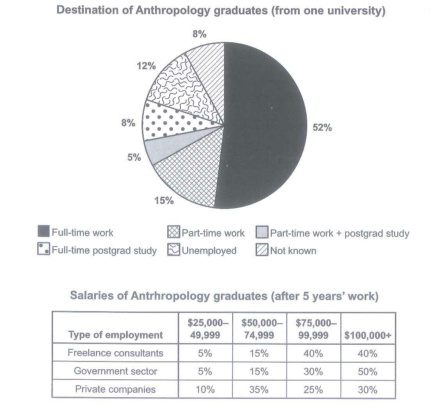
The chart below shows what Anthropology graduates from one university did after finishing their undergraduate degree course. The table shows the salaries of the anthropologists in work after five years.
Summarize the information by selecting and reporting the main features and make comparison where relevant.
Student answer (Band 5.5)
Based on the chart given we can see that anthropology is one of the highest degrees that suffers from unemployemnt as it sits there with a rate of 12%, while the other 88% go on different paths as 52% of the graduates got full-time work, while 15% of them only worked with it as a part-time work, and among all of these there's only 8% that went for a full-time postgrad study and 5% who went for both, a phd and working as part-time work, while the remaining 8% career is still unknown. For the salaries, it varies, as for freelance consultants we can see that the wages are more into 75k-99k and +100k with 40% each. Almost same thing goes for the governement sector as it's on 30% for 75k-99k and a little higher percentage for 100k+ which is 50%, and for 25k-49k it's 5% when 50k-74k is 15% exactly like the freelance consulatants. For the private companies workers it's a bit different, as the percentage on 25k-49k gets a little higher to 10%, but the biggets difference is in the 50k-74k wage as it jumped from 15% on the previous ones to 35%, for the remaining wages it got a bit low as we got a 25% on the 75k-99k one and a 30% on the 100k+ one. From this, we can conclure that the most payed ones are mostly the governement sector workers and the freelance consultants.
AI examiner evaluation
| Criterion | Band |
|---|---|
| Task Achievement / Task Response | 6.0 |
| Coherence and Cohesion | 5.0 |
| Lexical Resource | 5.5 |
| Grammatical Range and Accuracy | 5.0 |
| Overall | 5.5 |
Task Achievement / Task Response: Band 6.0
You cover both the graduate destinations and the salary table, and most figures are reported accurately. The overview that unemployment was 12% and full-time work was the largest destination is relevant, while your salary comparisons correctly identify the higher earnings in government and freelance work and the larger middle-income share in private companies. However, the response lacks a clearly separated, concise overview of the main patterns, and the final claim that the “most payed ones” are government workers and freelance consultants is broader than the table supports: it shows salary distributions, not which group earns the most overall. Some details, such as the destinations, are listed rather than synthesised. A sharper overview and more cautious interpretation would make the key features clearer and more fully developed.
Coherence and Cohesion: Band 5.0
The response follows a generally sensible order: it describes graduate destinations first, then compares salaries across the three employment types. Linking phrases such as “For the salaries” and “For the private companies workers” help signal these shifts. However, most of the information is packed into two very long sentences, so the progression is difficult to follow and comparisons become repetitive. Connectors such as “while,” “as,” and “and” are used repeatedly, sometimes joining several separate points without a clear hierarchy. The conclusion also repeats a broad salary comparison rather than neatly summarising the main patterns. Use distinct paragraphs for the chart and table, and shorter sentences that group related figures to improve the organisation and cohesion.
Lexical Resource: Band 5.5
You use relevant task vocabulary, including “full-time work,” “part-time,” “freelance consultants,” “government sector,” and salary ranges, so the reader can understand the subject. There are also attempts at comparison, such as “a little higher percentage” and “a bit different.” However, several choices are informal or imprecise for an academic report: “got a little higher,” “the biggets difference,” and “most payed ones.” Spelling errors such as “unemployemnt,” “governement,” “consulatants,” and “conclure” are noticeable, and “a phd” adds an unsupported detail because the chart only says postgraduate study. Aim for accurate spelling and more precise reporting verbs and comparison phrases; this would make the vocabulary more controlled and appropriate to the task.
Grammatical Range and Accuracy: Band 5.0
You attempt complex sentences and use clauses to compare figures, for example, “while the other 88% go on different paths as 52% of the graduates got full-time work.” This shows some range, but the long sentence structures are often difficult to control. In “there's only 8% that went,” the agreement and clause construction are awkward; “only 8% went” would be clearer. The sentence beginning “For the private companies workers” also contains several clauses joined by commas, creating a run-on structure. Punctuation and sentence boundaries need more consistent control. Use a mix of shorter statements and carefully formed complex sentences, checking agreement and clause links, so the comparisons remain easy to follow.
See this exact question answered at other band scores. The same prompt compared across bands.
Browse more IELTS Writing model answers or get your own writing scored by the same AI examiner.