Band 6.0 IELTS Writing Task 1 Model Answer
Overall Band Score: 6.0 · Cambridge IELTS 15 · 2026-11-27
IELTS Writing Task 1 question
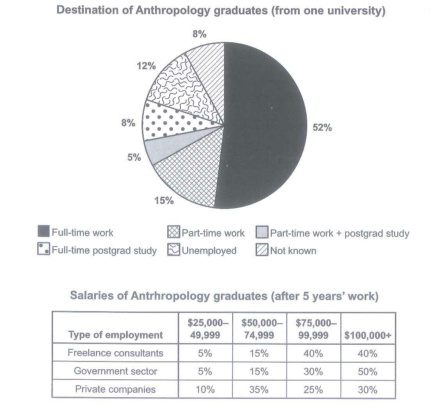
The chart below shows what Anthropology graduates from one university did after finishing their undergraduate degree course. The table shows the salaries of the anthropologists in work after five years.
Summarize the information by selecting and reporting the main features and make comparison where relevant.
Student answer (Band 6.0)
The pie chart illustrate what Anthropology graduates from one university did after their undergraduate course, and the table compares the salaries of the Anthropologist in work after five years.
Overall, more than half of Anthropology students got full-time work after finishing their undergradude, while students that went to part-time work and postgrad study has the least number. However, the private companies has the highest salaries earner of Anthropologist after five years' work,while freelance consultants was the lowest earner.
Firstly, 52% of Anthropology students went into full-time work after graduating, whereas only 5% of the graduates went into part-time work and postgrad stud. Futhermore, full-time postgraduate study and not known had the equal number of the graduates at 8% respectively, while 12% are unemployed.
Secondly, after five years' work, graduates working in a private compinies earn the highest salaries with 10% of them earning $25,000-49,999, 35% earns $50,000-74,99, while 25% and 30% of the graduates earn $ 75,000-99,999 and $100,000+. While 5% those in freelance consultants and government sector earn $25,000- $49,99.
AI examiner evaluation
| Criterion | Band |
|---|---|
| Task Achievement / Task Response | 5.5 |
| Coherence and Cohesion | 6.5 |
| Lexical Resource | 5.5 |
| Grammatical Range and Accuracy | 5.5 |
| Overall | 6.0 |
Task Achievement / Task Response: Band 5.5
You identify the main destination pattern accurately: full-time work is the largest category at 52%, and part-time work combined with postgraduate study is the smallest at 5%. You also report several salary figures for private-company employees correctly. However, the overview misreads the salary table: private companies are not the highest-paying sector overall, since 50% of government employees and 40% of freelance consultants earn $100,000 or more, compared with 30% in private companies. Calling freelance consultants the lowest earners is also unsupported. The salary discussion is incomplete: only the lowest salary band is mentioned for the other two sectors, and the higher bands are not compared. Covering the key salary contrasts accurately and more fully would strengthen the response.
Coherence and Cohesion: Band 6.5
The response has a clear overall arrangement, with an introduction, an overview, and separate paragraphs for graduate destinations and salaries. Sequencing phrases such as “Firstly” and “Secondly,” together with “whereas” and “while,” help the reader follow the comparisons. This organisation is effective, and the main topics are easy to identify. However, the salary paragraph stops after giving the lowest-band figures for freelance consultants and government employees, so the comparison is left unfinished. The overview also makes a broad salary claim that is not supported by the table, weakening the progression from overview to detail. To develop the response further, group salary bands or sectors systematically and use linking language to make the contrasts explicit.
Lexical Resource: Band 5.5
You use relevant task vocabulary, including “full-time work,” “postgraduate study,” “graduates,” and “salaries,” and the meaning is generally understandable. There are also attempts at more specific phrasing, such as “went into” work and “earning” particular salary ranges. However, several spelling and word-choice errors reduce precision: “undergradude,” “Futhermore,” “compinies,” and “postgrad stud” are noticeable, while “highest salaries earner” and “lowest earner” are awkward or inaccurate collocations. Repetition of “graduates” and “earn” also limits flexibility. Aim for accurate, natural expressions such as “entered full-time employment,” “the highest salary band,” and “employees in the government sector,” and check spelling and salary-range formatting carefully.
Grammatical Range and Accuracy: Band 5.5
You attempt a mix of simple and complex sentences, including comparisons with “whereas” and clauses introduced by “while,” so the response is not limited to short statements. However, errors in agreement and verb forms occur in several places: “The pie chart illustrate,” “students … has,” “the private companies has,” and “35% earns” should use forms that agree with their subjects. The sentence beginning “While 5% those in freelance consultants…” is also incomplete and lacks a clear grammatical structure. Some sentences are long and joined with commas, which makes the salary information harder to follow. Practise checking subject–verb agreement and constructing complete comparison clauses; clearer sentence boundaries would improve accuracy and readability.
See this exact question answered at other band scores. The same prompt compared across bands.
Browse more IELTS Writing model answers or get your own writing scored by the same AI examiner.