Band 6.0 IELTS Writing Task 1 Model Answer
Overall Band Score: 6.0 · Cambridge IELTS 16 · 2026-11-05
IELTS Writing Task 1 question
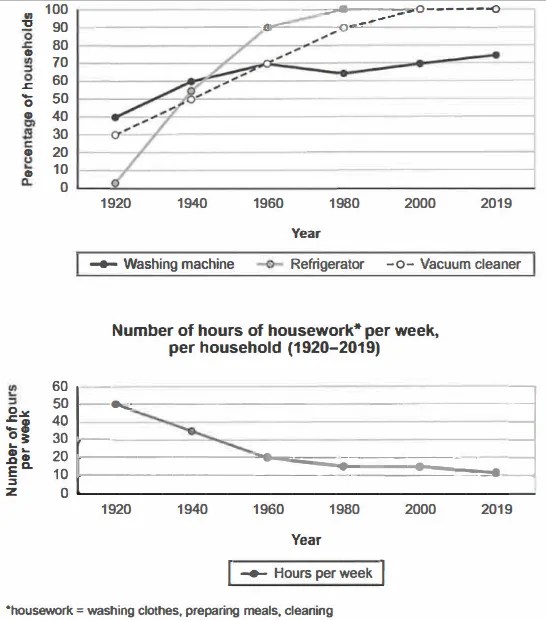
The charts below show the changes in ownership of electrical appliances and amount of time spent doing housework in households in one country between 1920 and 2019.
Summarise the information by selecting and reporting the main features, and make comparisons where relevant.
Percentage of households with electrical appliances (1920-2019)
Student answer (Band 6.0)
The charts below show the electrical appliances in households in one country in years 1920 to 2019 and the number of hours housework done per week per household.
Overall, Percentage of households using electrical appliances increased to its maximum. Refrigerators and vacuum cleaners were the most used appliances by the households. In contrast to that, housework hours per week, per household decreased.
Refrigerators started in 1920 from its lowest which was almost 0-2% but reached 90% in 1960 and then 100% in 1980 to 2019. In comparison to this, vacuum cleaner started at 30% in 1920 and in 1980 it reached to 90% while in [redacted phone] it became 100%. On the other hand, washing machine progressed slowly in 1920 it was 40% and till 2019 it only reached to 77%.
Despite this, the housework hours decreased till 2019. In 1920 it was 50 hrs per week which declined to almost 15 hrs per week.
At the end, it is clear that the use of electrical appliances increased over the time but this led to a decrease in housework hours. Less amount of time spent on housework.
AI examiner evaluation
| Criterion | Band |
|---|---|
| Task Achievement / Task Response | 6.5 |
| Coherence and Cohesion | 6.5 |
| Lexical Resource | 5.5 |
| Grammatical Range and Accuracy | 5.5 |
| Overall | 6.0 |
Task Achievement / Task Response: Band 6.5
You cover both charts and identify the main contrast: appliance ownership generally rose while weekly housework time fell. The overview also notes that refrigerators and vacuum cleaners became the most widely owned appliances. Several figures are accurately selected, including refrigerators at about 2% initially and 100% from 1980, and vacuum cleaners reaching 100% by 2000. This gives the response a clear factual basis. However, some important detail is underdeveloped: the washing-machine figure dips from 70% in 1960 to 65% in 1980 before rising, and housework falls in stages from 50 to 11 hours, rather than simply declining to about 15. The final claim that appliance use “led to” less housework also suggests causation that the charts do not establish.
Coherence and Cohesion: Band 6.5
The response has a recognisable structure: an introduction, an overview, a paragraph comparing appliance trends, and a final paragraph on housework. This makes the information generally easy to follow, and phrases such as “In comparison” and “On the other hand” help signal contrasts. The progression is not fully controlled, however. “Despite this” does not clearly connect the housework trend to the preceding appliance details, and the final two sentences repeat the overall message rather than adding a useful comparison. Grouping the appliance figures more systematically and then describing the housework trend with its key stages would create smoother progression. Some linking phrases feel mechanical, and the reference in “this led to a decrease” is unclear and overstates the relationship.
Lexical Resource: Band 5.5
You use relevant task vocabulary, including “electrical appliances,” “households,” “declined,” and “reached,” so the main trends are understandable. There is also some attempt to vary expressions, for example “In contrast” and “On the other hand.” However, the range is limited and several choices are awkward or imprecise: “the most used appliances” is less suitable than describing ownership, while “washing machine progressed slowly” does not naturally describe a percentage trend. “At the end” and “Less amount of time” are also unnatural in this context. Aim for precise trend language and natural collocations, such as “the proportion of households owning” an appliance and “housework hours fell steadily.”
Grammatical Range and Accuracy: Band 5.5
You attempt both simple and more complex sentence forms, including the contrast in “In contrast to that, housework hours per week … decreased” and the time clauses describing changes. The overall meaning is usually clear, but some grammatical errors remain. For example, “in years 1920 to 2019” needs an article or a different construction, and “Refrigerators started … from its lowest” has problems with number agreement and sentence structure. The fragment “Less amount of time spent on housework” is not a complete sentence. There are also inconsistent capitalisation and punctuation choices, such as capitalising “Percentage” mid-sentence and leaving extra spaces around commas. Check sentence completeness, articles, and singular/plural agreement when editing.
See this exact question answered at other band scores. The same prompt compared across bands.
Browse more IELTS Writing model answers or get your own writing scored by the same AI examiner.