Band 5.0 IELTS Writing Task 1 Model Answer
Overall Band Score: 5.0 · Cambridge IELTS 16 · 2026-11-05
IELTS Writing Task 1 question
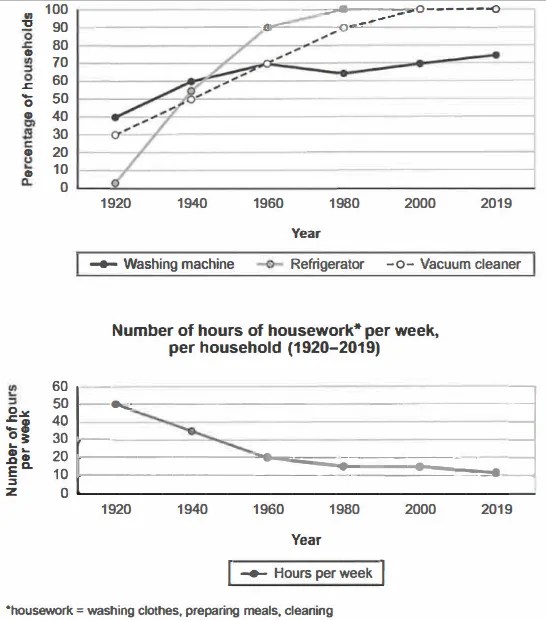
The charts below show the changes in ownership of electrical appliances and amount of time spent doing housework in households in one country between 1920 and 2019.
Summarise the information by selecting and reporting the main features, and make comparisons where relevant.
Percentage of households with electrical appliances (1920-2019)
Student answer (Band 5.0)
The Line graph illustrates that the changes in ownership of electrical appliances and period of time consumed doing housework and households in one country between 1920 and 2019. These includes washing machine, Refrigator and Vacuum cleaner and handwork.
Overall the graph illustrates that proportion of households the refrigrator have the peak point first in 1980s. Washing machine has less percentage during this time period while comparing with others. As technology advanced houseworks ratio decreased rapidly its just 10 number of hours per week in 2019.
From 1920 to 1980 Refrigrators are used more then in history before it peaked in 1980 while vacuum cleaners also not behind it also grows rapidly as increase in electronic appliances use the count of work per week reduced by a huge number from 50 hours per week to 10 hours in 2019.
Over the last from 2000 to 2019 it was stable to their peak points most of peoples used to these appliances instead of doing work by theirselves.
AI examiner evaluation
| Criterion | Band |
|---|---|
| Task Achievement / Task Response | 5.0 |
| Coherence and Cohesion | 5.0 |
| Lexical Resource | 5.0 |
| Grammatical Range and Accuracy | 5.0 |
| Overall | 5.0 |
Task Achievement / Task Response: Band 5.0
You identify the broad trends: appliance ownership generally rose, while weekly housework fell, and you include an overview. However, the overview is not fully accurate: refrigerators reached 100% in 1980 and remained there, rather than having a peak in the 1980s, and the washing-machine figure was not consistently lower than the others. Several comparisons are vague or incomplete, and the final paragraph does not clearly report the stable figures for 2000–2019. The housework total is about 11 hours in 2019, not 10. The response is also one word below the 150-word minimum; the 16 words copied from the prompt are excluded from the count. Develop the key comparisons with more precise data.
Coherence and Cohesion: Band 5.0
The response has separate paragraphs for an introduction, overview and details, so there is some organisation, and phrases such as “Overall” and “From 1920 to 1980” signal stages. However, the progression is difficult to follow because several ideas are combined without clear relationships. For example, the third paragraph moves from refrigerator ownership to vacuum cleaners and then to housework in one sentence. The final paragraph’s “Over the last from 2000 to 2019” is unclear, and “it” does not clearly identify which appliance or trend is being discussed. Organise the body by grouping appliance trends together and then describing housework, using clear references and comparisons.
Lexical Resource: Band 5.0
You use some relevant task vocabulary, including “ownership,” “proportion,” “appliances” and “per week,” which helps communicate the topic. However, the range is limited and several word-choice, collocation and spelling errors make parts of the report difficult to understand. Examples include “period of time consumed doing housework,” “handwork,” “peak point,” and “used more then in history before.” “Refrigrator” and “Refrigrators” are also misspelled, and “by theirselves” is not an appropriate form. Choose standard chart language and check spelling carefully; precise terms such as “household ownership,” “reached a plateau” and “hours spent on housework” would make the comparisons clearer.
Grammatical Range and Accuracy: Band 5.0
You attempt both simple and more complex sentences, including a time clause beginning “From 1920 to 1980” and a comparison introduced by “while.” However, complex structures are often faulty, and frequent errors affect clarity. For example, “These includes” has incorrect agreement, while “the proportion of households the refrigrator have” lacks a clear grammatical structure. The sentence beginning “From 1920 to 1980” also shifts between tenses and does not form a clear comparison. Articles and sentence boundaries need attention, as in “the graph illustrates that proportion.” Practise building accurate subject–verb–object sentences first, then add clauses with controlled tense and punctuation.
See this exact question answered at other band scores. The same prompt compared across bands.
Browse more IELTS Writing model answers or get your own writing scored by the same AI examiner.