Band 4.0 IELTS Writing Task 1 Model Answer
Overall Band Score: 4.0 · Cambridge IELTS 16 · 2026-11-06
IELTS Writing Task 1 question
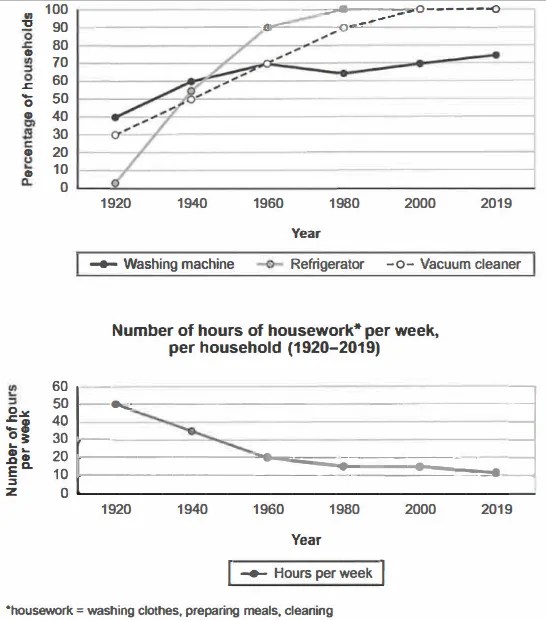
The charts below show the changes in ownership of electrical appliances and amount of time spent doing housework in households in one country between 1920 and 2019.
Summarise the information by selecting and reporting the main features, and make comparisons where relevant.
Percentage of households with electrical appliances (1920-2019)
Student answer (Band 4.0)
Overall, the percentage of households with electrical appliances ([redacted phone]). In 1920, the refrigerator was the highest figure in this figure, whereas in 2019, the vacuum cleaner was the lowest figure, in this graph. In [redacted phone] are remain stable in this figure, in 1980, are few increase and decrease in the figure.
AI examiner evaluation
| Criterion | Band |
|---|---|
| Task Achievement / Task Response | 2.5 |
| Coherence and Cohesion | 3.5 |
| Lexical Resource | 4.5 |
| Grammatical Range and Accuracy | 4.5 |
| Overall | 4.0 |
Task Achievement / Task Response: Band 2.5
The response makes a limited attempt to describe the charts, but it does not provide a clear, accurate overview of their main features. The claim that the refrigerator was the highest figure in 1920 is incorrect: washing machines were highest, at about 40%, while refrigerators were at about 2%. The statement that vacuum cleaners were lowest in 2019 is also incorrect; both refrigerators and vacuum cleaners reached 100%, while washing machines were around 75%. No meaningful account is given of the steady fall in housework time, from about 50 to 11 hours per week. The response is 44 words, well below the 150-word minimum, and is 106 words short; eight copied prompt words were excluded from the count. Report the main trends and support them with key comparisons.
Coherence and Cohesion: Band 3.5
There is a basic attempt to organise the response around an overall statement and comparisons between years, and the time references give the reader some sense of sequence. However, the ideas do not form a clear progression: the opening is a sentence fragment, and the later references to 2000–2019 and 1980 are not connected to specific appliance or housework trends. Repeated phrases such as “in this figure” and “in this graph” do not clarify how the points relate. Use a brief overview followed by logically grouped details—for example, appliance ownership in one section and housework hours in another—and use clear links such as “by contrast” or “meanwhile” only where they express a real relationship.
Lexical Resource: Band 4.5
The response uses relevant basic terms, including “percentage,” “households,” “refrigerator,” and “vacuum cleaner,” so the topic is identifiable. However, the vocabulary is repetitive and several expressions are imprecise or unnatural, particularly “the highest figure in this figure,” “the lowest figure,” and “few increase and decrease.” These choices make the comparisons difficult to interpret, especially when the data are also misreported. Use precise trend language and name the measure being compared, such as “ownership rose,” “remained stable,” or “housework hours declined.” A wider range of accurate chart vocabulary would help communicate the information more clearly.
Grammatical Range and Accuracy: Band 4.5
The response attempts to use a contrast clause with “whereas,” showing some ability to connect ideas, and the year references are generally understandable. However, sentence structures are limited, and several clauses are incomplete or have faulty verb forms. “Overall, the percentage of households with electrical appliances (1920-2019)” is a fragment rather than a complete overview sentence. “In 2000-2019 are remain stable” has an incorrect verb construction, while “in 1980, are few increase and decrease” lacks a clear subject and correctly formed verb phrase. Build complete sentences with an explicit subject and verb, for example, “Ownership remained stable between 2000 and 2019.” Check tense and agreement when describing changes over time.
See this exact question answered at other band scores. The same prompt compared across bands.
Browse more IELTS Writing model answers or get your own writing scored by the same AI examiner.