Band 6.5 IELTS Writing Task 1 Model Answer
Overall Band Score: 6.5 · Cambridge IELTS 16 · 2026-11-06
IELTS Writing Task 1 question
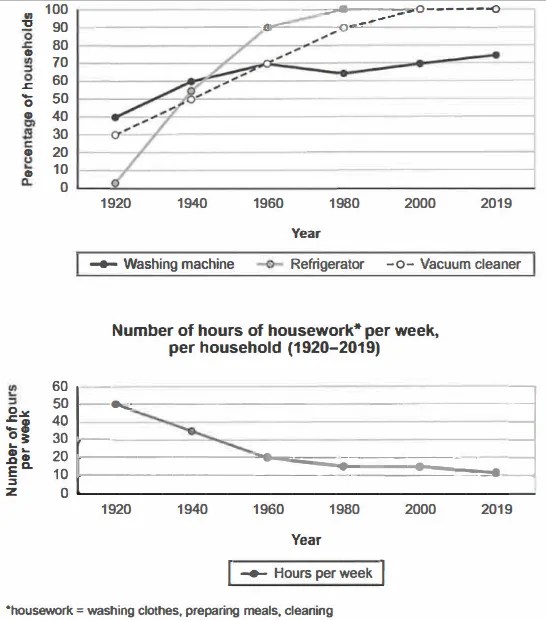
The charts below show the changes in ownership of electrical appliances and amount of time spent doing housework in households in one country between 1920 and 2019.
Summarise the information by selecting and reporting the main features, and make comparisons where relevant.
Percentage of households with electrical appliances (1920-2019)
Student answer (Band 6.5)
The line graphs illustrate the percentage of houses that contain some electrical appliances and the number of hours spent in housework per week in one country from 1920 to 2019.
Overall, the proportion of owening washing machines, refrigerators and vaccum cleaner increased significantly during the given period of time. While the number of housework descreased dramatically.
In 1920, the figure of households that have a refrigerator was 0%, this percentage rose dramatically and steadly to reach a peak of 100% by 1980 and maintained this value until 2019. the washing machine was present in 30% of house in 1920, this number increased to to reach 70% in 1960, before dropping to just over 60% by 1980 then it increased steadly to reach approximately 75% by 2019. The proportion of houses that have vacuum cleaner was 30% in 1920, then this value increased significantly to reach 100% by 2000 and remained unchanged until 2019.
The number of hours of houseworks decreased from 50 hours per week in 1920 to 10 hours per week by 2019.
AI examiner evaluation
| Criterion | Band |
|---|---|
| Task Achievement / Task Response | 6.5 |
| Coherence and Cohesion | 7.0 |
| Lexical Resource | 6.0 |
| Grammatical Range and Accuracy | 5.5 |
| Overall | 6.5 |
Task Achievement / Task Response: Band 6.5
You cover both charts and provide a clear overview: appliance ownership generally rose, while time spent on housework fell. Several key trends are reported accurately, including refrigerators reaching full ownership by 1980 and vacuum cleaners doing so by 2000. Some details, however, are inaccurate or incomplete. Refrigerators were at about 2% in 1920, not 0%, and washing-machine ownership began at 40%, not 30%. The housework figure fell to about 11 hours in 2019, rather than 10. The overview could also capture the important contrast that refrigerator and vacuum-cleaner ownership levelled off at 100%, while washing-machine ownership dipped around 1980 before recovering. This gives a relevant account of the main features, but not all comparisons are precise or equally developed.
Coherence and Cohesion: Band 7.0
The response is organised in a clear sequence: an introduction, a brief overview, and a detail paragraph covering the appliance trends and housework hours. This makes the information easy to follow, and linking phrases such as “before dropping” and “then” help show changes over time. The progression within the detail paragraph is generally logical, moving from refrigerators to washing machines, vacuum cleaners, and finally housework. However, the paragraph combines several series in a long block, and the transition to housework is abrupt. Consider separating the appliance comparisons from the housework trend, and use clearer links to compare the series directly. Overall, the organisation is effective, though cohesion could be more flexible and paragraphing more purposeful.
Lexical Resource: Band 6.0
You use a suitable range of trend vocabulary, including “rose dramatically,” “maintained,” “dropping,” and “remained unchanged,” which helps describe movement and stability. The meaning is generally clear, but some word choices and collocations are inaccurate or repetitive. For example, “the number of housework” is not a natural way to describe the measure, and “the figure of households that have a refrigerator” is less precise than a phrase such as “the proportion of households owning a refrigerator.” There are also spelling errors in “owening,” “vaccum,” “descreased,” and “steadly.” Aim for accurate spelling and vary the language used to describe increases, decreases, and ownership. The vocabulary is adequate for the task, but these inaccuracies limit precision.
Grammatical Range and Accuracy: Band 5.5
You attempt both simple and more complex sentence forms, including clauses with “before” and “while,” and the overall meaning remains understandable. However, some sentences contain errors in structure, tense, articles, or punctuation. For instance, “While the number of housework descreased dramatically” is a dependent clause presented as a sentence, and “the washing machine was present in 30% of house” has an incorrect article and plural form. In “this number increased to to reach 70%,” the repeated infinitive marker disrupts the sentence. Several sentences also join complete ideas with commas, as in the washing-machine description; use a full stop or a suitable conjunction. Greater control of these patterns, alongside more varied sentence structures, would improve accuracy.
See this exact question answered at other band scores. The same prompt compared across bands.
Browse more IELTS Writing model answers or get your own writing scored by the same AI examiner.