Band 5.5 IELTS Writing Task 1 Model Answer
Overall Band Score: 5.5 · Cambridge IELTS 16 · 2026-11-07
IELTS Writing Task 1 question
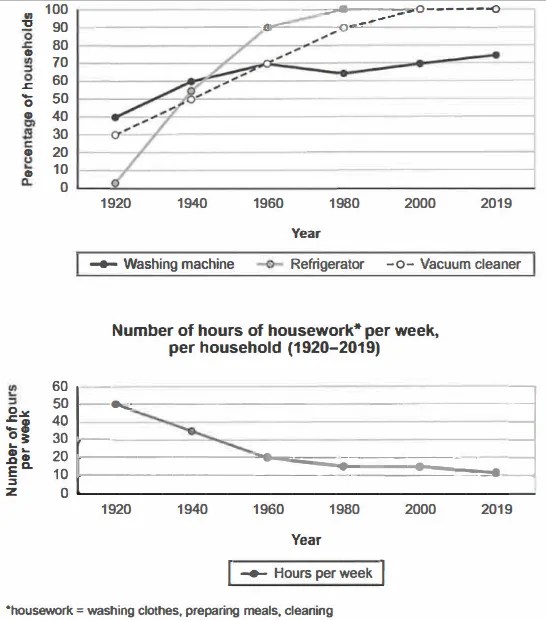
The charts below show the changes in ownership of electrical appliances and amount of time spent doing housework in households in one country between 1920 and 2019.
Summarise the information by selecting and reporting the main features, and make comparisons where relevant.
Percentage of households with electrical appliances (1920-2019)
Student answer (Band 5.5)
The chart repesents the variations of how many indiviuals have electronic machines and the amout of time spent by family members doing housework between 1920 and 2019.
Overview,it shows the proportion of households with electronic instruements and also it shows that the ratio of the washing machine was top of the list at first but then the other two appliances were seen higher then washing machine .The chart also gives us information about the working hours spent by family members and the hours decreasd steadily from 1920 to 2019.
The percentage of washing machines was top of the list .It started from 40 percent then a slight increase from 1920 to 1960 and reached at 60 percent.Then it fluctuated and reached at approximately 65 percent in 2019.The lowest percentage was of refrigerator .It started from 0 percent and we can see a noticeable increase from 0 percent to 100 percent surely.The middle one was vaccume cleaner .It started frpm 30 percent and hieghly increased to 100 percent as same as refrigerator in 2000.
The amount of time spent by family members decreased steadily from 50 hours in 1920 to 20 hours in 1980.Then remained constant for 30 years .Ater that a slight decrease from
AI examiner evaluation
| Criterion | Band |
|---|---|
| Task Achievement / Task Response | 5.5 |
| Coherence and Cohesion | 5.5 |
| Lexical Resource | 5.5 |
| Grammatical Range and Accuracy | 5.0 |
| Overall | 5.5 |
Task Achievement / Task Response: Band 5.5
You identify the two broad patterns: appliance ownership generally rose, while weekly housework time fell. You also include several figures, such as washing machines at 40% initially and vacuum cleaners reaching 100%. However, some key details are inaccurate or unclear. Washing-machine ownership rose to about 70% by 1960, dipped to 65% in 1980, and ended at 75%; your account gives 60% for 1960 and 65% for 2019. Refrigerators began at about 2%, not 0%, and reached 100% in 1980, rather than only describing a general rise. The overview’s claim that washing machines were initially highest is also incorrect, since they were above vacuum cleaners but not refrigerators later; clarify the comparison by year. The final sentence is unfinished, leaving the housework trend’s endpoint unreported.
Coherence and Cohesion: Band 5.5
The response has a recognisable structure: an introduction, an overview, a paragraph on appliances, and a final paragraph on housework. This gives the reader a basic route through the information. However, progression within paragraphs is sometimes difficult to follow, and the overview repeats information rather than clearly selecting the main comparisons. Phrases such as “top of the list,” “the middle one,” and “the other two appliances were seen higher” do not make the relationships between series and years precise. Linking is also limited, with repeated “then” and “and,” while the final paragraph stops mid-thought after “After that a slight decrease from.” Group the appliance trends in a clearer sequence and complete the housework comparison to make the report more cohesive.
Lexical Resource: Band 5.5
You use some relevant chart vocabulary, including “percentage,” “increased,” “decreased steadily,” and “remained constant,” so the main trends are generally understandable. However, the range is limited and several choices are imprecise or unnatural for describing data. “Electronic machines” and “electronic instruements” are less suitable than “electrical appliances,” while “the middle one” and “top of the list” are vague. There are also noticeable spelling errors, including “repesents,” “indiviuals,” “amout,” “vaccume,” and “hieghly,” which reduce clarity and control. Aim for accurate, consistent terms such as “households,” “ownership,” and “appliance penetration,” and use verbs like “rose,” “fell,” and “levelled off” to describe changes precisely.
Grammatical Range and Accuracy: Band 5.0
You attempt both simple and more extended sentences, and the overall meaning can usually be followed. However, grammatical control is uneven, with frequent errors in sentence formation, punctuation, and verb patterns. For example, “Overview,it shows” needs punctuation and a complete, well-formed clause; “reached at 60 percent” uses an incorrect verb pattern; and “Then remained constant for 30 years” lacks an explicit subject. The final fragment, “After that a slight decrease from,” is incomplete and leaves the sentence unfinished. There are also inconsistent sentence boundaries, such as the run-on construction in “It started from 40 percent then a slight increase.” Practise forming complete clauses and checking articles, prepositions, and punctuation before submitting.
See this exact question answered at other band scores. The same prompt compared across bands.
Browse more IELTS Writing model answers or get your own writing scored by the same AI examiner.