Band 6.5 IELTS Writing Task 1 Model Answer
Overall Band Score: 6.5 · Cambridge IELTS 16 · 2026-11-08
IELTS Writing Task 1 question
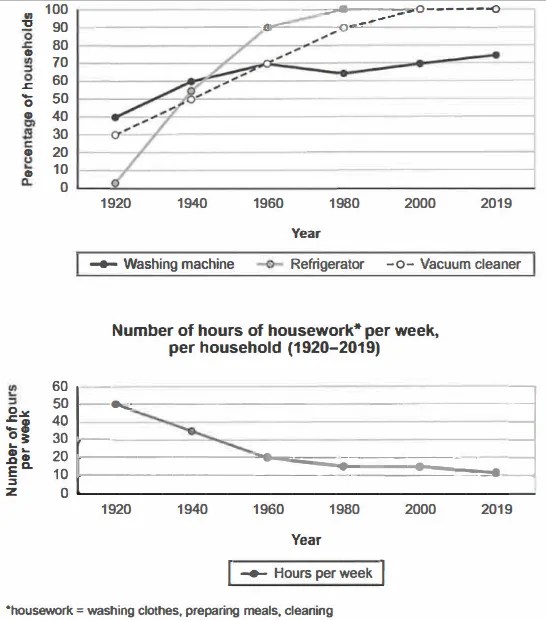
The charts below show the changes in ownership of electrical appliances and amount of time spent doing housework in households in one country between 1920 and 2019.
Summarise the information by selecting and reporting the main features, and make comparisons where relevant.
Percentage of households with electrical appliances (1920-2019)
Student answer (Band 6.5)
The charts compare trends of the ownership of household electrical appliances and the average time devoted to housework in a country from 1920 to 2019.
Overall, the percentage of households owning electrical appliances surged over the time with every household owning refrigerator and vacuum cleaner at the end. The average time spent on housework decreased significantly and became one-fifth of the time in 1920.
From 1920 to 1960, the trend for washing machine ownership increased from 40% to 70%. From this, it suffered a decline until 1980 after which it increased and became around 71% at the end of the period. The possession of refrigerator increased sharply from 0% in 1920 to 90% in 1960. In 1980, it increased to 100% and remained constant till the end. The trend for vacuum cleaner was a straight line starting from 30% in 1920 and becoming 100% in 2000 which remained till the end.
In 1920, average time devoted for housework were 50 hours per week which decreased and became 20% in 1960. From here, the trend also experienced downfall with only 10 hours per week in 2019.
AI examiner evaluation
| Criterion | Band |
|---|---|
| Task Achievement / Task Response | 6.5 |
| Coherence and Cohesion | 6.5 |
| Lexical Resource | 6.0 |
| Grammatical Range and Accuracy | 6.0 |
| Overall | 6.5 |
Task Achievement / Task Response: Band 6.5
You cover both charts and provide a clear overview of the main contrast: appliance ownership generally rose, while housework time fell. You also identify important endpoints, including refrigerators reaching full ownership by 1980 and vacuum cleaners by 2000. Most figures are accurately represented, though the refrigerator figure in 1920 is closer to 2% than 0%, and housework falls to 11 hours in 2019 rather than 10. The description of housework as becoming “one-fifth” of its initial level is a useful summary, but the body gives 20% in 1960 instead of 20 hours, which makes the unit unclear. To strengthen the response further, report the 1980–2000 plateau in housework and make the washing-machine dip and recovery more precise.
Coherence and Cohesion: Band 6.5
The response has a coherent overall arrangement: an introduction, a concise overview, and separate body paragraphs for appliance ownership and housework. The sequence within the appliance paragraph is generally easy to follow, and phrases such as “after which” and “remained constant” help show changes over time. However, some linking is mechanical or unclear. “From this” does not clearly identify the point from which washing-machine ownership declines, and “From here” is similarly vague in the final paragraph. The final paragraph also compresses the housework trend into two sentences, leaving the stable period from 1980 to 2000 unreported. Use clearer time references and connect the stages of each trend more explicitly.
Lexical Resource: Band 6.0
You use a reasonable range of task-related vocabulary, including “ownership,” “surged,” “decline,” “remained constant,” and “average time devoted to housework.” These choices communicate the broad trends, and the meaning is generally clear. Some expressions are not natural or precise in this context: “the trend for vacuum cleaner was a straight line” is an awkward way to describe rising ownership, while “experienced downfall” is an unsuitable collocation for a decrease in hours. “Became 20%” also confuses a percentage with a number of hours. Aim for precise chart language and natural collocations, such as “the proportion owning vacuum cleaners rose steadily” and “housework time fell to 20 hours per week.”
Grammatical Range and Accuracy: Band 6.0
You use a mix of simple and more complex sentence forms, including clauses with “after which” and “which remained,” and most sentences are understandable. Some grammatical errors remain. In “average time devoted for housework were 50 hours,” the singular subject requires “was,” and the preposition pattern should be “devoted to housework.” In “which remained till the end,” the reference of “which” is not fully clear; naming the figure or trend would improve the sentence. There are also occasional article and number-pattern issues, as in “ownership of household electrical appliances” where “the ownership” or “household ownership” would be more natural. Continue using complex structures, but check agreement and clause references carefully.
See this exact question answered at other band scores. The same prompt compared across bands.
Browse more IELTS Writing model answers or get your own writing scored by the same AI examiner.