Band 5.0 IELTS Writing Task 1 Model Answer
Overall Band Score: 5.0 · Cambridge IELTS 16 · 2026-11-08
IELTS Writing Task 1 question
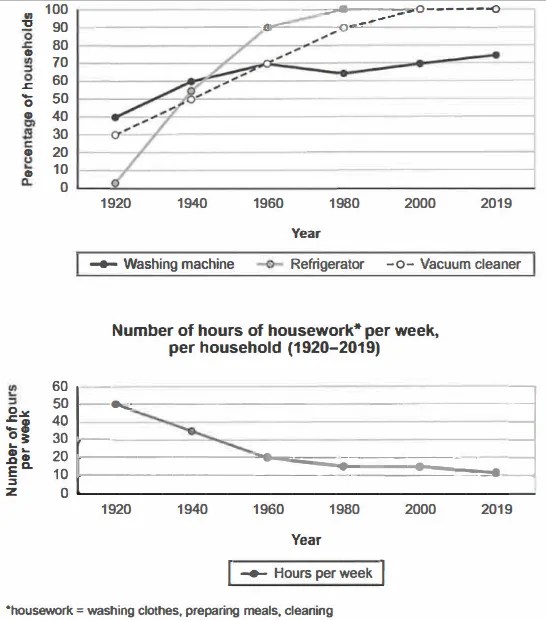
The charts below show the changes in ownership of electrical appliances and amount of time spent doing housework in households in one country between 1920 and 2019.
Summarise the information by selecting and reporting the main features, and make comparisons where relevant.
Percentage of households with electrical appliances (1920-2019)
Student answer (Band 5.0)
The chart illustrates the time spent in the housework in the household in the ownership of electrical appliances from 1920 to 2019.
In the chart shown about the electrical appliances, the use of the refrigerator in the 1920s was 0 %. And the washing machine is the highest use this year, and it was 40 %. and the use of the refrigerator and the vacuum cleaner has dominated the 100 percent use by the 2019s. The changes we see in the 1980s, the use of washing machines, have slightly fallen down from 70% to 64%.
In the seccond chart it was determined about the time of housework per week , In 1920s, It was a peaked point it's dominated for the 50 hours per week and by the 2019 it has repidly fallen down and it come to 10 hours per week.
So in the both case there is a difference.
AI examiner evaluation
| Criterion | Band |
|---|---|
| Task Achievement / Task Response | 5.0 |
| Coherence and Cohesion | 5.0 |
| Lexical Resource | 5.0 |
| Grammatical Range and Accuracy | 5.0 |
| Overall | 5.0 |
Task Achievement / Task Response: Band 5.0
You identify both charts and report several relevant overall changes, including the rise in refrigerator and vacuum-cleaner ownership and the fall in housework time. However, the response only partially summarises the main features: it gives little account of the appliances’ development across the full period and does not clearly compare the three series. Some details are inaccurate or unclear: refrigerator ownership was about 2%, rather than 0%, in 1920, and by 2019 it was the refrigerator and vacuum cleaner—not both at 100% use in a general sense, but each reaching 100%. The washing-machine figure fell from about 70% to 65% around 1980, then rose. A clearer overview and more accurate, selected comparisons would strengthen the report.
Coherence and Cohesion: Band 5.0
There is some organisation: the response begins with an introduction, discusses appliance ownership, then turns to housework time and ends with a brief comparison. This gives the reader a basic sense of the two topics. However, progression is limited, and the final sentence, “So in the both case there is a difference,” does not explain the relationship between the trends. Connections between details are often unclear, as in “And the washing machine is the highest use this year,” where the year is not specified. The repeated opening phrases “In the chart” and “In the…” also make the account feel mechanical. Use separate, purposeful paragraphs and link each chart’s key trend to supporting figures.
Lexical Resource: Band 5.0
The response uses some relevant task vocabulary, including “electrical appliances,” “refrigerator,” “vacuum cleaner,” “per week,” and “fallen,” so the topic is generally recognisable. However, the range is limited and several word choices or collocations make the meaning awkward, such as “the highest use,” “dominated the 100 percent use,” and “a peaked point.” There are also noticeable spelling errors, including “seccond” and “repidly,” which reduce accuracy. Aim for precise trend language and natural combinations, for example “ownership reached 100%” and “housework time declined.” Avoid repeating “use” when describing the proportion of households that owned an appliance.
Grammatical Range and Accuracy: Band 5.0
You attempt both simple statements and longer sentences, but the range is limited and errors occur frequently enough to make some relationships difficult to follow. For example, “The chart illustrates the time spent in the housework in the household in the ownership…” has an unclear grammatical structure, while “the use of the refrigerator and the vacuum cleaner has dominated” has problems with subject–verb agreement and sentence meaning. Capitalisation and punctuation are also inconsistent, as in “. and” and “In 1920s, It…”. Practise building clear sentences with a subject, verb and comparison, such as “Refrigerator ownership rose from about 2% in 1920 to 100% in 1980.” Check articles, agreement and sentence boundaries when editing.
See this exact question answered at other band scores. The same prompt compared across bands.
Browse more IELTS Writing model answers or get your own writing scored by the same AI examiner.