Band 4.0 IELTS Writing Task 1 Model Answer
Overall Band Score: 4.0 · Cambridge IELTS 16 · 2026-11-08
IELTS Writing Task 1 question
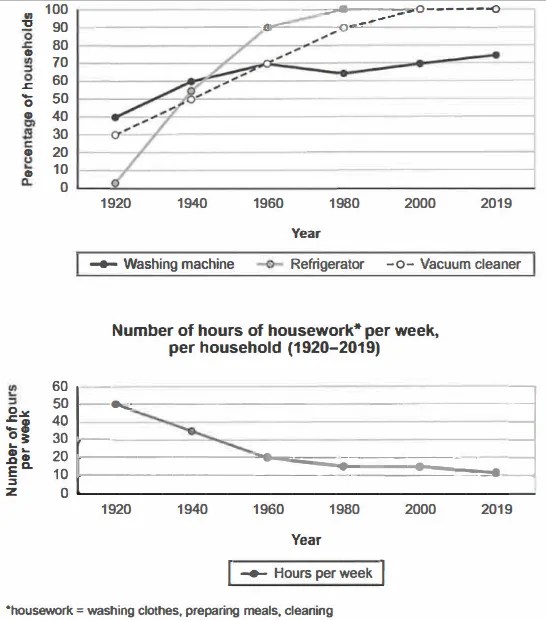
The charts below show the changes in ownership of electrical appliances and amount of time spent doing housework in households in one country between 1920 and 2019.
Summarise the information by selecting and reporting the main features, and make comparisons where relevant.
Percentage of households with electrical appliances (1920-2019)
Student answer (Band 4.0)
The line graph illustrate the ownership of electrical appliances and the quantity of spend time doing housework in households in one contry in the period of 1920 to 2019.
It can clearly seen the percentage of washing maching,refrigarator and vacume clearner there are many ups and downs in the mention period.the highest is vacuum cleaner and the lowest is washing machine in 2019.
In 1920 the percentage of house of refegarator was very low like nothing and from that its rapidly goese up to around 55% in 1940,and its gradualy going up and 1960 it reach to 90% and it the end it stop on 100% in 2000.In the other hand vacuum cleaner was the second use huosehold electrical appliance in 1920 it percentage was 30%,After that it
AI examiner evaluation
| Criterion | Band |
|---|---|
| Task Achievement / Task Response | 3.0 |
| Coherence and Cohesion | 4.0 |
| Lexical Resource | 5.0 |
| Grammatical Range and Accuracy | 4.5 |
| Overall | 4.0 |
Task Achievement / Task Response: Band 3.0
You identify the topic and mention several relevant trends, including the refrigerator’s rise from almost zero to 100% and the vacuum cleaner’s 30% starting point. However, the response addresses the task only partially: it ends mid-sentence (“After that it”), gives no account of the housework-hours series, and does not provide a complete comparison of the appliances. The overview is also inaccurate: washing machines were not the lowest-owned appliance in 2019, as both refrigerators and vacuum cleaners were at 100%. The response is 22 words below the required minimum, which further limits the detail reported. To improve, give a clear overview of the main trends, cover all four series, and support comparisons with selected figures.
Coherence and Cohesion: Band 4.0
There is a basic attempt to organise the response: an introduction is followed by a general statement and then a paragraph describing appliance trends. Some sequencing is clear in phrases such as “In 1920” and “from that,” so the reader can follow part of the refrigerator’s development. However, the progression is incomplete because the final sentence breaks off at “After that it,” and the housework data is not integrated at all. Linking expressions such as “In the other hand” are used inaccurately, and the overview does not lead into a complete, balanced account. Use separate, purposeful paragraphs for the overview and key details, and connect comparisons with accurate transitions such as “By contrast” or “Meanwhile.”
Lexical Resource: Band 5.0
You use some task-relevant vocabulary, including “percentage,” “ownership,” “electrical appliances,” and “rapidly,” which helps communicate the subject. However, the range is limited and several spelling and word-choice errors make parts difficult to read: “contry,” “washing maching,” “refrigarator,” and “vacume clearner.” Phrases such as “quantity of spend time” and “second use huosehold electrical appliance” are not natural ways to describe the chart. Aim for accurate, conventional expressions such as “time spent doing housework,” “household ownership of refrigerators,” and “the second most common appliance.” Proofreading spelling and choosing precise collocations would make your descriptions clearer and more appropriate for an academic report.
Grammatical Range and Accuracy: Band 4.5
You attempt both simple statements and longer sentences, but control is inconsistent. For example, “The line graph illustrate” has subject–verb disagreement, while “It can clearly seen” is missing the auxiliary “be.” The sentence beginning “In 1920 the percentage of house…” contains several clauses joined without clear grammatical control, and the final sentence is incomplete. Articles, verb forms, and sentence boundaries also need attention. These errors sometimes make the intended meaning difficult to follow, although the basic message about rising appliance ownership can still be understood. Practise writing complete sentences with a clear subject and verb, then check agreement and tense; for example, “Refrigerator ownership rose from about 2% in 1920 to 55% in 1940.”
See this exact question answered at other band scores. The same prompt compared across bands.
Browse more IELTS Writing model answers or get your own writing scored by the same AI examiner.