Band 6.0 IELTS Writing Task 1 Model Answer
Overall Band Score: 6.0 · Cambridge IELTS 16 · 2026-11-09
IELTS Writing Task 1 question
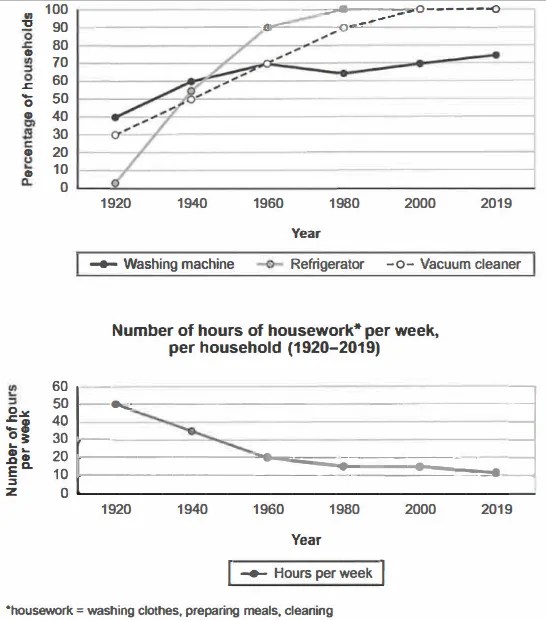
The charts below show the changes in ownership of electrical appliances and amount of time spent doing housework in households in one country between 1920 and 2019.
Summarise the information by selecting and reporting the main features, and make comparisons where relevant.
Percentage of households with electrical appliances (1920-2019)
Student answer (Band 6.0)
The two charts show the percentage of households that had a washing machine, a refrigerator and a vacuum cleaner in 2019 compared to 1920 and the number of hours of housework per household per week. The data is given every 20 years since 1920, only between 2000 and 2019 there are only 19 years.
Overall, what particularly strikes out is that the percentage of households with a washing machine, a refrigerator and a vacuum cleaner surged substantially, while the number of hours of housework in a week per household, decreased from 50% in 1920 to slightly over 10% in 2019.
The percentage of households with a refrigerator and vacuum cleaner is at 100% in 2019 (Slightly over 2% of the households had a refrigerator in 1920 and 30% had a vacuum cleaner in 1920), while the percentage of the washing machine is at appromately 73% in 2019 (73% in 2019 compared to 40% in 1920). Despite the high levels of electrical appliances in households in 2019 the number of hours of housework per week, decreased from 50% to slightly over 10%.
All in all, despite more households have elecrical appliances the hours of housework decreased.
AI examiner evaluation
| Criterion | Band |
|---|---|
| Task Achievement / Task Response | 6.0 |
| Coherence and Cohesion | 6.0 |
| Lexical Resource | 6.0 |
| Grammatical Range and Accuracy | 5.5 |
| Overall | 6.0 |
Task Achievement / Task Response: Band 6.0
You identify the main overall contrast: appliance ownership rose while weekly housework time fell, and you support this with several relevant figures, including refrigerator ownership rising from about 2% to 100% and washing-machine ownership from 40% to roughly 73%. However, the account is unevenly developed. The vacuum cleaner’s rise to full ownership and the refrigerator’s reaching 100% by 1980 are not described, and the washing-machine trend—including its dip around 1980—is omitted. The housework figure is also expressed as a percentage in places (“50%” and “slightly over 10%”), although it is measured in hours. A clearer overview and a few well-chosen intermediate comparisons would make the summary more complete and precise.
Coherence and Cohesion: Band 6.0
The response has a recognisable structure, moving from an introduction to an overview and then to supporting details, so the reader can follow its general direction. The final sentence, however, repeats the central point without adding information, and the third paragraph combines appliance figures with the housework trend in a way that makes comparisons less clear. Some linking is also mechanical, particularly “All in all” after an overview that has already stated the same conclusion. Organise the body into clearer comparisons—for example, one paragraph on appliance ownership and another on housework hours—and use references such as “this figure” only when their meaning is unmistakable.
Lexical Resource: Band 6.0
You use an adequate range for describing trends, including “surged substantially,” “decreased,” and “high levels,” and the meaning is generally clear. Some choices are inaccurate or unnatural: “what particularly strikes out” is not idiomatic, “the percentage of the washing machine” is imprecise, and “the data is given every 20 years” could be expressed more naturally. There are also spelling errors in “appromately” and “elecrical.” Use standard chart language such as “the proportion of households owning…” and “rose steadily,” while checking spelling and avoiding repeated general phrases. More precise vocabulary would help distinguish the different appliance trends.
Grammatical Range and Accuracy: Band 5.5
You attempt a mix of simple and complex sentences, and most of the message remains understandable. Some grammatical errors are noticeable, however. In “only between 2000 and 2019 there are only 19 years,” the clause structure and tense are awkward; “the number of hours … decreased” also needs a clearer sentence construction when joined to the preceding clause. The final sentence, “despite more households have electrical appliances,” uses an incorrect structure after “despite”; use a noun phrase or “although” with a full clause. There are also inconsistent article and number patterns, such as “the percentage of the washing machine.” Practise accurate contrast clauses and keep each sentence focused on one comparison.
See this exact question answered at other band scores. The same prompt compared across bands.
Browse more IELTS Writing model answers or get your own writing scored by the same AI examiner.