Band 6.5 IELTS Writing Task 1 Model Answer
Overall Band Score: 6.5 · Cambridge IELTS 16 · 2026-11-09
IELTS Writing Task 1 question
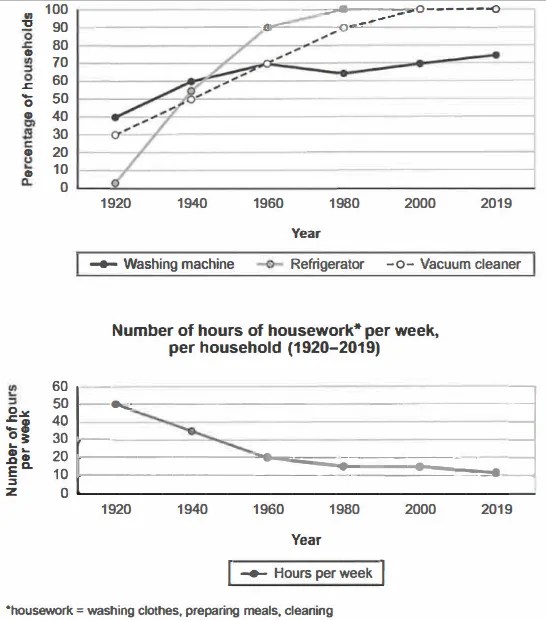
The charts below show the changes in ownership of electrical appliances and amount of time spent doing housework in households in one country between 1920 and 2019.
Summarise the information by selecting and reporting the main features, and make comparisons where relevant.
Percentage of households with electrical appliances (1920-2019)
Student answer (Band 6.5)
The line graphs illustrate the alters in ownership of electrical machineries and the number of hours spent doing housechores in households in one nation from 1920 to 2019.
Overall, households with electrical appliances recorded an upward trend throughout the period. In contrast, numbers of hours per week experienced dramatical fall.
Looking at the graph in more detail, refrigerator had the least popular households machinery in 1920, and then increased sharply at 90% in 1960, and again increase at 100 in 1980, then levelled off in 2019, while washing machine was the most popular item at 40% in 1920, 60% in 1960, subsequently, gradually decline approximately at 60% in 1980, and at the again increased noticeably at around 70, in 2019. Vacuum cleaner was the second-highest item used at 30% in 1920, then rose sharply at 100 in 2000, at the end, they remained stable in 2019.
Regarding number of hours of housework per week, this graph recorded the dramatically decline throughout the period. Starting from the highest percentage at 50 numbers in 1920, to decreased subsequently at 10 hours in 2019.
AI examiner evaluation
| Criterion | Band |
|---|---|
| Task Achievement / Task Response | 6.5 |
| Coherence and Cohesion | 7.0 |
| Lexical Resource | 6.0 |
| Grammatical Range and Accuracy | 5.5 |
| Overall | 6.5 |
Task Achievement / Task Response: Band 6.5
You cover both charts and identify their main contrast: appliance ownership generally rose while housework time fell. Several key trends are selected, including refrigerators reaching full ownership by 1980 and vacuum cleaners by 2000. The response also includes useful figures, but some details are inaccurate or unclear: refrigerators rose to about 90% in 1960, not simply “increased sharply at 90%,” and washing-machine ownership was about 70% in 1960, dipped to 65% in 1980, then reached 75% in 2019. The final housework figure is about 11 hours, so “10” is a reasonable approximation, but the intermediate decline is not reported. To strengthen the overview and detail, state the appliance exceptions and compare the full housework trend more precisely.
Coherence and Cohesion: Band 7.0
The response has a clear overall structure: an introduction, a brief overview, a paragraph on appliance ownership and a final paragraph on housework. This gives the reader a logical route through both charts, and sequencing phrases such as “in 1920,” “then” and “in 2019” help show change over time. The progression is generally clear, although the appliance paragraph packs several series and dates into long, loosely connected sentences. Phrases such as “and then,” “and again,” and “at the end” sometimes make the sequence feel mechanical, while “this graph” is an imprecise reference. Use shorter comparisons and clearer links between the series, and organise the housework figures as a complete trend rather than only its starting and ending points.
Lexical Resource: Band 6.0
You use a reasonable range of vocabulary for describing trends, including “increased sharply,” “levelled off,” “gradually decline” and “remained stable.” These attempts show awareness of the language needed for a chart summary, and the meaning is usually recoverable. However, several word choices or forms are inaccurate or unnatural: “alters” does not mean changes, “electrical machineries” is not the appropriate phrase, and “housechores” is better expressed as “housework.” “Dramatical fall” and “the most popular item” are also awkward in this context. Aim for precise, conventional collocations such as “ownership rose,” “household appliances,” and “a dramatic decline”; this will make the report sound more natural and exact.
Grammatical Range and Accuracy: Band 5.5
You attempt both simple and more extended sentence forms, and the overall meaning can generally be followed. However, some grammatical errors remain, particularly in verb forms, articles and sentence construction. For example, “refrigerator had the least popular households machinery” lacks a natural article and has an unclear noun phrase; “then increased sharply … and again increase” shifts incorrectly between past forms; and “to decreased subsequently” uses an incorrect verb form. The long sentence describing the appliances also joins several clauses without consistently controlled punctuation. Practise keeping the past tense consistent when reporting historical data, and check subject–verb agreement and clause structure. More accurate control of these patterns would make your varied sentences clearer.
See this exact question answered at other band scores. The same prompt compared across bands.
Browse more IELTS Writing model answers or get your own writing scored by the same AI examiner.