Band 5.5 IELTS Writing Task 1 Model Answer
Overall Band Score: 5.5 · Cambridge IELTS 16 · 2026-11-09
IELTS Writing Task 1 question
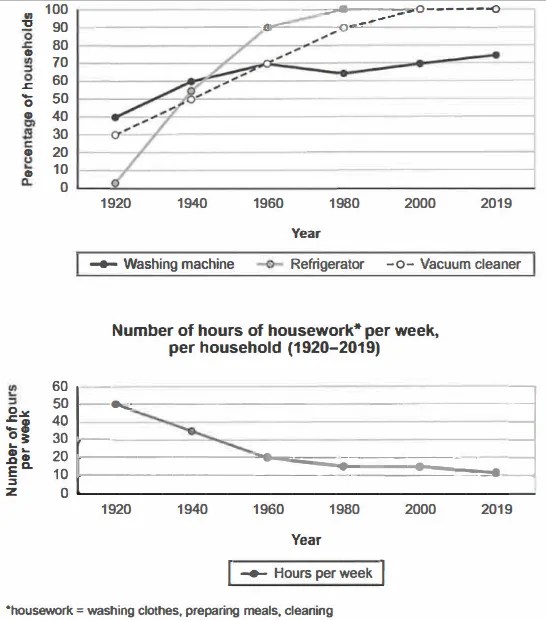
The charts below show the changes in ownership of electrical appliances and amount of time spent doing housework in households in one country between 1920 and 2019.
Summarise the information by selecting and reporting the main features, and make comparisons where relevant.
Percentage of households with electrical appliances (1920-2019)
Student answer (Band 5.5)
The line chart illustrate the percentage of households with electrical appliances as well as number of hours of housework per week , per household from the year 1920 to 2019.
In year 1920 no house has a refrigerator whereas ,vaccum cleanear and washing machine was present with the percentage of 30% and 40% respectively . similarly in year 2019 the percentage of household with electrical appliances surges as compare to 1920 with vacuum cleaner , refrigerator and washing machine upto 71%,and 99.9 % for both respectively .Overall from year 1940 to 2000 the percentage of both refigerator and vacuum cleanear increases while a fluctuating patteren is observed in the washing machine.
Similarly it is observed that from year 1920 the house work in terms of hours per week was highest upto 50 hours , which decreases with each passing year and reduce to 10 hours per week in year 2019.
AI examiner evaluation
| Criterion | Band |
|---|---|
| Task Achievement / Task Response | 5.5 |
| Coherence and Cohesion | 5.5 |
| Lexical Resource | 5.5 |
| Grammatical Range and Accuracy | 5.0 |
| Overall | 5.5 |
Task Achievement / Task Response: Band 5.5
You identify both charts and report the broad contrast: appliance ownership generally rose, while weekly housework fell from 50 hours to about 11. You also note the washing-machine fluctuation, which is a relevant feature. However, the response only partly selects and reports the main information. The overview is embedded in the middle rather than clearly stated, and some figures are inaccurate: refrigerator ownership was about 2% in 1920, not zero, and in 2019 washing machines were at about 75%, while refrigerators and vacuum cleaners were at 100%. The claim that both refrigerator and vacuum ownership increased from 1940 to 2000 also misses that refrigerator ownership had already reached 100% by 1980. Include key intermediate stages and compare the series more precisely.
Coherence and Cohesion: Band 5.5
The response has a basic sequence: it introduces the charts, discusses appliance ownership, and then turns to housework. This gives the reader a general sense of the information, and linking expressions such as “Overall” and “Similarly” show an attempt to connect ideas. However, the organisation is compressed into two long paragraphs, with the overview placed within the appliance details rather than clearly separated. Some transitions are not logical: “Similarly” does not accurately signal the contrast between appliance ownership and declining housework. Several ideas are joined by commas, making relationships between figures difficult to follow. Use a clear introduction, a concise overview, and separate detail paragraphs, grouping appliance trends together and then describing housework.
Lexical Resource: Band 5.5
You use some task-relevant vocabulary, including “percentage,” “households,” “fluctuating pattern,” and “decreases,” so the main trends are generally understandable. However, the range is limited and several word choices or collocations are inaccurate or awkward, such as “surges as compare to 1920,” “was present with the percentage,” and “house work in terms of hours.” Spelling errors, including “vaccum,” “cleanear,” “refigerator,” and “patteren,” are noticeable and reduce precision. Aim for standard chart language such as “the proportion of households owning,” “rose to,” and “declined steadily.” Check spelling carefully and avoid overly elaborate phrasing when a direct verb communicates the trend more clearly.
Grammatical Range and Accuracy: Band 5.0
You attempt both simple and more extended sentence forms, but control is inconsistent, which makes some sentences difficult to read. For example, “The line chart illustrate” has subject–verb disagreement, while “washing machine was present” does not agree with the plural subject. Articles and sentence construction are also problematic in “In year 1920 no house has a refrigerator,” and the long sentence beginning “Overall from year 1940…” contains several clauses joined without clear punctuation. Tense use shifts between present and past, including “has” and “was.” Use past tense consistently for the historical data, check singular and plural agreement, and divide long sentences into shorter, complete statements. More accurate control of these basic patterns is needed alongside attempts at complex structures.
See this exact question answered at other band scores. The same prompt compared across bands.
Browse more IELTS Writing model answers or get your own writing scored by the same AI examiner.