Band 5.5 IELTS Writing Task 1 Model Answer
Overall Band Score: 5.5 · Cambridge IELTS 16 · 2026-11-09
IELTS Writing Task 1 question
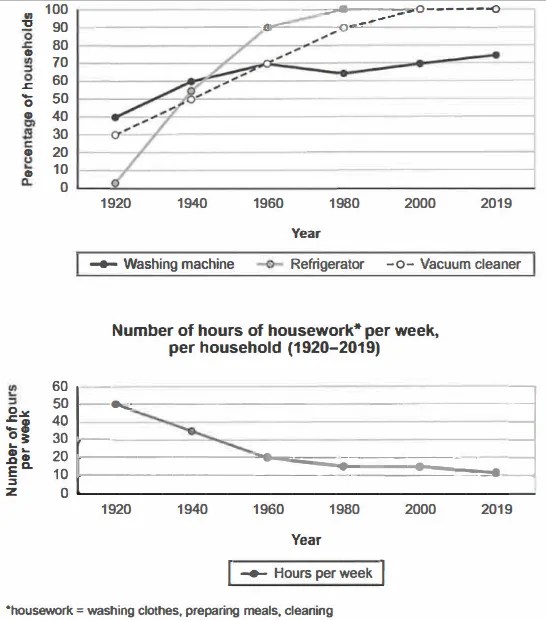
The charts below show the changes in ownership of electrical appliances and amount of time spent doing housework in households in one country between 1920 and 2019.
Summarise the information by selecting and reporting the main features, and make comparisons where relevant.
Percentage of households with electrical appliances (1920-2019)
Student answer (Band 5.5)
The pie chart illustrates the changes in the headship of electrical devices and amount of time utilized doing housework in households in one country between 1920 and 2019.
The percentages of all the appliances in the graph are in irregular manner from 1920 to 2019. The number of hours per week decreases gradually at starting in 1920 and continue to move downward till 1960 and then become constant.
Firstly, let's discuss about percentages of household with electrical appliances. Washing machine starts from approximately 40 in 1920. It goes on increasing till 70 in 1960 . After that, there is a slight decline and then become almost constant throughout. Refrigerator starts from 0 in 1920 then inclined sharply towards 1960, after this, a slightest rise and then remains same. Vacuum cleaner is initially at 30 in 1920 which goes on rising in continuous manner till 1980, from 1980 t0 2000, there is a minor rose up and then become straight.
Now, discuss about the number of hours of housework per week per household. The hours are at 50 in 1920 which declined gradually till 1960 and become approximately straight throughout the graph.
AI examiner evaluation
| Criterion | Band |
|---|---|
| Task Achievement / Task Response | 5.5 |
| Coherence and Cohesion | 6.0 |
| Lexical Resource | 5.5 |
| Grammatical Range and Accuracy | 5.5 |
| Overall | 5.5 |
Task Achievement / Task Response: Band 5.5
You identify the two broad patterns: appliance ownership generally rose, while housework time fell. You also include several relevant figures, such as washing machines at about 40% in 1920 and housework at 50 hours. However, the overview is unclear and partly inaccurate: appliance ownership was not simply “in irregular manner,” and housework did not remain constant after 1960, falling again to about 11 hours by 2019. Some key comparisons are missing, including refrigerators reaching 100% by 1980 and vacuum cleaners reaching full ownership by 2000. A few details are imprecise, such as the refrigerator starting at 0 rather than about 2%. A clearer overview and more accurate coverage of the main endpoints would make the summary more complete.
Coherence and Cohesion: Band 6.0
The response has a recognisable structure: an introduction, a brief overview, and separate paragraphs for appliances and housework. Sequencing words such as “Firstly” and “After that” help the reader follow the descriptions. However, progression is sometimes mechanical, and the overview does not clearly establish the main comparisons. The appliance paragraph lists each item in turn but does not consistently connect their trends or highlight how they differ. The final paragraph is very brief and leaves the housework trend incomplete. Some references, such as “then become straight throughout the graph,” are also unclear about which period is meant. Organise the overview around the major trends, then group details with clear time references.
Lexical Resource: Band 5.5
You use relevant topic vocabulary, including “percentages,” “appliances,” “decline,” and “gradually,” and the meaning is generally understandable. However, several word choices and collocations are inaccurate or unnatural, such as “headship of electrical devices,” “time utilized doing housework,” “inclined sharply,” and “a minor rose up.” “Pie chart” is also the wrong chart type; the task presents line graphs. Repetition of “starts,” “goes on,” and “become” limits the range, while phrases such as “straight throughout” are imprecise for describing a stable figure. Aim for standard trend language and accurate collocations, for example, “ownership,” “rose sharply,” and “remained stable.”
Grammatical Range and Accuracy: Band 5.5
You attempt both simple and longer sentences, and the reader can usually understand the intended trends. However, errors in verb forms, agreement, articles, and sentence construction recur. For example, “then become almost constant” needs a past-tense verb, while “which goes on rising” shifts tense within a past-period description. In “there is a slight decline and then become,” the verbs do not form a consistent grammatical structure. The opening phrase “the changes in the headship … and amount of time” also has faulty noun phrasing and article use. Punctuation is inconsistent, including spaces before full stops. Use past tense consistently for the historical data, check subject–verb agreement, and build complete parallel clauses when describing successive changes.
See this exact question answered at other band scores. The same prompt compared across bands.
Browse more IELTS Writing model answers or get your own writing scored by the same AI examiner.