Band 4.5 IELTS Writing Task 1 Model Answer
Overall Band Score: 4.5 · Cambridge IELTS 16 · 2026-11-10
IELTS Writing Task 1 question
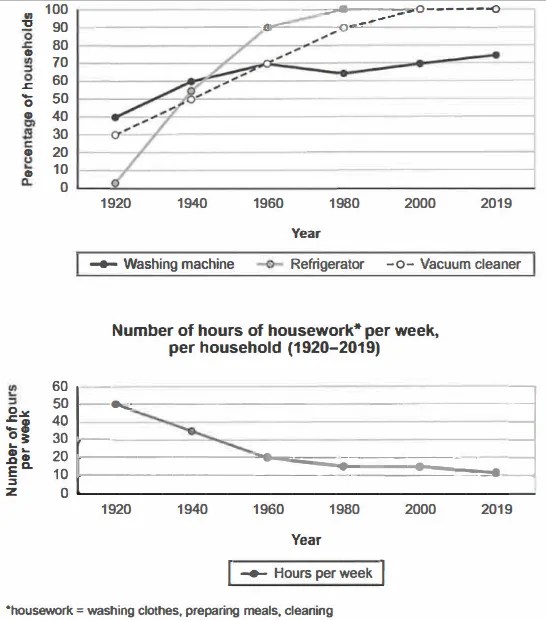
The charts below show the changes in ownership of electrical appliances and amount of time spent doing housework in households in one country between 1920 and 2019.
Summarise the information by selecting and reporting the main features, and make comparisons where relevant.
Percentage of households with electrical appliances (1920-2019)
Student answer (Band 4.5)
The given chart illustrate the contrast of using electric devices in house chores in a country with time spent in doing them with and without them in 1920 and 2019.
The most significant feature of first graph, use of refrigerator and vaccume was very common in both years. In 2nd graph highest time of people was spent in doing house chores.
Over all, both graph shows that 1920 most of the work was done without electric appliances thats why highest rate of spending time was in 1920 that is 50.
In 2019 most of the work is done by electric gadgets thats why minimum range in spwnd hour in 2019 is 10 hours per week.
This graph clears tahat electric appliances makes peopke
AI examiner evaluation
| Criterion | Band |
|---|---|
| Task Achievement / Task Response | 4.0 |
| Coherence and Cohesion | 4.5 |
| Lexical Resource | 4.5 |
| Grammatical Range and Accuracy | 4.5 |
| Overall | 4.5 |
Task Achievement / Task Response: Band 4.0
You identify the broad contrast that appliance ownership increased while housework time fell, and you correctly mention 50 hours in 1920 and about 10 hours in 2019. However, the response addresses the charts only minimally: it gives almost no appliance figures or comparisons, and the claim that refrigerators and vacuum cleaners were common in both years is inaccurate, especially for refrigerators, at about 2% in 1920. The overview is also unclear, and the final sentence is unfinished, so the effect of appliances is not explained. The response is 27 words below the required minimum, which further limits the detail available. To improve, give a clear overview and report key changes across the period, including the rise to full refrigerator and vacuum-cleaner ownership.
Coherence and Cohesion: Band 4.5
There is a basic attempt to organise the response: an opening sentence is followed by comments on the charts and a concluding generalisation. The contrast between appliance use and housework time provides a possible central thread. However, progression is difficult to follow because the overview is mixed with inaccurate or vague statements, such as “highest time of people was spent in doing house chores,” and the relationship between the two charts is asserted rather than clearly explained. “Over all” does not introduce a precise summary, and the final sentence stops abruptly. Use distinct paragraphs for the introduction, overview and key details, and connect comparisons explicitly so the reader can follow the trends.
Lexical Resource: Band 4.5
The response uses some relevant topic vocabulary, including “electric appliances,” “refrigerator,” “house chores” and “hours per week,” so the subject is generally recognisable. However, the range is basic and several word choices or collocations are awkward, including “contrast of using electric devices,” “spending time in doing them,” and “minimum range in spwnd hour.” Spelling errors such as “vaccume,” “tahat” and “peopke” also reduce clarity. The unfinished phrase “electric appliances makes peopke” leaves the intended point incomplete. Aim for accurate, conventional chart language such as “ownership,” “the proportion of households,” and “time spent on housework,” and check spelling before submitting.
Grammatical Range and Accuracy: Band 4.5
You attempt several complete sentences and use simple linking structures such as “thats why,” but grammatical control is inconsistent and the sentence patterns are limited. For example, “The given chart illustrate” has a subject–verb agreement error, while “both graph shows” also needs plural agreement. The opening sentence has an unclear structure, and “in doing them with and without them” makes the relationships between appliances and housework difficult to understand. Tense shifts between “was done” and “is done” are not well controlled, and the final sentence is incomplete. Practise accurate simple comparisons first, then add controlled complex sentences, checking agreement, articles and sentence completion.
See this exact question answered at other band scores. The same prompt compared across bands.
Browse more IELTS Writing model answers or get your own writing scored by the same AI examiner.