Band 5.0 IELTS Writing Task 1 Model Answer
Overall Band Score: 5.0 · Cambridge IELTS 16 · 2026-11-10
IELTS Writing Task 1 question
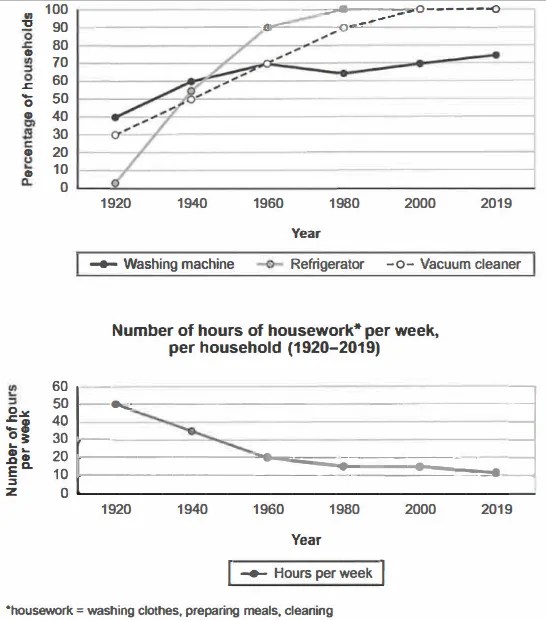
The charts below show the changes in ownership of electrical appliances and amount of time spent doing housework in households in one country between 1920 and 2019.
Summarise the information by selecting and reporting the main features, and make comparisons where relevant.
Percentage of households with electrical appliances (1920-2019)
Student answer (Band 5.0)
The charts below illustrate the changes in the percentage of households owning three different electrical appliances (washing machine ,refrigerator and vacuum cleaner) and the average number of house spend on housework per week between 1920 to 2019.
Overall, ownership of all three household appliance increased over the period. refrigerator and vacuum cleaner become universal in household, while washing machine experience some changes.
AI examiner evaluation
| Criterion | Band |
|---|---|
| Task Achievement / Task Response | 3.5 |
| Coherence and Cohesion | 5.5 |
| Lexical Resource | 5.5 |
| Grammatical Range and Accuracy | 5.5 |
| Overall | 5.0 |
Task Achievement / Task Response: Band 3.5
You identify the subject of both charts and give a relevant broad overview: appliance ownership generally rose, and refrigerators and vacuum cleaners eventually became universal. However, the response reports no specific figures or comparisons and omits the key housework trend, which fell from 50 hours to 11 hours per week. The statement that washing-machine ownership experienced “some changes” is too vague to describe its overall rise or its slight dip around 1980. Most importantly, the response is substantially below the required 150 words, leaving the task only minimally covered. To improve, add a concise overview of both charts, then select and compare the main figures across the period rather than relying on general statements.
Coherence and Cohesion: Band 5.5
The response has a basic, sensible order: an opening sentence introduces the charts, followed by an overview. This gives the reader a clear starting point, and the ideas remain relevant to the task. However, there is no detailed body paragraph or progression through the data, so the comparison is not developed. The overview also places several claims together without showing how the trends relate. Use separate paragraphs for the appliance figures and housework hours, and connect selected years with clear sequencing language such as “by 1960” and “in contrast.” This would build on the simple organisation already present and make the information easier to follow.
Lexical Resource: Band 5.5
You use relevant task vocabulary, including “percentage,” “owning,” “appliances,” and “per week,” and the reader can understand the general topic. However, the range is narrow because the response is very short, and some word choices or forms are awkward: “house spend on housework” does not clearly express the number of hours, while “some changes” is too general to describe a trend. There is also inconsistent capitalization of “refrigerator.” Aim for precise trend language and accurate collocations, for example, “the average time households spent doing housework” and “ownership fluctuated slightly.” These choices would make the summary more natural and informative.
Grammatical Range and Accuracy: Band 5.5
The response uses two complete sentences and attempts a compound overview with “while,” showing some ability to connect ideas. Meaning is generally recoverable, but grammatical control is uneven. In the opening, “between 1920 to 2019” uses an incorrect preposition pattern; write “between 1920 and 2019” or “from 1920 to 2019.” In the overview, “ownership … increased” needs a plural subject (“ownership rates … increased”) or a singular verb with “ownership,” and “refrigerator and vacuum cleaner become” needs plural forms and past tense. Articles and plurals also need attention. Practise checking subject–verb agreement, tense consistency, and sentence patterns while adding a wider range of accurate structures.
See this exact question answered at other band scores. The same prompt compared across bands.
Browse more IELTS Writing model answers or get your own writing scored by the same AI examiner.