Band 5.5 IELTS Writing Task 1 Model Answer
Overall Band Score: 5.5 · Cambridge IELTS 16 · 2026-11-10
IELTS Writing Task 1 question
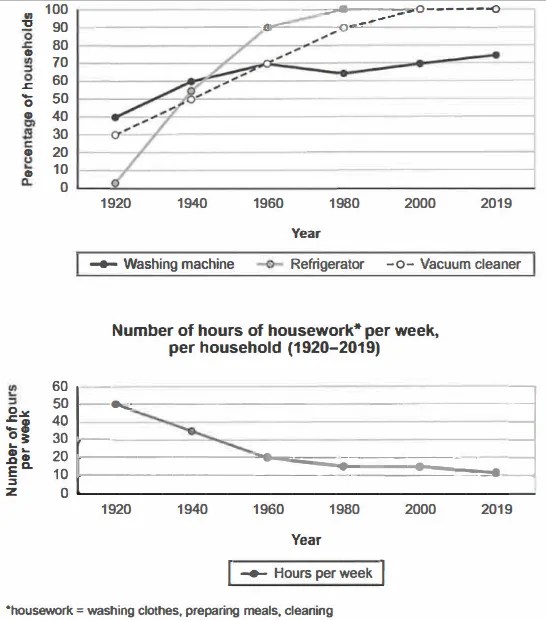
The charts below show the changes in ownership of electrical appliances and amount of time spent doing housework in households in one country between 1920 and 2019.
Summarise the information by selecting and reporting the main features, and make comparisons where relevant.
Percentage of households with electrical appliances (1920-2019)
Student answer (Band 5.5)
The given line charts illustrate the conversions of ownership of electrical devices and also about the spending of time of housework in households in a country between 1920 to 2019.
Overall, the following line graphs described about the change of ownership of electrical devices means there increased and decreased in usage as well as their spending of time on doing work of households.
Firstly,in the percentage of households with electric appliances durring 1920 to 2019. Refrigerator ownership started from 2% in 1920 and reached to 100% in 2019 which increased rapidly and the vacuum cleaner started from 30% and rose to 100% during 99 years. Further more, washing machine started from 40% and gradually increased to 75% till 2019.
Secondly, the spending of hours of housework per week per households is upto 50% in 1902 which decreased to 35% in 1940 and fallen to 20% in 1960, but in 0219 it become only 10% in which continuously fall were seen.
AI examiner evaluation
| Criterion | Band |
|---|---|
| Task Achievement / Task Response | 5.5 |
| Coherence and Cohesion | 6.0 |
| Lexical Resource | 5.0 |
| Grammatical Range and Accuracy | 5.0 |
| Overall | 5.5 |
Task Achievement / Task Response: Band 5.5
You identify the main broad patterns: appliance ownership generally rose, while time spent on housework fell. You also include several relevant figures, such as refrigerators rising from 2% to 100% and washing machines reaching 75%. However, the overview is unclear and does not accurately summarise the key contrasts: refrigerators reached full ownership by 1980, vacuum cleaners by 2000, while washing-machine ownership fluctuated and never reached 100%. The housework figures are also misreported: the chart begins at 50 hours in 1920, not 1902, and ends at about 11 hours in 2019, rather than 10% (the measure is hours, not a percentage). Develop the overview and compare the series more precisely to address the task more fully.
Coherence and Cohesion: Band 6.0
The response has a recognisable structure, with an introduction, an overview, and separate paragraphs for appliance ownership and housework. The sequence from appliances to housework is logical, and words such as “Firstly” and “Secondly” help signal the shift. However, the overview repeats the introduction without clearly stating the main trends, and some linking phrases are awkward or do not clarify relationships, as in “but in 0219 it become only 10% in which continuously fall were seen.” The appliance paragraph lists the three devices but gives little comparison between their different paths. Make the overview more informative, group related trends, and use transitions to show contrasts and stages rather than relying mainly on ordinal markers.
Lexical Resource: Band 5.0
You use some relevant task vocabulary, including “ownership,” “percentage,” “increased,” and “decreased,” so the reader can generally identify the topic and direction of change. However, the range is limited and several word choices or collocations are inaccurate, which sometimes makes the meaning unclear. For example, “conversions of ownership” does not describe the chart, and “spending of time of housework” is an unnatural way to refer to hours spent doing housework. “Reached to 100%” and “increased and decreased in usage” are also imprecise. Use standard trend language and the chart’s units consistently: describe ownership as a percentage and housework as hours per week. Check spelling and word forms such as “during” and “furthermore.”
Grammatical Range and Accuracy: Band 5.0
You attempt both simple statements and longer sentences, including a contrast with “but,” and the overall meaning is usually recoverable. However, the range of sentence structures is limited, and errors in verb forms, agreement, articles, and sentence construction occur often enough to make some statements difficult to follow. Examples include “there increased and decreased,” “the following line graphs described,” and “it become only 10%.” The opening sentence also uses an awkward construction, “between 1920 to 2019,” and punctuation is inconsistent, including missing spaces after commas. Practise forming accurate past-tense comparisons and use clear subject–verb patterns, for example, “Housework fell from 50 hours per week in 1920 to about 11 in 2019.”
See this exact question answered at other band scores. The same prompt compared across bands.
Browse more IELTS Writing model answers or get your own writing scored by the same AI examiner.