Band 6.0 IELTS Writing Task 1 Model Answer
Overall Band Score: 6.0 · Cambridge IELTS 16 · 2026-11-10
IELTS Writing Task 1 question
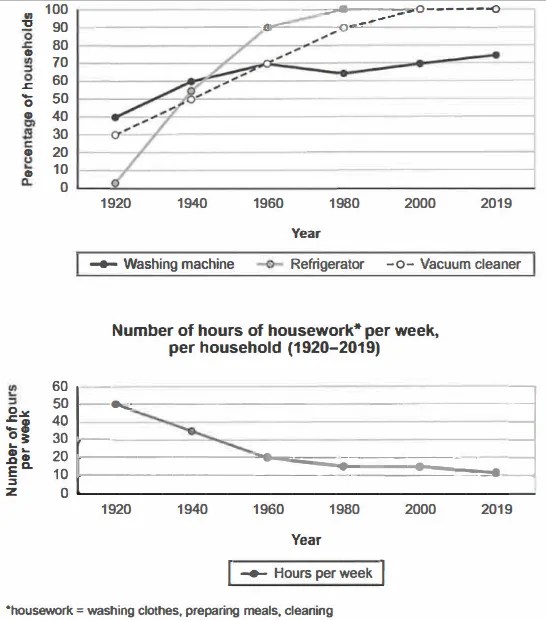
The charts below show the changes in ownership of electrical appliances and amount of time spent doing housework in households in one country between 1920 and 2019.
Summarise the information by selecting and reporting the main features, and make comparisons where relevant.
Percentage of households with electrical appliances (1920-2019)
Student answer (Band 6.0)
The former line chart gives comparison about the three distinct electrical appliances such as washing machine, refrigerator and vacuum cleaner, while the latter line chart illustrates the time spent doing house chores in one country from 1920 to 2019.
Overall, the three appliances observed a steady increased throughout the period. The vacuum cleaner and refrigrator have the most changes. While the number of hours doing housework declined consistently between 1920 and 2019.
Initially, washing machine started at the the top both of vacuum cleaner and refrigrator, just 40%, 30% and 0℅ respectively. in 1960, refrigerator surpassed washing machine and vacuum cleaner with a figure of 90%. While both appliances converged at 70%. Refrigerator and vacuum cleaner continued to rise until the end of the period, reaching a peak at 100%. Whereas washing machine increased steadily to over 70%
The number of hours doing housework decreased dramatically from 50% to 10%, from 1920 to 2019.
AI examiner evaluation
| Criterion | Band |
|---|---|
| Task Achievement / Task Response | 6.0 |
| Coherence and Cohesion | 6.5 |
| Lexical Resource | 6.0 |
| Grammatical Range and Accuracy | 5.5 |
| Overall | 6.0 |
Task Achievement / Task Response: Band 6.0
You identify the main overall pattern: appliance ownership generally rose, while time spent on housework fell. You also report several useful comparisons, including the refrigerator reaching 100% and the washing-machine figure being around 70% in 1960. However, some details are inaccurate or unclear: the refrigerator began at about 2%, not 0%, and in 1960 it was at 90%, above the other two appliances, which were both about 70%. The overview’s claim that all three appliances increased steadily overlooks the washing machine’s dip between 1960 and 1980. The housework figure is given as a percentage and as about 10 at the end, rather than hours and approximately 11. More precise reporting of these features would make the summary more complete.
Coherence and Cohesion: Band 6.5
The response has a clear overall structure: an introduction, an overview, and paragraphs describing appliance ownership and housework. The sequence from the initial figures to later trends is generally easy to follow, and contrast markers such as “while” and “whereas” help connect comparisons. This meets the lower-band expectation of a coherent arrangement and shows some flexibility in linking ideas. However, several links are awkward or incomplete: “While both appliances converged at 70%” is a fragment, and “Whereas washing machine increased steadily” is also not a complete sentence. The final paragraph is very brief and does not connect the housework trend to the appliance changes. Use complete sentences and develop the final comparison more fully.
Lexical Resource: Band 6.0
You use an adequate range of task-related vocabulary, including “surpassed,” “declined,” “converged,” and “reaching a peak,” which helps describe trends and comparisons. Some choices, however, are imprecise or unnatural: “gives comparison” and “the three appliances observed a steady increased” do not express the intended meaning idiomatically, while “house chores” is less suitable than “housework” in this context. There are also spelling errors in “refrigrator” and “initially” is followed by inconsistent capitalization. These errors do not prevent the reader from understanding the main message, but more accurate collocations and careful spelling would improve precision. Prefer standard chart language such as “compares,” “ownership rose,” and “the number of hours spent on housework.”
Grammatical Range and Accuracy: Band 5.5
You attempt a mix of sentence forms, including a complex opening with “while” and comparisons introduced by “whereas.” The main trends remain understandable, but some grammatical errors recur. For example, “the three appliances observed a steady increased” has an incorrect verb construction, and “washing machine started at the the top” contains a repeated article and an incomplete comparison pattern. The clauses beginning “While both appliances…” and “Whereas washing machine…” are fragments rather than complete sentences. There are also inconsistent sentence openings and capitalization, as in “in 1960.” Aim to make each comparison a complete sentence, check articles and verb forms, and use punctuation to separate independent clauses accurately.
See this exact question answered at other band scores. The same prompt compared across bands.
Browse more IELTS Writing model answers or get your own writing scored by the same AI examiner.