Band 5.5 IELTS Writing Task 1 Model Answer
Overall Band Score: 5.5 · Cambridge IELTS 16 · 2026-11-10
IELTS Writing Task 1 question
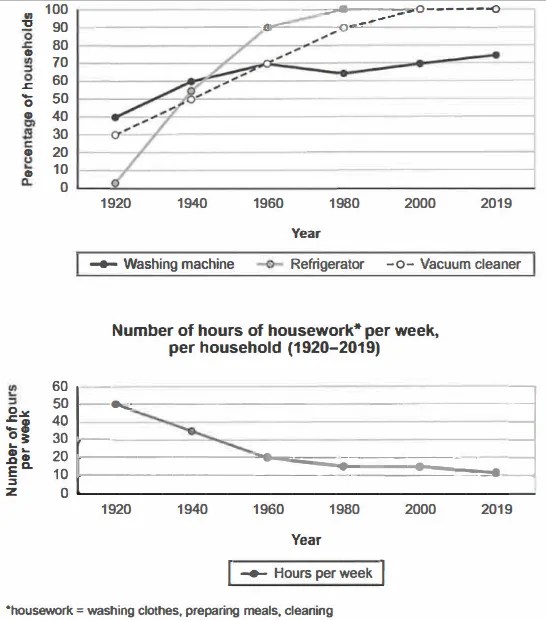
The charts below show the changes in ownership of electrical appliances and amount of time spent doing housework in households in one country between 1920 and 2019.
Summarise the information by selecting and reporting the main features, and make comparisons where relevant.
Percentage of households with electrical appliances (1920-2019)
Student answer (Band 5.5)
The first line graph illustrates the percentage of household in one country taht owned the electrical appliance and second graph depicts how much time spent on doing from the year 1920 to 2019 .
Overall , it is clear that the proportion of three appliances were show upward trend but the amount of time spent on houshold work represents downward trend .
To begin with , the percentage of washing machine was highest at 40 percent followed by vacuum cleaner and Refrigertor at 30 and 0 percent . The refrigerator significantly increased from 1920 to 1940 at almost 0 to 50 percent . However , the washing machine rose till 1960 it was 70 percent but it start declined . The proportion of vacum cleaner was suger from 1920 to 2000 with 20 percent each year and in 2000 to 2019 it was constant at 100 percent . Moreover , the refrigerator was climbed untill 1980 then it was unchange at 100 percent .
Nevertheless , the percentage of use appilance per week was at peak in 1920 at 50 percent then it start drop down untill 1980 with nearly 20 percent . From 1980 to 2000 it was steady at about 13 percent . But after 2000 it again start fell approximately from 13 percent to 10 percent
AI examiner evaluation
| Criterion | Band |
|---|---|
| Task Achievement / Task Response | 6.0 |
| Coherence and Cohesion | 6.5 |
| Lexical Resource | 5.0 |
| Grammatical Range and Accuracy | 5.0 |
| Overall | 5.5 |
Task Achievement / Task Response: Band 6.0
You cover both graphs and identify their main contrasting patterns: appliance ownership generally rises, while housework time falls. Several key figures are reported accurately, including washing-machine ownership at 40% initially and 70% in 1960, and refrigerators reaching 100% by 1980. However, some details are misread or unclear: the refrigerator starts at about 2%, not 0%; vacuum-cleaner ownership rises from 30% to 100%, rather than increasing by “20 percent each year”; and the washing-machine figure dips in 1980 before recovering. The housework figures are hours, not percentages, and the fall to 20 hours occurs by 1960, not 1980. A more precise overview and clearer comparisons would make the report more complete.
Coherence and Cohesion: Band 6.5
The response has a recognisable structure, with an introduction, an overview and separate discussion of the appliance and housework data. Sequencing is generally understandable, and transitions such as “To begin with,” “Moreover” and “Nevertheless” help signal movement between points. This gives the report a coherent overall arrangement. However, some links are mechanical or do not express the relationship accurately: “Nevertheless” introduces another graph rather than a contrast, while “However” is used for the washing-machine trend without clearly explaining the change. Several sentences combine multiple figures without a clear progression, particularly the appliance comparisons. Grouping the appliance trends more systematically and using transitions to show actual contrasts or time changes would improve cohesion.
Lexical Resource: Band 5.0
You use relevant task vocabulary such as “proportion,” “increased,” “declined” and “steady,” and you attempt to describe trends rather than simply list figures. However, the range and control are limited by repeated or inaccurate expressions. Phrases such as “the percentage of use appliance per week” and “the proportion of vacuum cleaner was suger” make the intended meaning difficult to follow; “suger” also appears to be a spelling error. There are further spelling problems in “taht,” “houshold,” “Refrigertor,” “vacum” and “appilance.” Use precise collocations such as “the share of households owning…” and “hours spent on housework,” and check spelling carefully. More accurate trend verbs would help distinguish rises, dips and plateaus.
Grammatical Range and Accuracy: Band 5.0
You attempt both simple and more complex sentences, including clauses beginning with “but,” “however” and “after 2000,” and the overall meaning is usually recoverable. Nevertheless, errors in sentence structure and verb forms occur often enough to make some statements awkward or unclear. For example, “the proportion of three appliances were show upward trend” has problems with agreement and verb construction, while “it start declined” and “it again start fell” use incorrect verb forms. Articles and noun forms are also inconsistent, as in “the electrical appliance” and “percentage of household.” Punctuation spacing is irregular, with spaces before commas and full stops. Practise accurate past-tense reporting and complete sentence patterns, while retaining your attempts at varied clauses.
See this exact question answered at other band scores. The same prompt compared across bands.
Browse more IELTS Writing model answers or get your own writing scored by the same AI examiner.