Band 6.0 IELTS Writing Task 1 Model Answer
Overall Band Score: 6.0 · Cambridge IELTS 16 · 2026-11-10
IELTS Writing Task 1 question
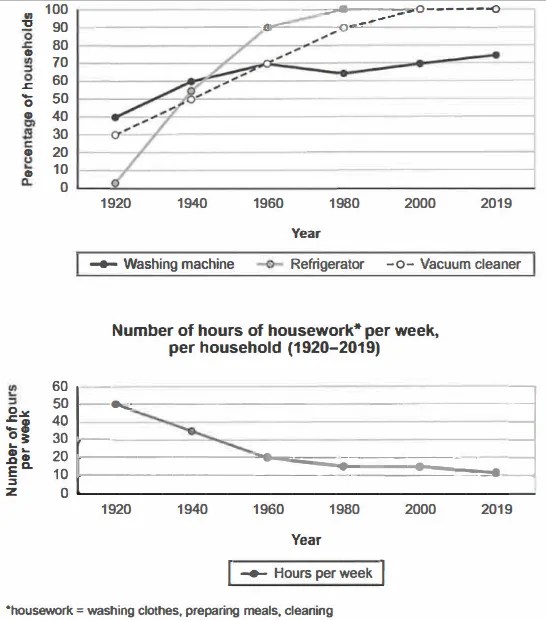
The charts below show the changes in ownership of electrical appliances and amount of time spent doing housework in households in one country between 1920 and 2019.
Summarise the information by selecting and reporting the main features, and make comparisons where relevant.
Percentage of households with electrical appliances (1920-2019)
Student answer (Band 6.0)
The line graphs illustrate the trends of owening multiple electrical appliances and the amount of time spent during household works per week over the time period of 1920 to 2019.
Overall refregrators and vacuum cleaners have been the most dominating items, but their usage per week fell down consistantly.
In 1920 refrigrators were introduced in market and reached 55% of the houses by the year 1940, these numbers kept growing and hit 90% in 1960. By the year 1980 every house has a refrigrator and this number remaines constant till 2019. In 1920 30% of houses have vacuum cleaners which went up to 50% in 1940 and this growth remained constant and arrived 100% in 2000 and remained still till 2019. However the washing machines wew standing at 40% in 1920 which kept fluctuating and ended up at 75% in 2019.
However the usage of house appliances per week was 50% in 1920 which dramatically fell to 20% by the year 1960 and declined gradually by time and ended up at 10% in 2019.
AI examiner evaluation
| Criterion | Band |
|---|---|
| Task Achievement / Task Response | 6.5 |
| Coherence and Cohesion | 6.0 |
| Lexical Resource | 6.0 |
| Grammatical Range and Accuracy | 5.5 |
| Overall | 6.0 |
Task Achievement / Task Response: Band 6.5
You cover both charts and provide a clear overview: appliance ownership generally rose, while time spent on housework declined. Several key figures are accurately selected, including refrigerators reaching 90% in 1960 and full ownership by 1980, and vacuum cleaners reaching 100% in 2000. This meets the task well, with some evidence of the broader comparisons expected at a stronger level. However, the overview says refrigerators and vacuum cleaners were the “most dominating items,” which is imprecise, and “their usage per week” confuses ownership with housework time. The washing-machine trend is described as fluctuating, but its small dip from 70% to 65% and subsequent recovery could be reported more precisely. Housework is measured in hours, not percentages, and ends at about 11 hours, rather than 10.
Coherence and Cohesion: Band 6.0
The response has a coherent overall arrangement: an introduction, an overview, a paragraph on appliance ownership, and a final paragraph on housework. The sequence through the years is generally easy to follow, and linking expressions such as “Overall,” “However,” and “By the year” help connect information. To make the progression clearer and less mechanical, group the appliance trends comparatively rather than describing each in a long sequence of year-by-year statements. The repeated “However” at the start of two paragraphs is not always an appropriate contrast, and the reference in “their usage per week” is unclear. More precise links between the two charts would strengthen cohesion.
Lexical Resource: Band 6.0
You use a reasonable range of task-related vocabulary, including “reached,” “hit,” “remained constant,” “fluctuating,” and “declined gradually.” These choices help communicate the main trends, although some less natural expressions and spelling errors reduce precision. For example, “ownening” and “refregrators” are misspelled, while “most dominating items” and “usage of house appliances” are awkward or unclear. “Household works” is not the natural term for the activity shown; use “housework.” Also, “introduced in market” suggests a historical launch, whereas the chart only shows household ownership. Aim for accurate collocations and distinguish appliance ownership from time spent doing housework.
Grammatical Range and Accuracy: Band 5.5
You attempt a mix of simple and complex sentences, including clauses linked with “which” and time phrases such as “By the year 1980.” The main meaning is generally understandable, but some grammatical errors recur. For example, “every house has a refrigerator” shifts into the present tense while describing past data; “this number remaines constant” has incorrect subject–verb agreement; and “30% of houses have vacuum cleaners” should use past tense. The sentence beginning “In 1920 refrigerators were introduced…” also needs clearer grammatical framing because the chart reports ownership, not when products entered the market. Check tense consistency, agreement, and sentence boundaries when combining several trends.
See this exact question answered at other band scores. The same prompt compared across bands.
Browse more IELTS Writing model answers or get your own writing scored by the same AI examiner.