Band 5.5 IELTS Writing Task 1 Model Answer
Overall Band Score: 5.5 · Cambridge IELTS 16 · 2026-11-11
IELTS Writing Task 1 question
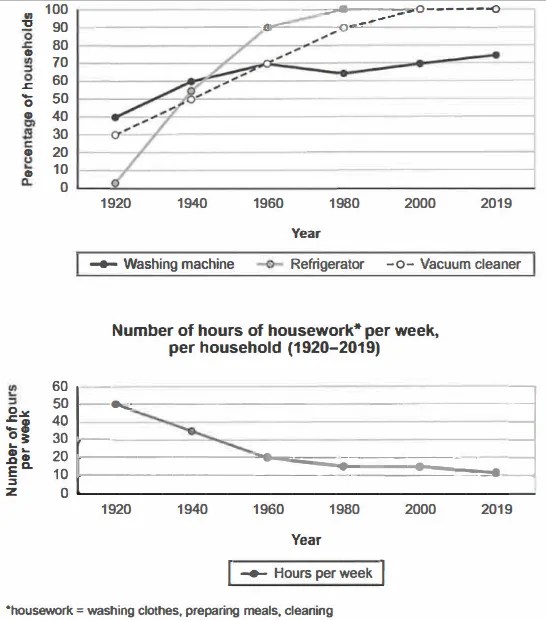
The charts below show the changes in ownership of electrical appliances and amount of time spent doing housework in households in one country between 1920 and 2019.
Summarise the information by selecting and reporting the main features, and make comparisons where relevant.
Percentage of households with electrical appliances (1920-2019)
Student answer (Band 5.5)
The first line graph compares the changes in percentage of electrical appliances in household in a country between 1920 qnd 2019. The second line graph illustrates the changes in number of hours of housework per week, per household.Overall, the percentage of use of household appliances show increase over the period and there is constant decrease in work hours per week from 1920 to 2019.
in 1920, washing machines and vaccum cleaner accounts for 40% and 30% while, the use of refregrators just start. In 1940 the use off all three appliences were approximatelly equal in use. In 1960 refregrator use exceeded from both and reaches at 90%. From 1960 onward the use of refregrator and vaccum cleaner shows constant increase and reached at 100% in 2000 and remained constant betweeen 2000 and 2019, whereas, percentage of washing machine reached at appeoximately 75% in 2019.
In 1920, number of work hours per week are 50 than grapg shows asignificant decline in work hours over the period and reached at 10 in 2019.
AI examiner evaluation
| Criterion | Band |
|---|---|
| Task Achievement / Task Response | 6.0 |
| Coherence and Cohesion | 6.0 |
| Lexical Resource | 5.5 |
| Grammatical Range and Accuracy | 5.0 |
| Overall | 5.5 |
Task Achievement / Task Response: Band 6.0
You identify the two charts and give a relevant overview: appliance ownership generally rises, while weekly housework time falls. Several key figures are reported accurately, including the 1920 washing-machine and vacuum-cleaner levels and the refrigerator reaching 90% in 1960. However, some comparisons are unclear or incomplete. Saying all three appliances were “approximately equal” in 1940 overlooks the refrigerator’s roughly 55% level compared with 60% for washing machines and 50% for vacuum cleaners. The account also misses the washing-machine dip around 1980 and the fact that housework time levels off at about 15 hours before falling again. The final figure is closer to 11 hours than 10. A more precise overview and fuller coverage of these changes would strengthen the report.
Coherence and Cohesion: Band 6.0
The response has a recognisable structure: an introduction, an overview, a paragraph on appliance ownership and a final paragraph on housework. This gives the reader a generally coherent route through the information, and contrasts such as “whereas” help connect trends. However, the progression within the appliance paragraph is not always clear: “From 1960 onward” groups the refrigerator and vacuum cleaner together, although their starting points and rates of change differ. Some linking is also awkward or mechanical, and the housework paragraph is very brief compared with the appliance discussion. Use clearer time-based sequencing and separate comparisons where needed; for example, describe the refrigerator and vacuum cleaner trends individually before comparing their eventual 100% levels. Ensure paragraph breaks and spacing are consistent.
Lexical Resource: Band 5.5
You use relevant task vocabulary, including “percentage,” “exceeded,” “decline,” and “remained constant,” so the main trends are usually understandable. There is also some attempt to vary expressions for change. However, spelling errors are frequent enough to weaken the presentation, including “vaccum,” “refregrators,” “appliences,” and “approximatelly.” Several phrases are imprecise or unnatural, such as “the percentage of use of household appliances” and “the use of refrigerator just start.” Choose standard collocations such as “the proportion of households owning…” and “refrigerator ownership began at…”. Avoid repeating “use” when the chart measures household ownership, and check spelling carefully. More precise vocabulary would make the comparisons clearer and more academic.
Grammatical Range and Accuracy: Band 5.0
You attempt both simple and more complex sentences, including a contrast with “whereas,” and the overall meaning can generally be followed. However, grammatical control is uneven, with errors in agreement, tense, articles and sentence construction. For example, “the percentage … show increase” needs a singular verb and an article, while “washing machines and vaccum cleaner accounts” has a plural subject but a singular verb. The phrase “In 1920, number of work hours per week are 50 than grapg shows…” is not a complete, well-formed comparison. Some sentences also run together, as in the transition from the introduction to “Overall.” Practise accurate past-tense reporting and build comparisons as complete clauses; this will let you use complex structures more reliably.
See this exact question answered at other band scores. The same prompt compared across bands.
Browse more IELTS Writing model answers or get your own writing scored by the same AI examiner.