Band 5.5 IELTS Writing Task 1 Model Answer
Overall Band Score: 5.5 · Cambridge IELTS 16 · 2026-11-11
IELTS Writing Task 1 question
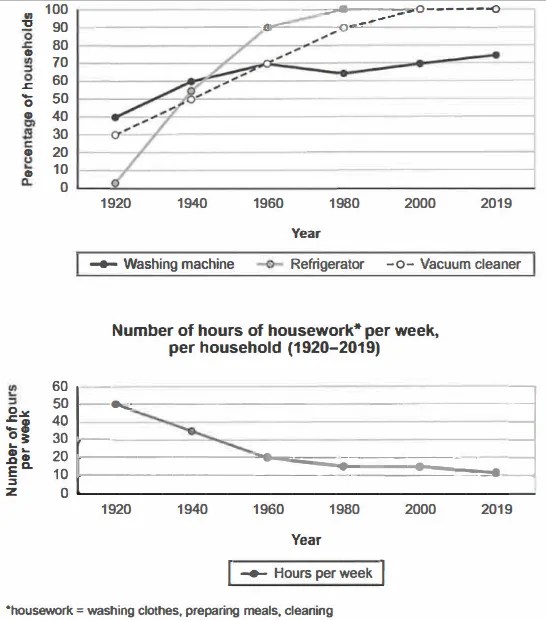
The charts below show the changes in ownership of electrical appliances and amount of time spent doing housework in households in one country between 1920 and 2019.
Summarise the information by selecting and reporting the main features, and make comparisons where relevant.
Percentage of households with electrical appliances (1920-2019)
Student answer (Band 5.5)
The vertical charts below illustrate the variation in possesion of electrical gadgets and the amount of time spent in houses doing house chores in a country from 1920 to 2019.
Overall, the washing machines have the highest percentage of households nearly 70%, and was lowest about 40% in 1920, the refrigrators have the highest ratio in 1980 approximately 100% and the lowest in 1920 about 0%; meanwhile, the vaccum cleaners have the highest percentage in 2019 which is 100%, and lowest in 1920 approx 30%. the number of working hours were at its peak in 1920 nearly 50 hours per week, the lowest in 2019 about 10 hours a week.
The percentage of husework of a washing machine is 40% in 1920, 60% in 1940, 70% in 1960, 65% in 1980, and 72% in 2019; meanwhile, the refrigrators have ratio about 0% in 1920, 55in 1940, 90% in 1960, and 100% from 1980 to 2019, the vaccum cleaners have the percentage about 30% in 1920, 50%, 70%, and 90% in 1940, 1960, and 1980 repectively and 1005 in 2000 and 2019. The number of working hours per in 1920 was 50 hours, 35 hours in 1940, 20 hours in 1960, 15 hours in 1980 and 2000, and was 10 hours in 2019.
AI examiner evaluation
| Criterion | Band |
|---|---|
| Task Achievement / Task Response | 6.0 |
| Coherence and Cohesion | 6.0 |
| Lexical Resource | 5.5 |
| Grammatical Range and Accuracy | 5.0 |
| Overall | 5.5 |
Task Achievement / Task Response: Band 6.0
You cover both charts and identify the broad relationship: appliance ownership generally rose while weekly housework declined. The overview also selects useful extremes, such as housework falling from about 50 hours to around 10 and refrigerators reaching full household ownership. However, some comparisons are unclear or inaccurate: washing machines did not have the highest ownership overall, and their peak was about 75% in 2019, not nearly 70% as the overview suggests. The final figure is also given as “1005” for vacuum cleaners, evidently a mistaken figure for 100%. Some key trends, including the refrigerator’s rapid rise and the washing machine’s temporary dip, are reported but not clearly synthesised. More precise, trend-focused comparisons would make the summary more complete.
Coherence and Cohesion: Band 6.0
The response has a recognisable structure: an introduction, an overview, and a paragraph giving figures. This makes the main purpose easy to follow, and linking words such as “Overall” and “meanwhile” help signal relationships. However, the overview lists separate highs and lows rather than presenting the charts’ main patterns together, and the final paragraph largely repeats the same series in sequence. Some links are mechanical or unclear, particularly the repeated use of “meanwhile” and the long sentence joining several appliance figures. Organise the details into clearer comparisons—for example, group the two appliances that reached 100% and contrast them with the washing machine’s fluctuation—so progression is more deliberate and repetition is reduced.
Lexical Resource: Band 5.5
You use a reasonable range of task-related vocabulary, including “percentage,” “ratio,” “peak,” and “approximately,” and the reader can generally understand the intended comparisons. However, several choices are inaccurate or unnatural for describing these charts: “vertical charts” is not the right term, “possession” is less suitable than “ownership,” and “percentage of housework of a washing machine” confuses appliance ownership with housework. Spelling errors such as “possesion,” “refrigrators,” “vaccum,” and “repectively” also reduce precision. The phrase “working hours” may suggest employment rather than time spent on chores. Use standard chart language consistently and check spelling, especially for repeated key terms, to make your descriptions more precise and natural.
Grammatical Range and Accuracy: Band 5.0
You attempt both simple and more extended sentence forms, and the overall meaning is usually recoverable. Some grammatical errors remain, particularly in agreement and sentence construction. For example, “the washing machines … and was lowest” shifts from a plural subject to a singular verb, while “the number of working hours were” has a singular subject with a plural verb. The sentence beginning “Overall” also joins several comparisons with inconsistent punctuation and capitalisation. In “100% from 1980 to 2019,” the time phrase is understandable, but the surrounding list needs clearer parallel structure. Practise matching verbs to their subjects and separating long lists into controlled sentences; this will improve accuracy without limiting your ability to use complex structures.
See this exact question answered at other band scores. The same prompt compared across bands.
Browse more IELTS Writing model answers or get your own writing scored by the same AI examiner.