Band 6.5 IELTS Writing Task 1 Model Answer
Overall Band Score: 6.5 · Cambridge IELTS 16 · 2026-11-11
IELTS Writing Task 1 question
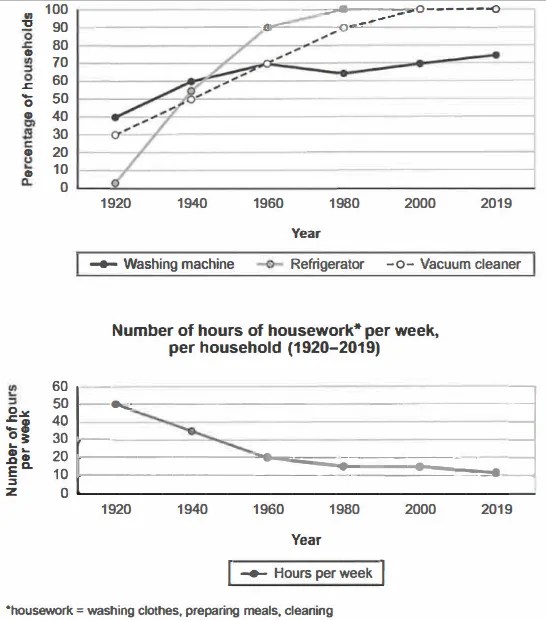
The charts below show the changes in ownership of electrical appliances and amount of time spent doing housework in households in one country between 1920 and 2019.
Summarise the information by selecting and reporting the main features, and make comparisons where relevant.
Percentage of households with electrical appliances (1920-2019)
Student answer (Band 6.5)
The line graphs compare the percentages of households that owned electrical appliances and average number of hours households spent doing housework in one country between 1920 and 2019.
Overall, refrigerator and vacuum cleaner increased considerable throughout the period, while washing machine remained relatively stable. In contrast, the number of hours households spent doing housework declined over the period, except in 1980 and 2000.
In 1920, washing machine accounted for approximately 40% of the appliances households owned, making it the highest, compared with vacuum cleaner, at 30%, whereas refrigerator represented about 2%. By 1940, washing machine climbed to 60%, while refrigerator increased to about 55%. Meanwhile, vacuum cleaner reached approximately 50%. Consequently, by 2019, refrigerator and vacuum cleaner reached the maximum, at 100%.
Regarding the number of hours spent, in 1920, households spent 50 hours, making it the highest. the figure continued declining, at approximately 15 hours, by 1980 and 2000. It fell slightly to about 12 hours by 2019.
AI examiner evaluation
| Criterion | Band |
|---|---|
| Task Achievement / Task Response | 6.5 |
| Coherence and Cohesion | 7.0 |
| Lexical Resource | 6.5 |
| Grammatical Range and Accuracy | 6.5 |
| Overall | 6.5 |
Task Achievement / Task Response: Band 6.5
You identify the main overall contrast: appliance ownership generally rose, while housework time fell, and you include several relevant figures, such as washing machines at about 40% in 1920 and refrigerators at roughly 2%. The response also notes that refrigerators and vacuum cleaners reached 100% by 2019. However, some key features are not fully reported: the washing-machine series dips from about 70% in 1960 to 65% in 1980 before rising, and the refrigerator reaches 100% by 1980, earlier than the vacuum cleaner. The overview’s claim that housework declined “except in 1980 and 2000” is inaccurate; the figure was stable at 15 hours in those years, not an exception to the downward trend. More precise coverage of these comparisons would make the summary more complete.
Coherence and Cohesion: Band 7.0
The response is organised into a clear introduction, overview and two detail paragraphs, and the sequence from the early figures to the later endpoint is easy to follow. Linking expressions such as “Overall,” “By 1940,” and “Regarding” help signal the stages of the report. This clear progression is a strength. Some connections between details could be more explicit, however: the appliance paragraph jumps from 1940 directly to 2019, leaving the important middle-period changes unreported, and “Consequently” does not express a clear cause-and-effect relationship between the 1940 figures and the 2019 outcome. The housework paragraph also ends without a fuller comparison across the period. Use transitions to show chronological development and contrast, rather than simply introducing the next point.
Lexical Resource: Band 6.5
You use a suitable range of task vocabulary, including “percentages,” “remained relatively stable,” “declined,” and “reached the maximum,” so the main trends are generally clear. There are also some imprecise or unnatural choices that limit precision. “Refrigerator and vacuum cleaner increased considerable” needs a more natural description of ownership, and “washing machine accounted for … the appliances households owned” is awkward because the figure represents the share of households owning the appliance. “Making it the highest” is also vague; specify that it had the highest ownership rate. Aim for accurate collocations such as “the proportion of households owning refrigerators rose” and “ownership peaked at 100%.” These refinements would make the vocabulary more flexible and precise.
Grammatical Range and Accuracy: Band 6.5
You use a mix of simple and more complex sentence forms, including comparisons with “while” and “whereas,” and most of the meaning remains clear. Some grammatical errors persist. In the overview, “refrigerator and vacuum cleaner increased” has a subject–verb agreement problem and an unclear subject; the appliances’ ownership rates increased. In “washing machine accounted for approximately 40%,” the singular count noun needs an article, and the sentence structure does not clearly identify what the percentage measures. The sentence beginning “the figure continued declining” also starts with a lowercase letter after a full stop. Check articles, agreement, and sentence boundaries, and make sure each sentence names the measured quantity clearly. More consistently accurate complex sentences would strengthen control.
See this exact question answered at other band scores. The same prompt compared across bands.
Browse more IELTS Writing model answers or get your own writing scored by the same AI examiner.