Band 6.0 IELTS Writing Task 1 Model Answer
Overall Band Score: 6.0 · Cambridge IELTS 16 · 2026-11-13
IELTS Writing Task 1 question
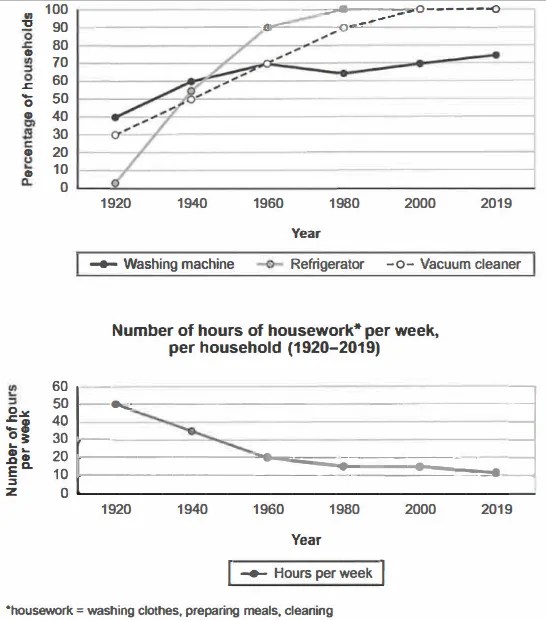
The charts below show the changes in ownership of electrical appliances and amount of time spent doing housework in households in one country between 1920 and 2019.
Summarise the information by selecting and reporting the main features, and make comparisons where relevant.
Percentage of households with electrical appliances (1920-2019)
Student answer (Band 6.0)
The two line graph compares the percentage of household that owned three electrical appliances ( Washing machine, Refrigerator and Vacuum cleaner ) and the average number of hours of household per week in a country between 1920 - 2019.
Overall, ownership of three appliances increased substantially over the period, with vacuum cleaner and refrigerator becoming almost universal by the end of the period. at the same time, the amount or time spent on housework decreased dramatically.
In 1920 around 40% household owned washing machine, while approximately 30% had a vacuum cleaner. In contrast, almost no home had a refrigerator. Refrigerator ownership rose rapidly , reaching about 90% by 1960 and 100% from 1980 onwards.
vacuum cleaner ownership also increased steadily from 30% in 1920 to 100% by 2000. Washing machine showed more gradual rise, climbing from 40% to around 72% in 1960 before a slightly dipping to 65% in 1980.
The second para graph shows a clear downward trend in the time spent by household work. In 1920 household spent about 50 hours per week in cooking, cleaning and washing cloths. this figure fell steadily from 50 to 35 hours in 1940 and 20hours by 1960, Further dropping to roughly 15 hours in 1980, it reached only 10 hour per week in both 2000 and 2019
AI examiner evaluation
| Criterion | Band |
|---|---|
| Task Achievement / Task Response | 6.5 |
| Coherence and Cohesion | 6.5 |
| Lexical Resource | 6.0 |
| Grammatical Range and Accuracy | 5.5 |
| Overall | 6.0 |
Task Achievement / Task Response: Band 6.5
You cover both charts and give a clear overview: appliance ownership generally rose, while housework time fell. Several key comparisons are accurately selected, including refrigerators reaching 100% from 1980 and vacuum cleaners reaching full ownership by 2000. The washing-machine account also notes its dip to 65% in 1980. However, some details are inaccurate: washing-machine ownership was about 70% in 1960, not 72%, and housework was about 11 hours in 2019 rather than 10; the text also says 10 hours in both 2000 and 2019, although 2000 was about 15. The main features are relevant, but the final figures and some comparisons need closer checking for a more complete, precise account.
Coherence and Cohesion: Band 6.5
The response has a sensible overall structure: an introduction, an overview, and separate discussion of appliance ownership and housework. The sequence within the appliance paragraph is easy to follow, and contrasts such as “In contrast” help distinguish refrigerator ownership from the other appliances. This clear organisation is a strength. However, progression is occasionally weakened by inconsistent paragraphing and sentence boundaries: “vacuum cleaner ownership” begins with a lowercase letter after a full stop, and “Further dropping” is attached to a long sentence in a way that makes the timeline less clear. Some linking is also mechanical, with repeated “from…to” patterns. Use consistent paragraph starts and connect each time point with clear, varied transitions.
Lexical Resource: Band 6.0
You use a suitable range of task vocabulary, including “ownership,” “increased substantially,” “rose rapidly,” “steadily,” and “downward trend.” These choices communicate the main movements and show some flexibility beyond basic description. However, several word-choice and collocation errors reduce precision: “average number of hours of household” and “time spent by household work” are unnatural, while “washing cloths” should refer to clothes. There are also spelling and form issues such as “para graph” and “dipping” in “before a slightly dipping.” Aim for accurate chart language and natural collocations, for example “hours spent on housework” and “households owned.” The vocabulary is adequate for the task, but these slips prevent consistently precise expression.
Grammatical Range and Accuracy: Band 5.5
You attempt both simple and more complex sentence forms, including a contrastive opening with “while” and the participial construction “Further dropping to roughly 15 hours…”. Most of the intended meaning remains understandable. Some grammatical errors nevertheless recur: “percentage of household” lacks plural agreement, “40% household owned” needs a plural noun, and “before a slightly dipping” has an incorrect structure. The final sentence also joins several time points with unclear punctuation, and sentence openings such as “at the same time” and “this figure” are not capitalised. These are some errors in agreement, articles, sentence construction, and punctuation. Check each sentence for a complete grammatical pattern and use full stops or commas to make the timeline relationships clear.
See this exact question answered at other band scores. The same prompt compared across bands.
Browse more IELTS Writing model answers or get your own writing scored by the same AI examiner.