Band 4.5 IELTS Writing Task 1 Model Answer
Overall Band Score: 4.5 · Cambridge IELTS 16 · 2026-11-13
IELTS Writing Task 1 question
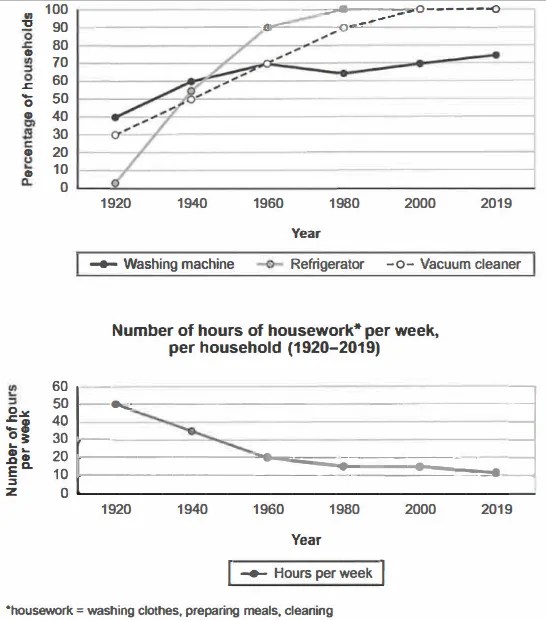
The charts below show the changes in ownership of electrical appliances and amount of time spent doing housework in households in one country between 1920 and 2019.
Summarise the information by selecting and reporting the main features, and make comparisons where relevant.
Percentage of households with electrical appliances (1920-2019)
Student answer (Band 4.5)
The line graph illustrates the change in percentage of household owning electrical appliances such as Washing machine, Refeigerator, Vacuum cleaner and hours spent doing housework between 1920 and 2019.
Overall, it can be easily seen that all four applicances has dramatic rise in usage, starting at the lowest point in 1920 anf being projected to reach the peak in 2019.
Washing machine and Refrigertor saw a slightly rise in households, respectively from 0 to about 100 in washing machine and around 40 to about 100 percent from 1920 to 2000. After that
AI examiner evaluation
| Criterion | Band |
|---|---|
| Task Achievement / Task Response | 3.0 |
| Coherence and Cohesion | 4.0 |
| Lexical Resource | 5.5 |
| Grammatical Range and Accuracy | 5.0 |
| Overall | 4.5 |
Task Achievement / Task Response: Band 3.0
You identify the chart’s general subject and attempt an overview, but the response covers only a small part of the information. The overview says all four appliances rose, which is inaccurate because housework hours fell, and the washing-machine figure is incorrectly described as rising from 0 to about 100; it actually increases from about 40% to 75%. The refrigerator starts at about 2%, not 40%, and reaches 100% by 1980. The vacuum-cleaner trend and the substantial decline in housework are not reported. The final sentence also stops at “After that,” leaving the comparison unfinished. The response is 92 words, below the required 150, so it cannot provide the necessary selection and development of key features. Include a complete overview and compare the main trends with accurate figures.
Coherence and Cohesion: Band 4.0
There is a basic attempt to organise the response: an introductory sentence is followed by an overview and then a detail paragraph. This gives the reader a starting structure, and phrases such as “Overall” and “After that” show an effort to connect ideas. However, progression is very limited because the response ends mid-sentence and does not develop the chart’s separate trends. The overview also groups housework with the appliances, although its trend is opposite, which makes the relationship between the information unclear. To improve, use a complete paragraph for the overview and organise details into logical comparisons—for example, appliance ownership in one paragraph and housework hours in another. Finish each sentence and use linking expressions only where they clarify the comparison.
Lexical Resource: Band 5.5
The response uses some relevant task vocabulary, including “percentage,” “households,” “appliances,” and “dramatic rise,” so the topic is generally recognisable. However, the range is narrow and several spelling errors reduce accuracy: “applicances,” “Refeigerator,” “Refrigertor,” and “anf.” Some expressions are also imprecise for describing the chart. “Usage” suggests how often appliances are used, whereas the graph shows household ownership; “projected” is unsuitable because the chart reports observed data through 2019. Aim for precise trend language and accurate spelling, such as “ownership increased,” “reached a peak,” and “remained stable.” A wider set of terms for declines and plateaus would also help you describe the housework series and the appliance trends more clearly.
Grammatical Range and Accuracy: Band 5.0
You attempt both a complex opening sentence and a separate overview, but grammatical control is inconsistent. In “all four applicances has dramatic rise,” the subject–verb agreement and noun phrase are faulty; a correct pattern would be “all three appliances rose.” The opening also needs a plural construction such as “households owning,” rather than “household owning.” The phrase “starting at the lowest point in 1920 and being projected to reach” is awkwardly constructed, and the final “After that” is an incomplete sentence. Most of the response relies on simple sentence patterns, with little variety to express comparisons. Practise accurate past-tense reporting and complete comparative sentences, checking agreement, articles, and sentence boundaries before finishing.
See this exact question answered at other band scores. The same prompt compared across bands.
Browse more IELTS Writing model answers or get your own writing scored by the same AI examiner.