Band 5.5 IELTS Writing Task 1 Model Answer
Overall Band Score: 5.5 · Cambridge IELTS 16 · 2026-11-13
IELTS Writing Task 1 question
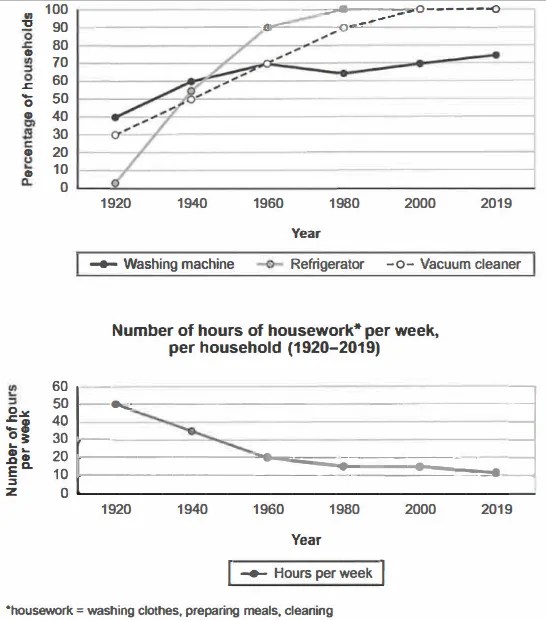
The charts below show the changes in ownership of electrical appliances and amount of time spent doing housework in households in one country between 1920 and 2019.
Summarise the information by selecting and reporting the main features, and make comparisons where relevant.
Percentage of households with electrical appliances (1920-2019)
Student answer (Band 5.5)
The line graph provides the information regarding the changes in ownership of electrical appliances, and the amount of time spent on doing housework in a country for period of 99 years from 1920 to 2019. In general there are few significant similarites between the electrical appliances and housework.
An anlysis of the chart indicates that the household with electrical appliances during the period in 1920 the use of washing was 0% than in 2000 it raised to above 95%.And the refrigerator and vaccum cleaner are above 20% in 1920 than both constantly reached above 60% in the year of 2019.
Further examination of the data shows that numbers of hours of housework per week per household.During the 1920 the average working hours per week recorded as 50 hours, people involved in works such as washingclothes,preparing meals, and cleaning.By the 2019 it declined to 10 hours per week as huge difference.
Overall, the pattern displays more differences than similarites in ownership of electrical appliances and time spent on housework in the period of 99 years.
AI examiner evaluation
| Criterion | Band |
|---|---|
| Task Achievement / Task Response | 5.0 |
| Coherence and Cohesion | 6.0 |
| Lexical Resource | 5.5 |
| Grammatical Range and Accuracy | 5.0 |
| Overall | 5.5 |
Task Achievement / Task Response: Band 5.0
You identify both subjects of the charts and report the broad fall in housework, including the correct starting figure of 50 hours and an approximate 2019 figure of 10. However, the overview is unclear: saying there are “significant similarities” is not a useful summary of the main trends, and the final claim that there are “more differences” does not explain them. Several appliance figures are inaccurate or too vague. Washing-machine ownership was about 40% in 1920, not 0%, and the refrigerator and vacuum cleaner were about 2% and 30%, respectively—not both above 20%. The response also misses key comparisons, such as refrigerators reaching 100% by 1980 and vacuum cleaners by 2000. Select the main trends accurately and support them with clearer comparisons.
Coherence and Cohesion: Band 6.0
The response has a recognisable overall arrangement: an introduction, discussion of appliance ownership, a paragraph on housework, and a concluding statement. This gives the reader a basic route through the information. However, progression within the paragraphs is sometimes unclear. For example, “An analysis of the chart indicates” is followed by several appliance claims that are not clearly separated or compared, while “Further examination” introduces the housework data without a smooth link to the earlier trends. The overview and conclusion also repeat the idea of similarities and differences without clarifying the main pattern. Use a concise overview after the introduction, then group related data logically and use precise links such as “by contrast” or “while” to show comparisons.
Lexical Resource: Band 5.5
You use some task-relevant vocabulary, including “ownership,” “declined,” “average,” and “per week,” and the reader can generally identify the topics being discussed. However, the range is limited and several choices are inaccurate or unnatural, which makes some statements difficult to interpret. For instance, “the use of washing was 0%” does not clearly describe ownership of washing machines, and “the household with electrical appliances” is an awkward way to refer to the proportion of households owning them. There are also spelling errors such as “similarites,” “anlysis,” and “vaccum,” alongside the joined form “washingclothes.” Aim for precise chart language such as “the proportion of households owning…” and check spelling and collocations carefully.
Grammatical Range and Accuracy: Band 5.0
You attempt some longer sentence forms, including “By the 2019 it declined to 10 hours per week as huge difference,” but control is inconsistent, and errors sometimes make relationships between ideas unclear. Examples include the incomplete construction “During the 1920 the average working hours per week recorded as 50 hours,” which needs a subject and an appropriate verb form, and “the household with electrical appliances during the period in 1920,” where the sentence structure is difficult to follow. Articles, prepositions, and punctuation are also unreliable, as in “for period of 99 years” and the missing spaces after full stops. Practise building accurate simple sentences first, then combine them with controlled clauses using “while” or “whereas.”
See this exact question answered at other band scores. The same prompt compared across bands.
Browse more IELTS Writing model answers or get your own writing scored by the same AI examiner.