Band 7.0 IELTS Writing Task 1 Model Answer
Overall Band Score: 7.0 · Cambridge IELTS 16 · 2026-11-14
IELTS Writing Task 1 question
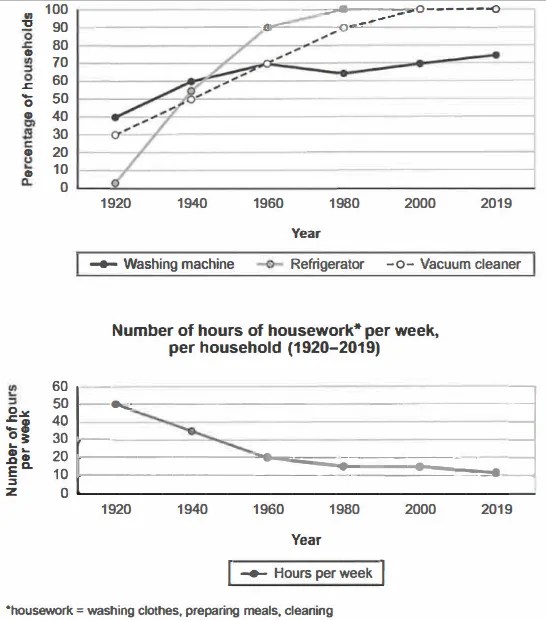
The charts below show the changes in ownership of electrical appliances and amount of time spent doing housework in households in one country between 1920 and 2019.
Summarise the information by selecting and reporting the main features, and make comparisons where relevant.
Percentage of households with electrical appliances (1920-2019)
Student answer (Band 7.0)
The first line graph illustrates how the ownership of three electrical appliances: washing machine refrigerator, vacuum cleaner varies in one particular country from 1920 to 2019, while the second graph demonstrates the number of hours of housework per household over the same period.
Overall, it can be seen that uses of all the electrical appliances showed a positive trend except washing machine which experienced a slight decline in 1980 before recovering again. In contrast time spent doing housework declined throughout the period.
Refrigerator experienced the highest growth compared with others. In 1920, no households used refrigerator which then sharply increased over the 20 years and reached to over 50%. This figure then started to rose untill 1980 and then remained stable untill the final year at 100%. The ownership of vacuum cleaner steadily increased, starting at about 30% and reached at 100% in 2000 which remained stable in this number untill 2019. Washing machine stood at 40% in 1920 which rose to 60% in the next 40 years before slightly declined to just over 50%. Then it rebounded again and finished its journey at around 65%.
In 1920, people spent more time in houseworks in a week, at about 50 hours. Then this number steadily decreased to around 30hours in 1940. Then, it continued its declining untill 1980 at approximately 15 hours which remained stable untill 2000 before again a slight decrease in 2019 at 10hours.
AI examiner evaluation
| Criterion | Band |
|---|---|
| Task Achievement / Task Response | 7.5 |
| Coherence and Cohesion | 7.0 |
| Lexical Resource | 6.5 |
| Grammatical Range and Accuracy | 6.0 |
| Overall | 7.0 |
Task Achievement / Task Response: Band 7.5
You cover both graphs and provide a clear overview: appliance ownership generally rose, while housework time fell. You also identify important patterns, including refrigerators reaching full ownership by 1980 and vacuum cleaners by 2000. Most figures are reported in line with the chart, but several details are inaccurate: refrigerators began at about 2%, not zero; washing-machine ownership dipped to about 65% in 1980, not just over 50%; and it ended at about 75%, rather than 65%. The housework figure was around 35 hours in 1940, not 30. Your account is otherwise relevant and supported with data. Greater precision in these comparisons, alongside a more exact overview of the appliance trends, would strengthen the response further.
Coherence and Cohesion: Band 7.0
The response is organised in a clear sequence: an introduction, an overview, a paragraph on appliance ownership, and a final paragraph on housework. This gives the reader a logical progression through both visuals. Linking expressions such as “Overall,” “In contrast,” and “Then” help show relationships between trends, and the appliance series are grouped sensibly. However, repeated use of “Then” makes some of the later reporting feel mechanical, and the long appliance paragraph would be easier to follow if comparisons between the three items were signposted more explicitly. Use a wider range of transitions and clearer references when moving between years and series to make the cohesion more flexible.
Lexical Resource: Band 6.5
You use a reasonable range of task-related vocabulary, including “ownership,” “positive trend,” “declined,” “rebounded,” and “remained stable.” These choices communicate the main movements and show some flexibility beyond basic description. However, several collocations and forms are inaccurate or awkward, such as “uses of all the electrical appliances,” “reached to over 50%,” and “started to rose.” Spelling errors in “untill” and “houseworks,” as well as inconsistent spacing in expressions such as “30hours,” also reduce precision. Aim for natural chart-description phrases and check word forms and spelling carefully. More accurate use of terms such as “proportion,” “levelled off,” and “fell” would help make the account more fluent and precise.
Grammatical Range and Accuracy: Band 6.0
You attempt a mix of simple and complex sentences, including a contrast in “Overall … except washing machine” and a relative clause in “which then sharply increased.” The meaning is generally clear, but some grammatical errors remain. Articles and plurals are missing in phrases such as “washing machine” and “refrigerator”; verb forms are incorrect in “started to rose” and “before slightly declined”; and the construction “reached at 100%” is not grammatically controlled. There are also punctuation and sentence-boundary issues, particularly in the opening list of appliances. Review article use, subject–verb patterns, and verb forms after “to” and “before.” More consistently accurate complex sentences would improve control.
See this exact question answered at other band scores. The same prompt compared across bands.
Browse more IELTS Writing model answers or get your own writing scored by the same AI examiner.