Band 5.0 IELTS Writing Task 1 Model Answer
Overall Band Score: 5.0 · Cambridge IELTS 16 · 2026-11-14
IELTS Writing Task 1 question
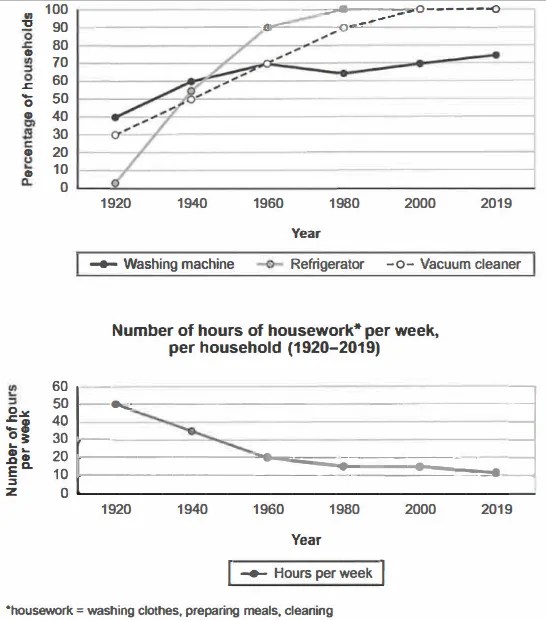
The charts below show the changes in ownership of electrical appliances and amount of time spent doing housework in households in one country between 1920 and 2019.
Summarise the information by selecting and reporting the main features, and make comparisons where relevant.
Percentage of households with electrical appliances (1920-2019)
Student answer (Band 5.0)
This first line graph illustrates the different electrical appliances used during housework while the second line graph gives the pourcentage of duration spent using them in house work during the period of 1920 to 2019 in one nation.
Overall, the use of vacuum cleaner and refrigerator kept increasing consistently during all the period studied while washing maching witnessed flactuations in their used time. However, we can observe that housework saw a dramatic decline between 1920 and 2019.
According to the first graph, the electrical appliance that kept increasing without flactuations are vacuum cleaner and refrigerator.Households in 1920 did not have refrigerators while 30% of them had a vacuum cleaner. the use of both machine kept increasing consistently until it reached its peak of 100%. Though, they both witnessed a ramained ownership from 2000 to 2019.While,
AI examiner evaluation
| Criterion | Band |
|---|---|
| Task Achievement / Task Response | 5.0 |
| Coherence and Cohesion | 4.5 |
| Lexical Resource | 5.5 |
| Grammatical Range and Accuracy | 5.0 |
| Overall | 5.0 |
Task Achievement / Task Response: Band 5.0
You identify the broad contrast that appliance ownership generally rose while weekly housework declined, and you include some relevant figures, such as 30% for vacuum cleaners in 1920 and ownership eventually reaching 100%. However, the response only partially covers the charts: it gives no figures for housework hours and omits the washing-machine trend, including its dip and later recovery. The description of the second graph as the “duration spent using” appliances also misrepresents what it measures. The response ends mid-sentence and contains 135 words, below the required 150, leaving key information undeveloped. To improve, give a complete overview and compare the main series with accurate figures from both graphs.
Coherence and Cohesion: Band 4.5
There is a basic structure: an introduction, an overview, and a paragraph beginning “According to the first graph.” The overview also attempts to group the appliance trends before giving details. However, progression is difficult to follow because the final paragraph stops at “While,” and the washing-machine information is never completed. Several links are awkward or incomplete, including “Though, they both witnessed a ramained ownership” and “While,” which leave relationships between ideas unclear. The response also repeats the claim that refrigerators and vacuum cleaners increased consistently. Use separate, complete paragraphs for the overview and the two chart descriptions, and connect comparisons with clear, accurate transitions.
Lexical Resource: Band 5.5
You use some task-relevant vocabulary, including “electrical appliances,” “fluctuations,” “dramatic decline,” and “peak,” showing an attempt to describe trends rather than simply list data. However, several word choices and spelling errors reduce precision: “pourcentage” and “flactuations” are misspelled, “used time” is unclear, and “ramained ownership” does not express the intended idea. “Duration spent using them” is also an inaccurate description of the housework-hours graph. Aim for precise collocations such as “the proportion of households owning” an appliance and “hours spent on housework.” Proofread spelling and choose vocabulary that accurately names what each graph measures.
Grammatical Range and Accuracy: Band 5.0
The response attempts some complex structures, for example, “Overall, the use of vacuum cleaner and refrigerator kept increasing … while washing maching witnessed…,” and the main trend is usually understandable. However, errors are frequent, and some sentence structures are incomplete or difficult to interpret. Examples include “the use of both machine kept increasing,” where the subject and verb do not agree, and “Households in 1920 did not have refrigerators while 30% of them had a vacuum cleaner,” which needs clearer article and number control. The final “While,” is a fragment, and punctuation is inconsistent, with missing spaces after full stops. Practise complete sentences, subject–verb agreement, articles, and punctuation, then check each sentence for a clear subject and main verb.
See this exact question answered at other band scores. The same prompt compared across bands.
Browse more IELTS Writing model answers or get your own writing scored by the same AI examiner.