Band 4.5 IELTS Writing Task 1 Model Answer
Overall Band Score: 4.5 · Cambridge IELTS 16 · 2026-11-14
IELTS Writing Task 1 question
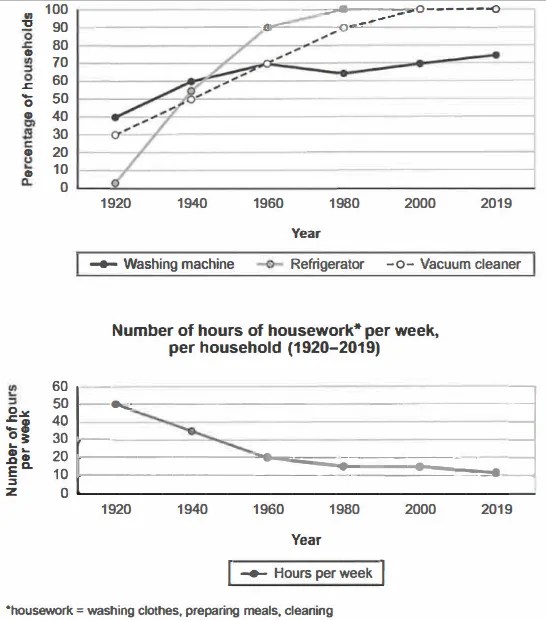
The charts below show the changes in ownership of electrical appliances and amount of time spent doing housework in households in one country between 1920 and 2019.
Summarise the information by selecting and reporting the main features, and make comparisons where relevant.
Percentage of households with electrical appliances (1920-2019)
Student answer (Band 4.5)
The line graph illustrates the percentage of households in three different households appliances washing machine, refriigerator and vacuum cleaner between 1920 to 2019.
Overall, it is clear that refrigerator and vacuum cleaner it was the highest percentage through the period while, washing machine deacrease dramatically through the period.
To begin with, refrigerator was the highest percentage it has started in 1920 and end it was 2019. However, the percentage 0% to 100% during the period and at the end of period it was levelled off. Vacuum cleaner had the second rank during the session it start 30% and gone to 100% at the end of period. Washing machine started from 40% and it was going to up moroever, after 1960 it had declined to 62% after 1980 it had to increased till the end of period it reach at 72%.
In
AI examiner evaluation
| Criterion | Band |
|---|---|
| Task Achievement / Task Response | 3.5 |
| Coherence and Cohesion | 4.5 |
| Lexical Resource | 5.0 |
| Grammatical Range and Accuracy | 5.0 |
| Overall | 4.5 |
Task Achievement / Task Response: Band 3.5
The response identifies the broad subject and reports some relevant figures, including the vacuum cleaner’s rise from 30% to 100% and the washing machine’s initial 40%. However, the overview is inaccurate: refrigerators and vacuum cleaners did not both remain the highest throughout, and washing-machine ownership did not decline dramatically overall; it rose from 40% to about 75%, with only a temporary dip. The refrigerator began at about 2%, not 0%, and the account omits the major fall in housework hours, a central feature of the second graph. The final sentence is unfinished, and the response is 9 words below the required minimum. To improve, give an accurate overview of both graphs and select key comparisons from each.
Coherence and Cohesion: Band 4.5
There is a basic attempt to organise the response, with an opening, an overview and a paragraph beginning “To begin with.” The sequence of appliance trends is generally understandable, and linking expressions such as “However” and “moreover” are used. However, progression is weakened by unclear or contradictory statements, especially the overview’s claim that washing-machine ownership “deacrease dramatically” followed by a description of its rise. Several sentences repeat the same pattern of naming an appliance and giving figures, while the housework data is not integrated. The final fragment, “In,” leaves the response unfinished. Use a clear overview followed by logically grouped details, and ensure each paragraph is complete and connected to the task’s two graphs.
Lexical Resource: Band 5.0
The response uses some relevant task vocabulary, including “percentage,” “period,” “declined,” and “levelled off,” so the reader can recognise the topic and intended trends. However, the range is limited and several word choices or collocations are inaccurate, such as “three different households appliances,” “had the second rank,” and “gone to 100%.” Spelling errors, including “refriigerator,” “deacrease,” and “moroever,” also reduce clarity and control. Aim for precise chart language: describe figures as “the proportion of households owning…” and use verbs such as “rose,” “fell,” “reached,” and “remained stable.” Check spelling carefully and avoid phrases that do not sound natural in formal data reporting.
Grammatical Range and Accuracy: Band 5.0
The response attempts both simple and more extended sentences, and some basic meaning is recoverable. However, grammatical control is inconsistent, particularly in clauses describing trends. For example, “refrigerator was the highest percentage it has started in 1920 and end it was 2019” joins ideas without clear sentence structure, while “it start 30% and gone to 100%” has faulty verb forms. There are also problems with agreement and articles, as in “refrigerator and vacuum cleaner it was,” and with tense consistency across the period. The unfinished final fragment further affects accuracy. Practise complete sentences with a clear subject and verb, using past-tense forms consistently—for example, “Refrigerator ownership rose from about 2% in 1920 to 100% in 1980.”
See this exact question answered at other band scores. The same prompt compared across bands.
Browse more IELTS Writing model answers or get your own writing scored by the same AI examiner.